Best Jump Starters for Trucks, SUVs and Large Engines
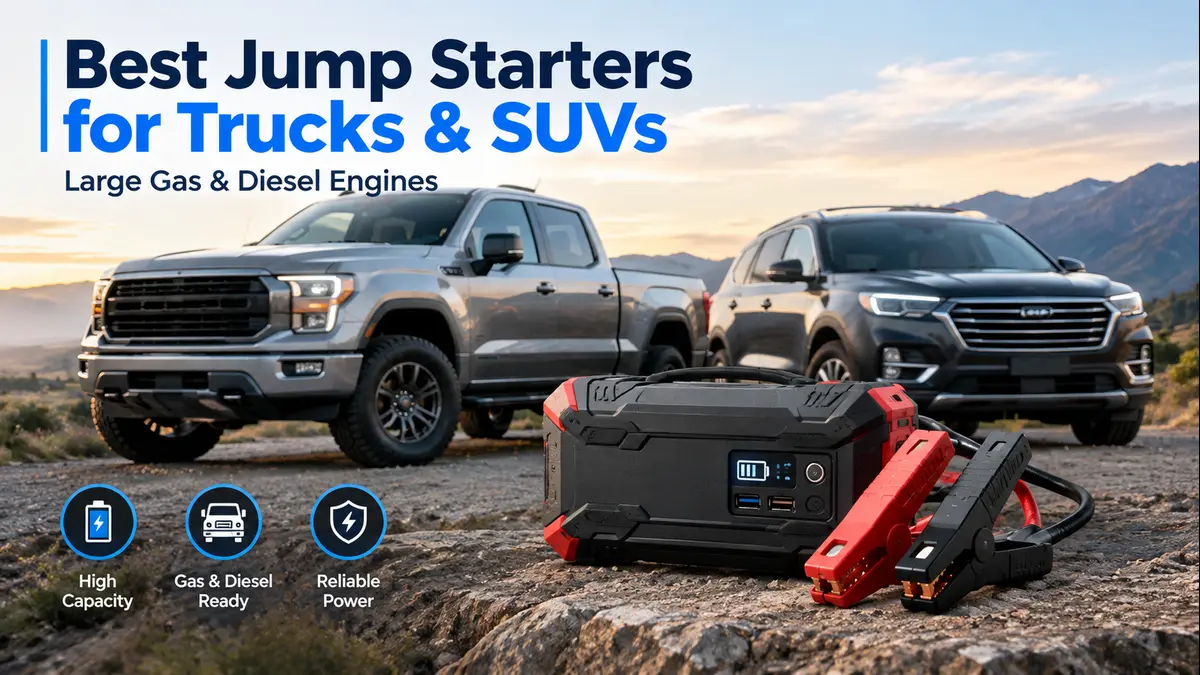
The best jump starter for trucks depends on the exact gasoline or diesel engine, climate, battery condition and how the vehicle will be used. This guide compares large-engine portable jump starters and professional-style jump boxes for trucks and SUVs.
Explore more in our Automotive guides. For primary specifications, see the official NOCO and Clore Automotive websites.
How We Compared the Best Jump Starter For Trucks
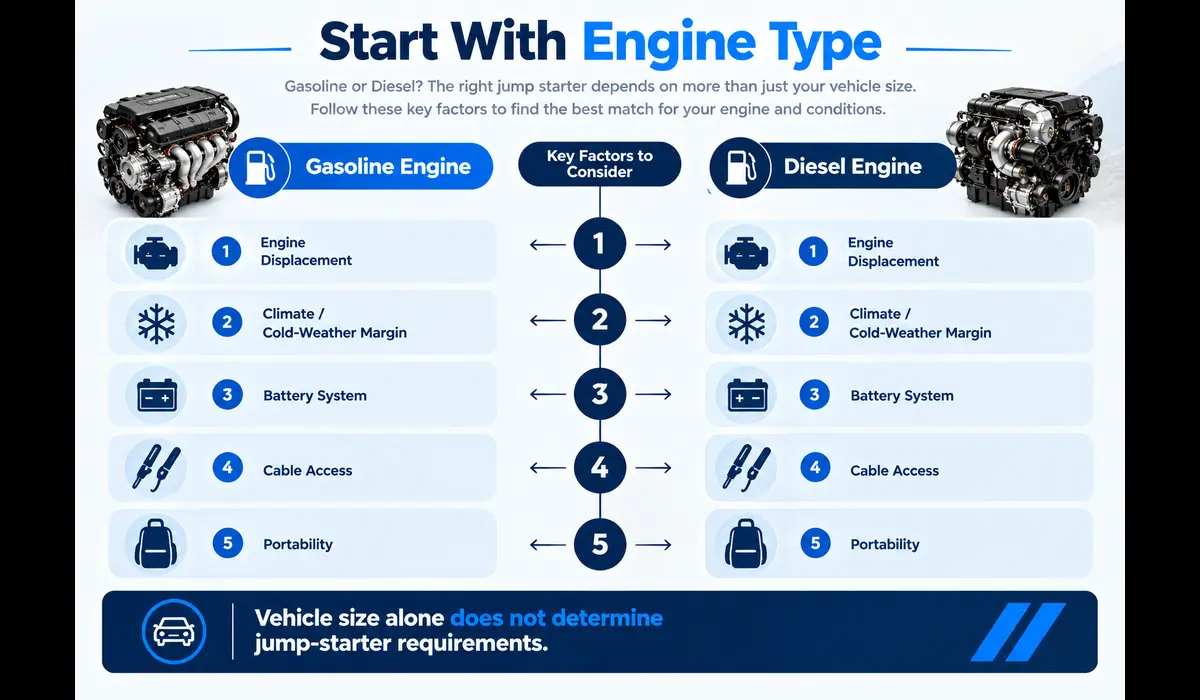
A compact jump starter that works perfectly for a four-cylinder sedan is not automatically the right emergency tool for a full-size pickup, large SUV or diesel engine.
When comparing the best jump starter for trucks, large engines generally require more starting capability, and diesel vehicles can be especially demanding. Battery condition, temperature, engine displacement and the vehicle's electrical system all affect how difficult an emergency start can be.
For the best jump starter for trucks, engine compatibility is more important than simply buying the product with the largest advertised peak-amp number.
For this guide, the focus is on jump starters positioned for larger gasoline and diesel engines, plus the practical differences between compact lithium packs and heavier professional-style jump boxes.
Amazon Disclosure: As an Amazon Associate I earn from qualifying purchases. GrowthVista Media may receive a commission from qualifying purchases made through our links, at no additional cost to you.
Editorial Methodology
GrowthVista has not independently laboratory-tested every model in this guide. Engine-size, current, battery, charging and feature figures discussed below are manufacturer specifications and should not be interpreted as GrowthVista test measurements. Cross-brand peak-current numbers are not perfectly standardized. Always verify the exact vehicle, battery system and current product documentation before purchase.
Quick Shortlist
| Jump Starter | Published Positioning | Why It Belongs on the Shortlist | Check Price |
|---|---|---|---|
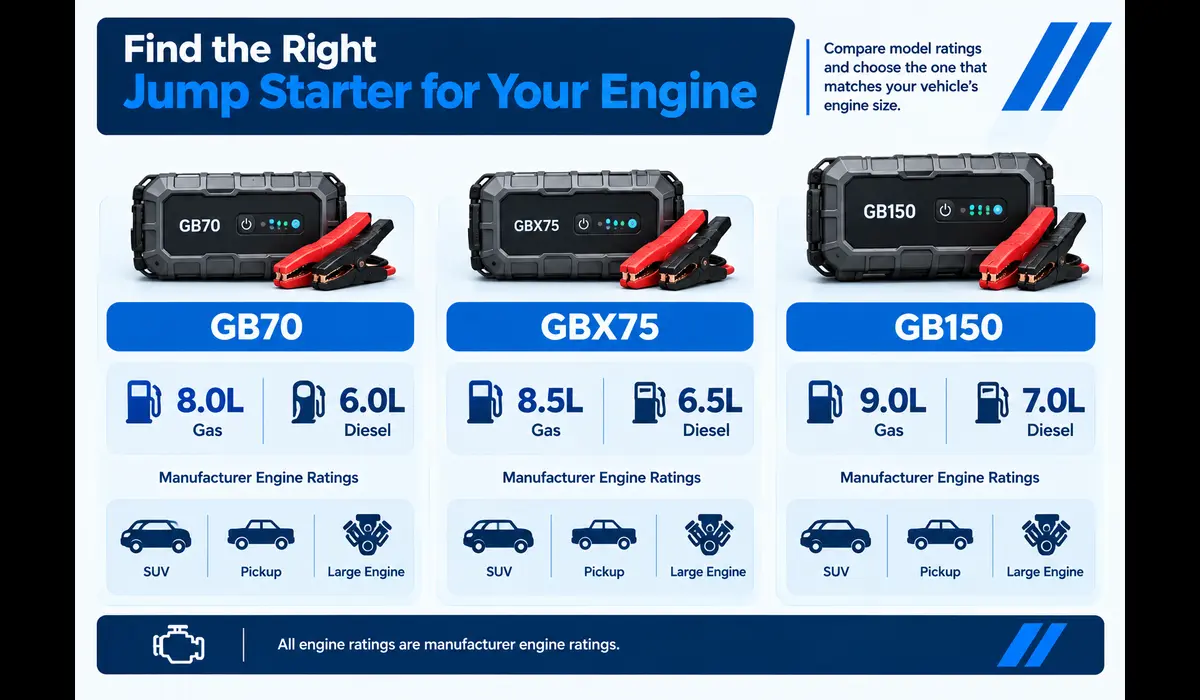
| NOCO GB70 | 2,000A; up to 8.0L gas / 6.0L diesel | Established large-engine Boost option | Check Price → |
| NOCO GBX75 | 2,500A; up to 8.5L gas / 6.5L diesel | Large-engine capacity plus fast USB-C | Check Price → |
| NOCO GB150 | 3,000A; up to 9.0L gas / 7.0L diesel | Step up for larger engines | Check Price → |
| GOOLOO GT4000 family | 4,000A manufacturer peak rating | Large internal battery and fast-charging focus | Check Price → |
| WOLFBOX MegaVolt 24 | High-output large-engine product family | Feature-rich lithium alternative | Check Price → |
| LOKITHOR J401X | Large-engine lithium jump-starter class | High-capacity portable option | Check Price → |
| Clore Jump-N-Carry JNC325 | Portable lithium professional-style option | Strong clamps/cables and service-oriented positioning | Check Price → |
| Clore Jump-N-Carry JNC660 | Traditional professional jump box | Workshop-style design and robust cable system | Check Price → |
The shortlist is not ranked. A 3.0L diesel SUV and a 7.0L gasoline truck do not need the same jump starter, even if both are described as “large vehicles.”
1. NOCO GB70 — A Practical Starting Point for Larger Vehicles
The NOCO GB70 is a useful reference point for buyers moving beyond compact passenger-car jump starters.
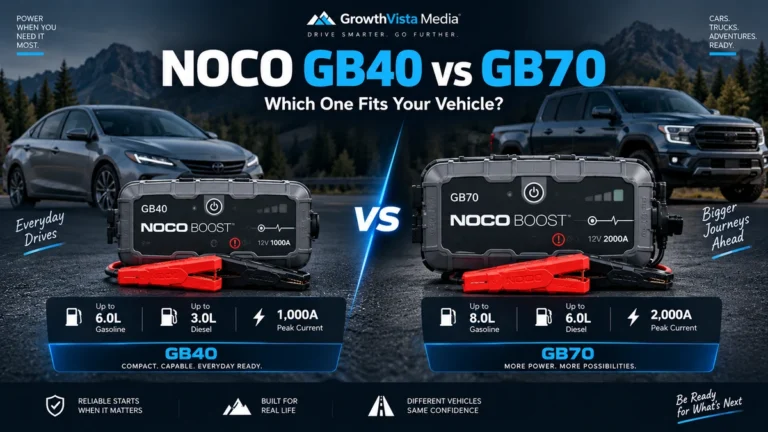
NOCO currently rates the GB70 at 2,000A and for gasoline engines up to 8.0L and diesel engines up to 6.0L. That places it comfortably above the GB40's 6.0L gas / 3.0L diesel range.
The GB70 also carries a 56Wh internal lithium-ion battery and a 400-lumen flashlight. A 12V accessory output adds usefulness around larger roadside kits.
The trade-off is size. At roughly 4.18 lb, the GB70 is much heavier than the compact GB40, but still far easier to carry than many traditional professional jump boxes.
For an SUV, gasoline pickup or compatible diesel vehicle, it is a sensible model to compare before moving into NOCO's still-larger products.
2,000A manufacturer rating
Up to 8.0L gasoline
Up to 6.0L diesel
56Wh internal battery
400-lumen flashlight
12V accessory output
IP65 with ports closed
Check Current NOCO GB70 Price →
2. NOCO GBX75 — Large-Engine Capacity With Modern USB-C
The GBX75 targets a similar large-vehicle buyer but belongs to NOCO's newer Boost X generation.
NOCO currently rates it at 2,500A and for gasoline engines up to 8.5L and diesel engines up to 6.5L.
The major difference from the original Boost generation is charging. Boost X was designed around high-power USB-C Power Delivery, making it more convenient for drivers who want faster jump-starter recharging and useful device charging.
That matters on road trips and in multi-vehicle households where the unit may be used as an emergency power bank rather than sitting untouched in the trunk.
If your vehicle fits both GB70 and GBX75, the choice is less about whether either can theoretically cover the engine and more about whether you value the newer charging system enough to justify it.
2,500A manufacturer rating
Up to 8.5L gasoline
Up to 6.5L diesel
Boost X USB-C Power Delivery architecture
Large-engine portable lithium format
Check Current NOCO GBX75 Price →
3. NOCO GB150 — When the Engine Gets Bigger
The GB150 moves another step up NOCO's original Boost ladder.
NOCO's current model-selection guidance lists it at 3,000A with support for gasoline engines up to 9.0L and diesel engines up to 7.0L.
That makes it relevant for buyers whose engines exceed the GB70's published range, as well as households or businesses that want one unit capable of covering a broader group of vehicles.
Moving upward does add size and weight, so there is little reason to buy the GB150 for a small gasoline crossover simply because it carries a larger number.
The strongest case for this class is an actual engine requirement or a multi-vehicle fleet where the extra compatibility will be used.
3,000A manufacturer rating
Up to 9.0L gasoline
Up to 7.0L diesel
Designed for larger-engine applications
Useful step between consumer Boost models and even larger professional equipment
Check Current NOCO GB150 Price →
4. GOOLOO GT4000 Family — High Output and Fast-Charging Focus
GOOLOO's GT4000 family approaches the large-engine category with a large internal battery and a strong emphasis on fast charging and information displays.
GOOLOO's current FAQ lists the GT4000 and GT4000S with an 88.8Wh battery and a 4,000A peak-current rating.
The GT4000 also adds intelligent pre-heating for severe-cold conditions according to GOOLOO's current documentation, while the GT4000S omits that specific feature.
For truck and SUV owners, the appeal is not simply the 4,000A headline. The large stored-energy capacity and high-power charging can make the unit more useful on long trips or as an emergency device charger.
Because peak-current measurement can differ across manufacturers, compare the exact current GOOLOO engine rating and independent performance evidence rather than assuming 4,000A makes it twice as capable as a 2,000A competitor.
Check Current GOOLOO GT4000 Price →
5. WOLFBOX MegaVolt 24 — Feature-Rich Large-Vehicle Direction
WOLFBOX's MegaVolt family is aimed at buyers who want a high-output lithium jump starter with modern secondary features.
The exact MegaVolt model matters because WOLFBOX sells variants with different capabilities, including products that combine jump starting with high-power USB-C and, in the 24Air variant, an integrated compressor.
For a truck owner, that can be attractive because one emergency battery can potentially cover starting, device charging, lighting and tire inflation.
The downside is that every added function increases complexity and often physical size. If you already carry a dedicated compressor and power bank, a simpler jump starter may be easier to maintain.
Verify the current engine compatibility, battery capacity, charging wattage and included accessories for the exact MegaVolt model rather than transferring specifications from one variant to another.
Check Current WOLFBOX MegaVolt Options →
6. LOKITHOR J401X — High-Capacity Portable Lithium Option
LOKITHOR's larger jump starters occupy the space between compact consumer packs and traditional workshop jump boxes.
The J401X class is relevant to this guide because it is designed around large-engine starting while retaining the portability and digital controls buyers expect from modern lithium equipment.
LOKITHOR's broader range also includes combination compressor models, so make sure you are comparing the dedicated J-series product you actually intend to buy.
For truck use, pay particular attention to the current published gasoline/diesel rating, cable reach, clamp opening and operating-temperature specification. Those details can matter more at the side of a large engine bay than an extra USB port.
Check Current LOKITHOR J401X Price →
7. Clore Jump-N-Carry JNC325 — Portable Professional-Style Alternative
Clore Automotive has a long history in professional jump-starting equipment, and the JNC325 brings that approach into a more portable lithium format.
The reason to consider a Clore product is not necessarily a spectacular marketing number. Professional-oriented buyers often care about clamp quality, cable construction, repeatability and serviceability.
For a pickup owner who uses a jump starter more often than the typical consumer, those practical hardware details can be more valuable than having the smallest possible case.
Check the current JNC325 specifications and vehicle compatibility before purchase, particularly if your use involves large diesel engines or repeated starts.
Check Current Clore JNC325 Price →
8. Clore JNC660 — Why Traditional Jump Boxes Still Exist
The JNC660 represents a very different design philosophy from compact lithium packs.
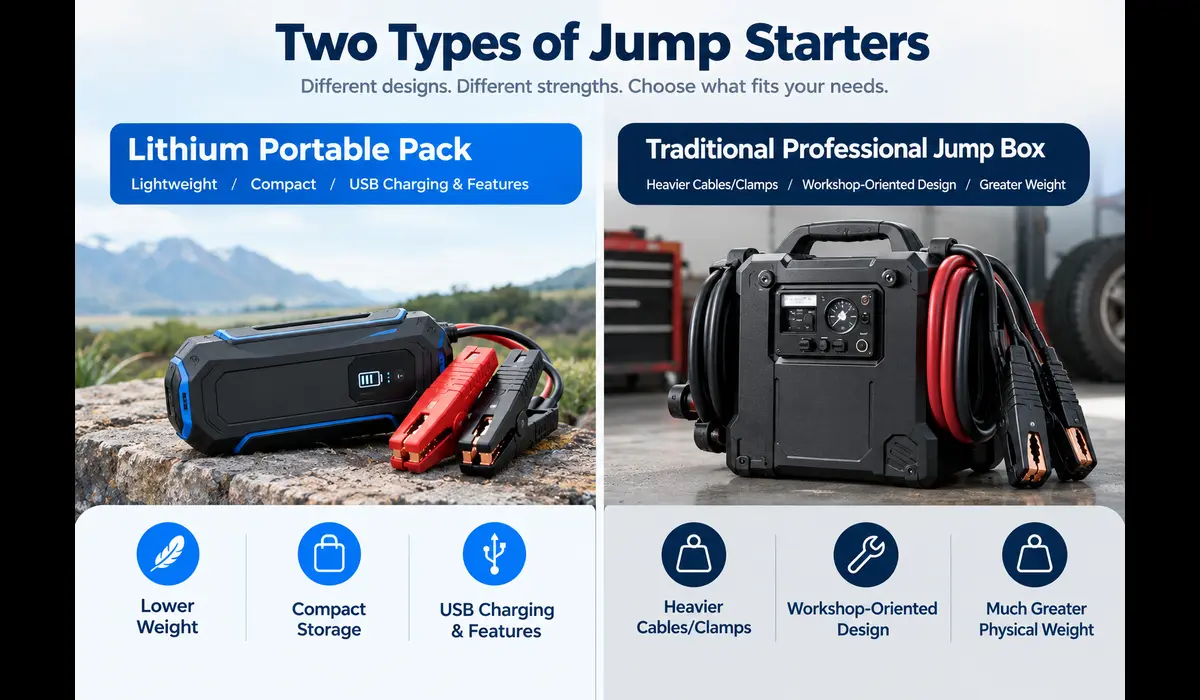
It is a traditional professional jump box built around a much larger lead-acid battery and heavy-duty cables. That makes it substantially heavier and less convenient to keep in a small passenger car.
But workshops, roadside operators and users who prioritize robust clamps and repeated service have different needs from someone buying an emergency device that may be used once every two years.
A traditional jump box can therefore remain relevant even when its size looks outdated beside a lithium pack.
The trade-off is obvious: portability. If the jump starter needs to live permanently in a personal SUV or pickup, lithium is usually much easier to store and carry. If it lives in a garage or service vehicle, the calculation changes.
Check Current Clore JNC660 Price →
Why Diesel Engines Need Extra Attention
Diesel engines are a major reason the best jump starter for trucks should not be selected from a list of high amp numbers alone.
Manufacturers frequently publish a lower maximum diesel displacement than gasoline displacement for the same jump starter. The NOCO GB70, for example, is rated up to 8.0L gasoline but 6.0L diesel.
That difference reflects the greater starting demands commonly associated with diesel engines.
If you drive a 6.7L diesel pickup, a product rated only to 6.0L diesel is outside the manufacturer's stated range even if its gasoline rating looks large enough.
Always use the diesel rating when shopping for a diesel vehicle.
Cold Weather Changes the Equation
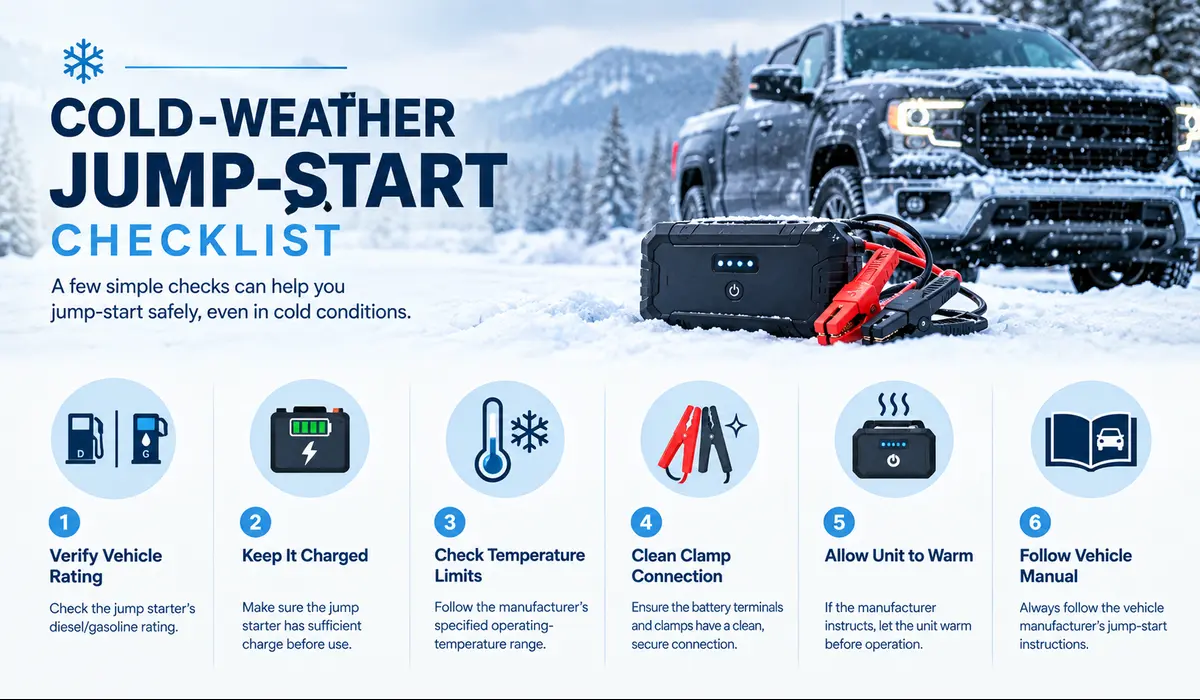
Cold weather is another factor when choosing the best jump starter for trucks, because it simultaneously makes the vehicle battery weaker and makes starting the engine more difficult.
That means a jump starter that sits right at the edge of its published engine rating may provide less practical margin during severe winter conditions.
The jump starter's own battery temperature matters too. Lithium batteries have specified operating and charging ranges, and leaving a device in extreme temperatures can affect performance.
Some manufacturers add cold-weather features. GOOLOO, for example, currently distinguishes the GT4000 with an intelligent pre-heating function intended for very cold operation.
If winter reliability is critical, check the exact operating-temperature range and consider additional capacity margin rather than relying only on a warm-weather engine-size match.
Cable Length and Clamp Design Matter More on Large Vehicles
Large engine bays can make battery access awkward. Some vehicles also use remote jump-start terminals rather than requiring direct battery access.
Before buying the best jump starter for trucks, check whether the cables comfortably reach the connection points specified by the vehicle manufacturer.
Clamp opening, spring pressure and contact area also matter. A high-output battery pack cannot deliver useful current through a poor electrical connection.
This is one area where professional-style jump boxes often justify their additional bulk: cables and clamps are central to the product rather than an afterthought.
Don't Confuse a Jump Starter With a Battery Charger
A portable jump starter supplies a short burst of energy to help start the engine. It does not restore a discharged vehicle battery to full charge in the way a proper charger or maintainer does. If a truck battery repeatedly needs a jump, diagnose the battery, charging system or parasitic drain rather than treating the jump starter as the permanent solution.
How Much Capacity Do You Actually Need?
| Vehicle Example | What to Check First | Typical Direction |
|---|---|---|
| 4-cylinder gasoline crossover | Exact engine size | A compact unit may be enough; large-truck model can be unnecessary |
| V6/V8 gasoline SUV | Gas engine displacement | GB70-class or equivalent may make sense depending on size |
| Large gasoline pickup | Exact displacement + climate | Large-engine lithium unit |
| 3.0L diesel SUV | Diesel rating | Several mid/high-capacity units can fit |
| 5.0–6.0L diesel | Diesel rating + winter margin | GB70/GBX75-class or equivalent |
| 6.7L diesel pickup | Must exceed 6.0L diesel rating | Look beyond products capped at 6.0L diesel |
| Fleet / multiple vehicle sizes | Largest engine in fleet | Broader-capacity unit or professional equipment |
| Garage / frequent use | Cable/clamp durability + serviceability | Professional-style jump box deserves consideration |
What Features Are Worth Paying For?
High-Power USB-C
Useful when the jump starter also serves as a laptop or phone power bank. It can also dramatically reduce recharge time on compatible models.
12V Accessory Output
Useful for compatible inflators and other roadside accessories. The NOCO GB70 is an example of a model with a dedicated 12V output.
Built-In Compressor
Convenient if you want one device for both battery and tire emergencies. It adds bulk and means both functions depend on the same internal battery.
Large Flashlight
Useful at night, particularly around a large engine bay. Treat it as a secondary feature rather than a reason to ignore engine compatibility.
Display
A screen can make charge level and operating status easier to understand, but clear LEDs can perform the essential safety/status role too.
Manual Override / Force Start
Useful for batteries too deeply discharged for normal detection, but it can bypass normal safety logic. Use only as documented.
Who Should Choose a Compact Lithium Jump Starter?
Personal truck or SUV owners who value trunk space
Drivers who may carry the unit on road trips
Users who want USB-C or power-bank functionality
Households needing occasional emergency starting
Buyers who want a lighter unit that is easy to position around the engine bay
Who Should Consider a Professional Jump Box?
Garages and workshops
Roadside or fleet environments
Users who perform repeated jump starts
Buyers who prioritize heavy cables and clamps over portability
Service vehicles where the unit does not need to be carried far
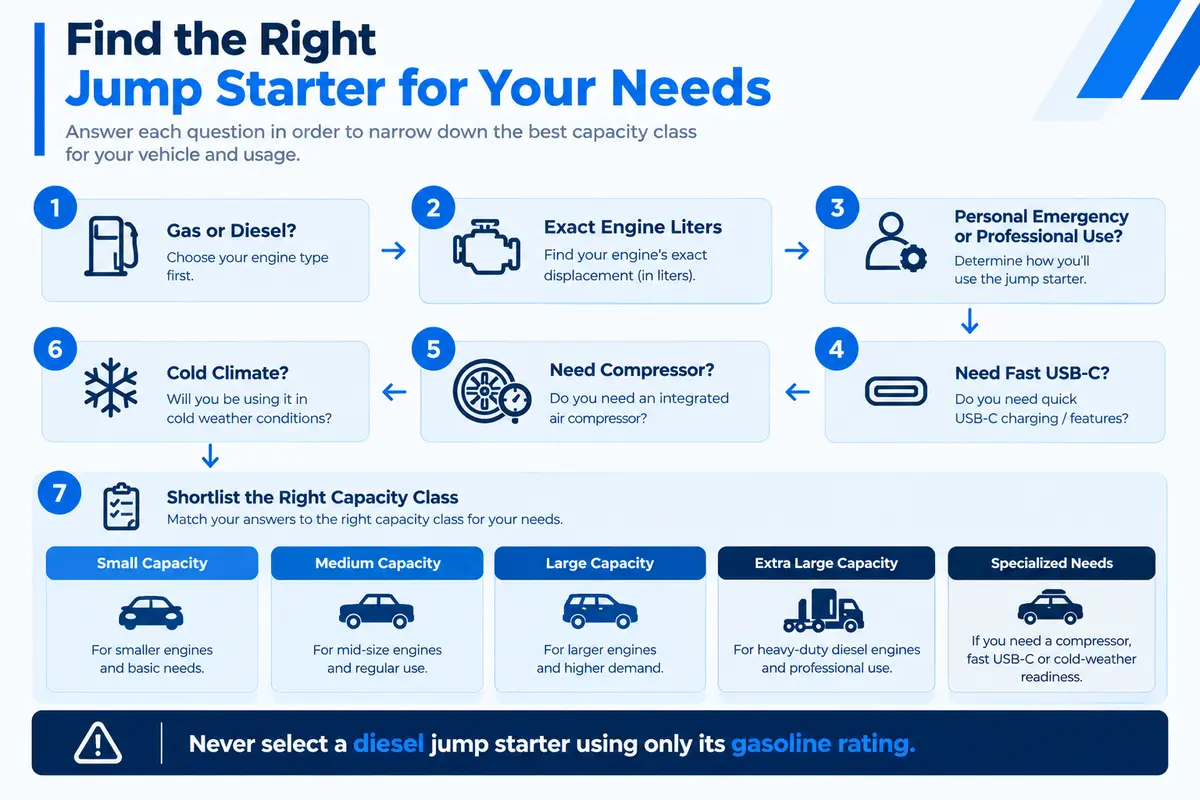
Best Jump Starter for Trucks: Practical Buying Checklist
Confirm whether the vehicle uses a 12V battery system.
Write down the exact engine displacement and whether it is gasoline or diesel.
Choose a model whose manufacturer rating covers that engine.
Leave sensible margin for severe cold or demanding use.
Check cable length and access to the vehicle's recommended jump points.
Review clamp design and safety indicators.
Compare operating and storage-temperature limits.
Decide whether USB-C, 12V output or an inflator is genuinely useful.
Check product weight and storage dimensions.
Verify warranty, current manual and seller.
Use a live affiliate CTA rather than hard-coding a temporary Amazon price.
Frequently Asked Questions
What size jump starter do I need for a truck?
There is no single amp figure for every truck. Use the manufacturer's published rating for your exact gasoline or diesel engine displacement, then consider climate and usage.
Is 2,000A enough for a truck?
It can be for compatible engines. For example, NOCO rates its 2,000A GB70 up to 8.0L gasoline and 6.0L diesel. A larger diesel may require a different model.
What jump starter should I use for a 6.7L diesel?
Choose a product explicitly rated for at least that diesel displacement. A unit capped at 6.0L diesel is outside its manufacturer's published range.
Is a lithium jump starter good for a diesel truck?
Yes, if the specific lithium unit is rated for the diesel engine and conditions. Do not assume all lithium packs have the same capability.
Are traditional jump boxes better than lithium?
They are different. Lithium is lighter and easier to store; traditional professional jump boxes can emphasize heavy cables, clamps and repeated workshop use.
Does cold weather mean I need a bigger jump starter?
Cold weather reduces practical starting margin. Check manufacturer temperature limits and consider a model comfortably within its engine rating rather than at the edge.
Can I leave a lithium jump starter in my truck all year?
Follow the manufacturer's storage-temperature guidance. Vehicle interiors can reach extreme temperatures, so permanent storage is not automatically appropriate in every climate.
Can a jump starter recharge my truck battery?
A normal jump starter provides starting energy; it is not a substitute for a proper battery charger or maintainer.
Should I buy the highest peak-amp model I can afford?
Not necessarily. Once the unit comfortably meets your vehicle requirement, portability, charging, cables, safety and support may matter more than additional headline current.
Do I need a jump starter with an air compressor?
Only if consolidating roadside tools is valuable to you. A separate compressor can provide redundancy and may offer better specialist inflation performance.
Final Thoughts on the Best Jump Starter For Trucks
Choosing the best jump starter for trucks for an SUV or large engine should begin with the vehicle—not the marketing number printed on the battery pack.
For many larger gasoline vehicles and diesels up to 6.0L, the NOCO GB70 is a useful reference point. The GBX75 adds a newer fast-charging architecture and slightly broader engine coverage, while the GB150 moves further into large-engine territory.
GOOLOO, WOLFBOX and LOKITHOR provide feature-rich lithium alternatives worth comparing when large batteries, displays, fast charging or all-in-one functions matter.
Clore's Jump-N-Carry products show why professional jump boxes still have a place: frequent-use buyers may care more about cable and clamp hardware than minimal weight.
The key is to match the published diesel or gasoline engine rating, leave appropriate margin for the conditions, and then choose the size and feature set you are actually willing to keep charged and carry.
Compare Jump Starters for Trucks & SUVs →
When choosing the best jump starter for trucks, match the manufacturer’s diesel or gasoline engine rating first, then compare cold-weather margin, cables, charging and portability.