NOCO GB40 vs GB70: Which Jump Starter Fits Your Vehicle?
NOCO GB40 vs GB70: Which Jump Starter Fits Your Vehicle?
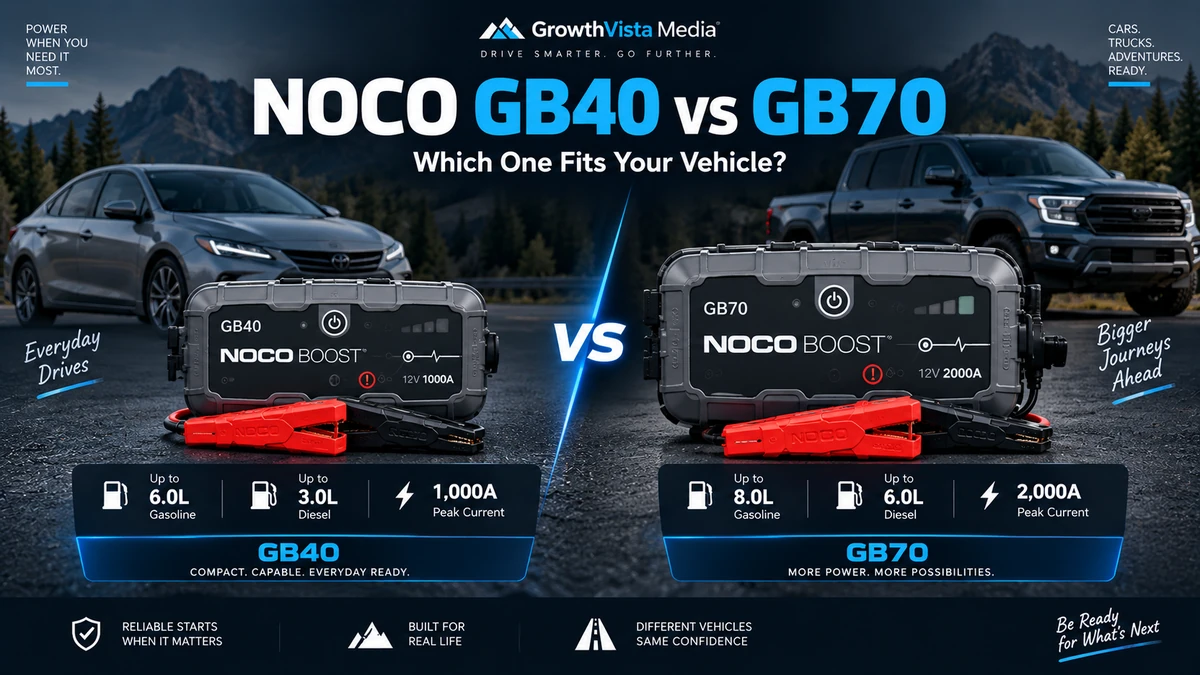
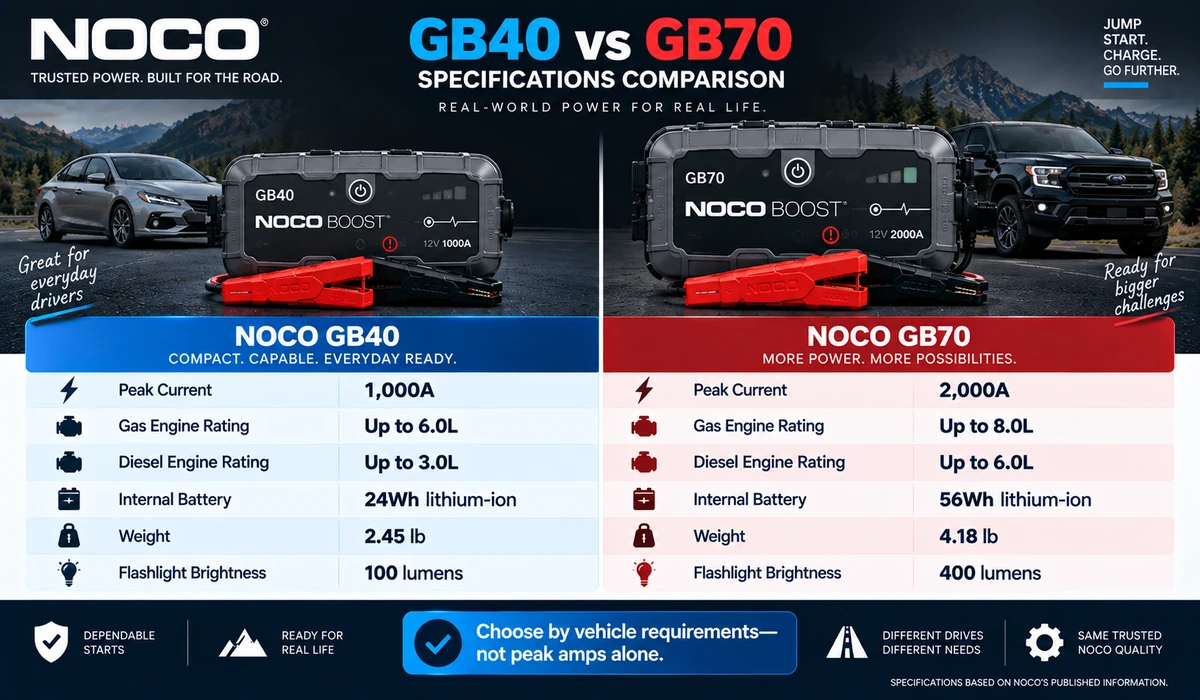
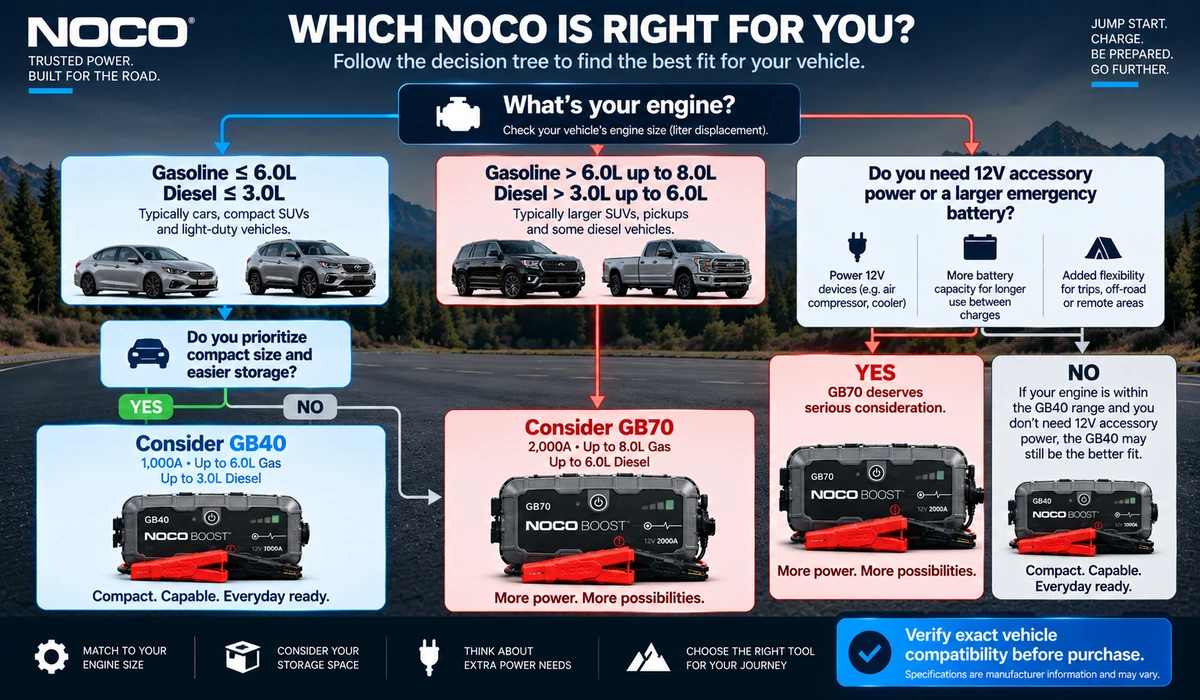
The NOCO GB40 vs GB70 comparison comes down mainly to engine compatibility, battery capacity, size and intended use. Both belong to NOCO’s Boost family, but they’re designed for noticeably different vehicles.
The GB40 is NOCO’s 1,000A portable jump starter, currently rated for gasoline engines up to 6.0 liters and diesel engines up to 3.0 liters.
The larger GB70 doubles the advertised peak-current rating to 2,000A and expands compatibility to gasoline engines up to 8.0 liters and diesel engines up to 6.0 liters.
But engine capacity isn’t the only difference. The GB70 also has a much larger internal battery, a brighter flashlight and a 12V accessory output. The trade-off is a larger, heavier unit.
So paying more for the GB70 isn’t automatically the better decision. If you drive an ordinary gasoline passenger car, the smaller GB40 may already provide the manufacturer-rated capacity you need while taking up considerably less space.
If you own a larger SUV, pickup or diesel vehicle, the GB70’s additional capacity becomes much more relevant. This comparison breaks down those differences so you can match the jump starter to the vehicle rather than simply buying the model with the bigger number.
Editorial Methodology
GrowthVista has not independently laboratory-tested these two jump starters. This comparison uses current NOCO specifications, documentation and published product capabilities. Figures such as maximum engine displacement and number of jump starts are therefore manufacturer ratings, not GrowthVista test results.
NOCO GB40 vs GB70: Quick Comparison
| Specification | NOCO GB40 | NOCO GB70 |
|---|---|---|
| Peak current | 1,000A | 2,000A |
| Gas engine rating | Up to 6.0L | Up to 8.0L |
| Diesel engine rating | Up to 3.0L | Up to 6.0L |
| Internal battery | 24Wh lithium-ion | 56Wh lithium-ion |
| USB input | 5V / 2.1A max | 5V / 2.1A max |
| USB output | 5V / 2.1A max | 5V / 2.1A max |
| 12V output | — | 12V / 15A |
| Flashlight | 100 lumens | 400 lumens |
| IP rating | IP65 | IP65 |
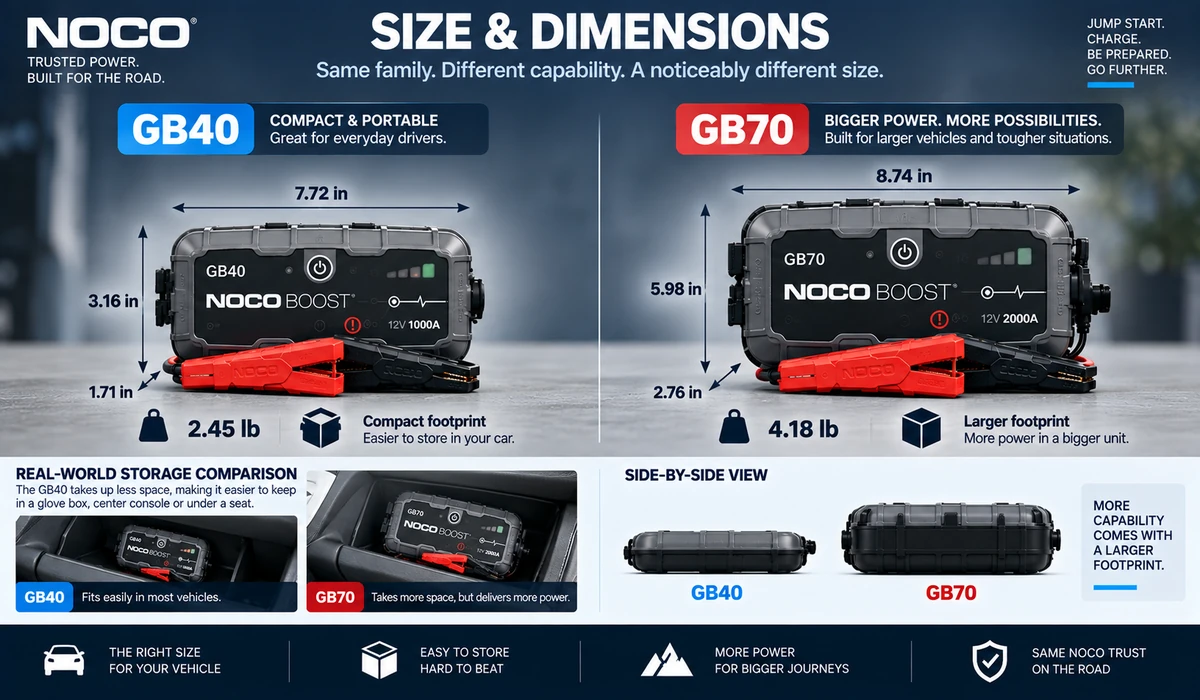
| Weight | 2.45 lb | 4.18 lb |
| Dimensions | 7.72 × 3.16 × 1.71 in | 8.74 × 5.98 × 2.76 in |
| Warranty | 1 year | 1 year |
For most buyers, the decision can be simplified to this: GB40 means smaller vehicles and easier storage; GB70 means larger engines and substantially more internal capacity. Engine compatibility should be the first filter.
Engine Compatibility: This Is the Most Important Difference
The first specification to check isn’t weight, flashlight brightness or USB charging. It’s your engine.
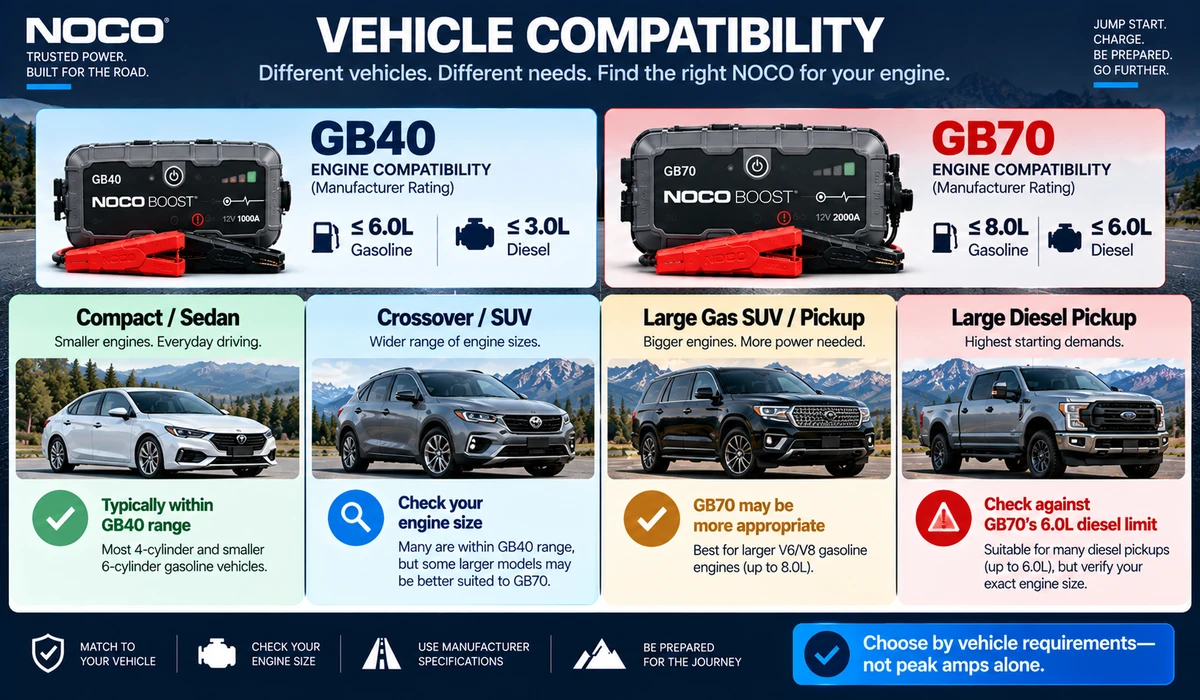
NOCO currently rates the GB40 for gasoline engines up to 6.0L and diesel engines up to 3.0L. The GB70 moves to gasoline engines up to 8.0L and diesel engines up to 6.0L.
That difference is especially significant for diesel owners. The gasoline rating increases by two liters, while the published diesel rating doubles from 3.0L to 6.0L.
For a typical 2.0L or 2.5L gasoline passenger car, the engine is already comfortably below the GB40’s published limit. Buying the GB70 solely because its label says 2,000A may provide capacity you don’t actually need while increasing the size and weight of the emergency kit.
The calculation changes with a larger gasoline V8 or diesel pickup. A diesel engine above 3.0L falls outside the GB40’s published rating, while the GB70 covers diesel engines up to 6.0L.
1,000A vs 2,000A: Does Twice the Peak Current Matter?
On paper, the GB40 is rated at 1,000A peak and the GB70 at 2,000A peak. But that doesn’t mean every GB70 owner gets twice the practical value.
A jump starter only needs to provide appropriate starting capability for the vehicle connected to it. If your car falls comfortably inside the GB40’s intended range, the GB70’s additional capacity may rarely be necessary.
The higher-output model becomes more meaningful as the engine gets larger, the application becomes more demanding, or you want one jump starter to cover several vehicles of different sizes. This is why engine compatibility is a better first filter than peak amps alone.
Battery Capacity: 24Wh vs 56Wh
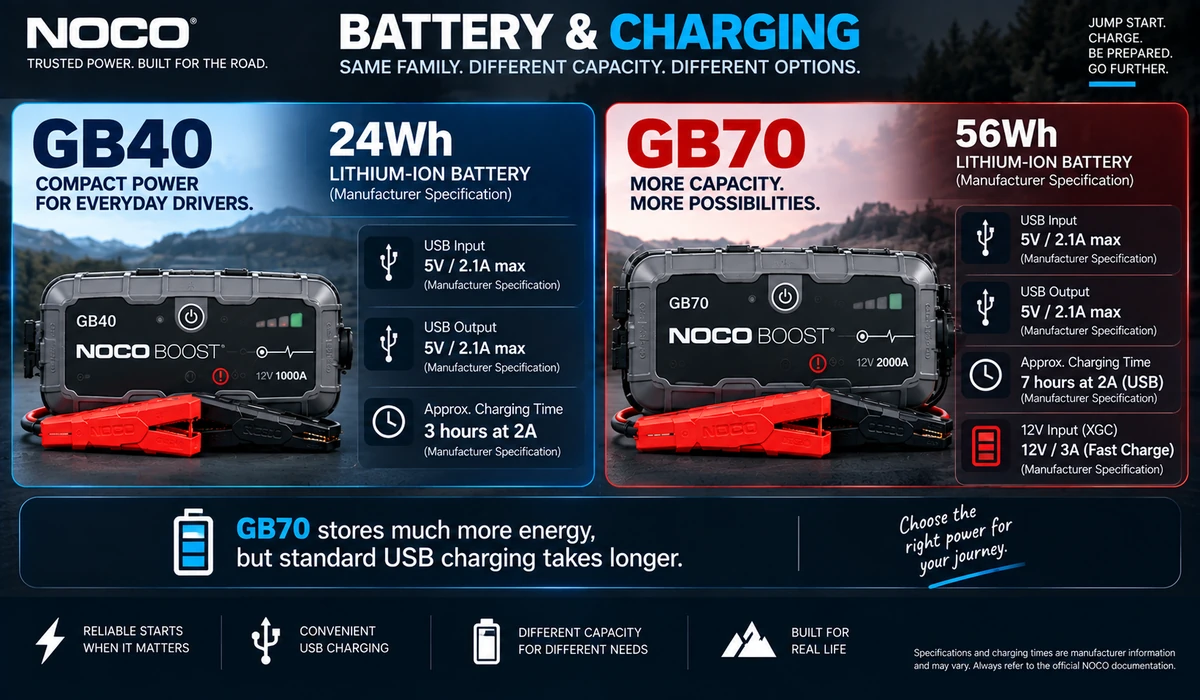
The GB40 contains a 24Wh lithium-ion battery. The GB70 increases that to 56Wh—more than twice the stored energy.
The additional capacity supports the GB70’s more demanding role and makes it a more useful portable emergency-power source. NOCO advertises the GB40 for up to 20 jump starts per charge and the GB70 for up to 40 under its stated conditions. Real results depend on battery condition, temperature, vehicle and other factors.
For someone keeping the unit exclusively for one passenger car, that difference may not be important. For someone managing several vehicles, using it around an RV or boat, or wanting additional emergency power, it becomes more useful.
Size and Weight: GB40 Is Considerably Easier to Carry
The GB40 weighs approximately 2.45 lb, while the GB70 weighs approximately 4.18 lb. That’s roughly 70% more weight for the GB70.
The GB40 measures about 7.72 × 3.16 × 1.71 inches. The GB70 is approximately 8.74 × 5.98 × 2.76 inches.
The GB40 is therefore easier to fit into a compact roadside kit. If you drive a small car and want something that can live quietly in the trunk, this is one of the strongest reasons not to automatically upgrade. The GB70 remains portable, but it is a substantially larger object.
Flashlight: GB70 Is Much Brighter
Both models include built-in LED flashlights with multiple modes, but their output differs substantially. The GB40 is rated at 100 lumens, while the GB70 increases that to 400 lumens.
A flashlight isn’t the primary reason to buy a jump starter, but it can be genuinely useful during a nighttime battery problem. The brighter GB70 light is a worthwhile secondary advantage for frequent road trips, camping or a more extensive emergency kit.
The GB70 Can Power 12V Accessories
The GB70 includes a 12V XGC output rated at 15A. NOCO describes using it to power compatible 12V equipment such as tire inflators and power inverters.
That gives the GB70 another role beyond jump starting. The GB40 doesn’t provide the same dedicated 12V accessory-output capability. If you only want to jump-start your car, this shouldn’t push you toward the GB70; for a broader portable emergency-power kit, it is meaningful.
USB Charging: More Similar Than You Might Expect
Both models use relatively modest USB charging compared with newer high-power USB-C jump starters. NOCO specifies USB input and output up to 5V/2.1A.
The GB40 can recharge in approximately three hours from an appropriate 2A USB source according to NOCO documentation. The larger GB70 takes approximately seven hours through a 2A USB source, while its separate 12V/3A XGC fast-charge input can reduce recharge time to around three hours.
If modern high-power USB-C charging is one of your highest priorities, compare NOCO’s newer Boost X range as well.
Safety Features: Very Similar
Both products share NOCO’s core Boost safety approach, including spark-proof technology and reverse-polarity protection.
Both also include a manual override function for situations where battery voltage is too low for normal detection. Manual override should not be treated as the normal operating method because it changes normal detection behavior. Follow the model-specific instructions and your vehicle manual.
Water and Dust Protection: It’s a Tie
Both units carry an IP65 rating with the ports closed. That provides useful environmental protection for roadside equipment, but IP65 does not mean either unit is designed for immersion.
For most buyers, there is no meaningful GB40-versus-GB70 advantage in this category.
GB40 vs GB70 for Different Vehicles
| Vehicle / Use Case | Model to Investigate First | Why |
|---|---|---|
| Small gasoline car | GB40 | Compact and comfortably within rating for many cars |
| Typical sedan | GB40 | Lower weight and smaller storage footprint |
| Gas crossover | GB40 or GB70 | Depends on engine displacement |
| Large gasoline SUV | GB70 | Up to 8.0L gasoline rating |
| Large gasoline pickup | GB70 | Greater engine capacity |
| Diesel ≤3.0L | GB40 can fit | Within published diesel rating |
| Diesel 3.0–6.0L | GB70 | GB40 falls outside published range |
| Multiple family vehicles | Often GB70 | Broader vehicle coverage |
| RV / boat / 12V accessory use | GB70 | Larger battery + 12V output |
| Small emergency kit | GB40 | Much more compact |
This table is a starting point, not a substitute for checking the exact engine and vehicle requirements.
Reasons to Choose the GB40
Your engine falls comfortably inside the 6.0L gas / 3.0L diesel rating.
You drive a normal passenger car or compatible crossover.
Compact storage matters.
You want the lighter of the two products.
You don’t need a 12V accessory output.
You don’t need the additional emergency battery capacity.
You primarily want a jump starter rather than a broader portable-power unit.
The key advantage isn’t simply that the GB40 is smaller. It’s that you’re not carrying capacity you may never use.
Reasons to Choose the GB70
Your gasoline engine is larger than the GB40’s rating.
Your diesel engine is above 3.0L but within the GB70’s 6.0L rating.
You want one unit to cover several differently sized vehicles.
You value the larger 56Wh internal battery.
You want a 400-lumen flashlight.
You want to power compatible 12V accessories.
The additional size and weight aren’t a problem.
This is particularly relevant for larger SUVs, trucks, boats and RV-oriented emergency kits.
What About the GB50 Between Them?
There is another option worth knowing about. NOCO’s GB50 sits between these two products. NOCO currently rates it at 1,500A, up to 7.0L gasoline and up to 4.5L diesel.
That can make the GB50 relevant when the GB40 doesn’t provide enough engine capacity but the GB70 feels unnecessarily large. The buying path can therefore be GB40 → GB50 → GB70, based primarily on engine requirements.
What About the Newer Boost X Series?
The original Boost family isn’t NOCO’s only option. NOCO’s newer Boost X models extend engine compatibility and add modern fast USB-C charging on applicable models.
| Model | Gas Engine Rating | Diesel Engine Rating |
|---|---|---|
| GBX45 | Up to 6.5L | Up to 4.0L |
| GBX55 | Up to 7.5L | Up to 5.0L |
| GBX75 | Up to 8.5L | Up to 6.0L |
| GBX155 | Up to 10.0L | Up to 8.0L |
The newer series becomes especially relevant if modern fast USB-C charging is important. That doesn’t automatically make the GB40 or GB70 obsolete; it simply gives buyers more choices within NOCO’s lineup.
GB40 vs GB70: Pros and Trade-Offs
NOCO GB40
Advantages
Smaller and lighter
1,000A manufacturer rating
Up to 6.0L gasoline engines
Up to 3.0L diesel engines
24Wh internal battery
IP65
Reverse-polarity protection
100-lumen flashlight
Easier to fit into a compact car emergency kit
Trade-offs
Lower engine-size ceiling
Smaller internal battery
100-lumen rather than 400-lumen flashlight
No dedicated 12V accessory output
Less appropriate for larger diesel engines
NOCO GB70
Advantages
2,000A manufacturer rating
Up to 8.0L gasoline
Up to 6.0L diesel
56Wh internal battery
400-lumen flashlight
Dedicated 12V/15A output
Wider range of vehicle applications
Better suited to large-vehicle emergency kits
Trade-offs
Considerably heavier
Takes up more storage space
Standard USB charging is slower because of the larger battery
Capacity may be unnecessary for a small gasoline car
Frequently Asked Questions
Is the NOCO GB70 more powerful than the GB40?
Yes in terms of NOCO’s published specifications. The GB70 is rated at 2,000A versus 1,000A for the GB40 and supports larger gasoline and diesel engines.
Is the GB70 worth buying instead of the GB40?
That depends primarily on your vehicle. If your engine falls comfortably inside the GB40’s published rating and you value compact storage, the additional GB70 capacity may not be necessary. Larger engines and diesel vehicles make the GB70 more relevant.
Can the GB40 start a truck?
Potentially, depending on the truck’s engine. NOCO rates the GB40 by engine displacement, not simply vehicle body style. It supports gasoline engines up to 6.0L and diesel engines up to 3.0L.
Can the GB70 start a diesel truck?
NOCO rates the GB70 for diesel engines up to 6.0L. Check the displacement of your exact truck before buying.
Is the GB70 twice as good because it has twice the peak amps?
No. The 2,000A rating gives the GB70 additional starting capacity, but a vehicle already comfortably inside the GB40’s intended range doesn’t automatically benefit twice as much.
Which one is easier to keep in a car?
The GB40. NOCO lists it at 2.45 lb compared with 4.18 lb for the GB70, and its dimensions are substantially smaller.
Can either jump starter charge my car battery?
These are jump starters, not conventional battery chargers. A separate compatible car battery charger or maintainer is needed if the goal is to recharge the vehicle battery itself. See our guide to [best car battery chargers and maintainers] for options designed for charging and maintaining a vehicle battery.
Does the GB70 have a better flashlight?
It has a brighter published output: 400 lumens compared with 100 lumens for the GB40.
Which has the larger battery?
The GB70. Its internal lithium-ion battery is rated at 56Wh versus 24Wh for the GB40.
Final Thoughts on NOCO GB40 vs GB70
The NOCO GB40 and GB70 aren’t really competing for exactly the same buyer.
The GB40 makes sense as a compact emergency jump starter for many ordinary passenger vehicles. It’s considerably smaller and lighter, yet NOCO rates it for gasoline engines up to 6.0L and diesel engines up to 3.0L.
The GB70 is the step up for drivers who genuinely need more capacity. Its 8.0L gasoline and 6.0L diesel ratings give it much broader large-engine coverage, while its 56Wh battery, 400-lumen light and 12V output make it more capable as a general emergency-power device.
But those advantages come with substantially more size and weight. Don’t choose the GB70 simply because 2,000A sounds better than 1,000A. Check your engine first.
If your vehicle falls comfortably inside the GB40’s specifications and you primarily want something compact to keep in the car, the GB40 deserves consideration. If the engine exceeds the GB40’s published limits—or you specifically want the larger battery and 12V accessory capability—the GB70 is the more appropriate model of these two.
And if your requirements fall directly between them, remember that NOCO also offers the 1,500A GB50.