Best USB-C Car Jump Starters That Double as Power Banks
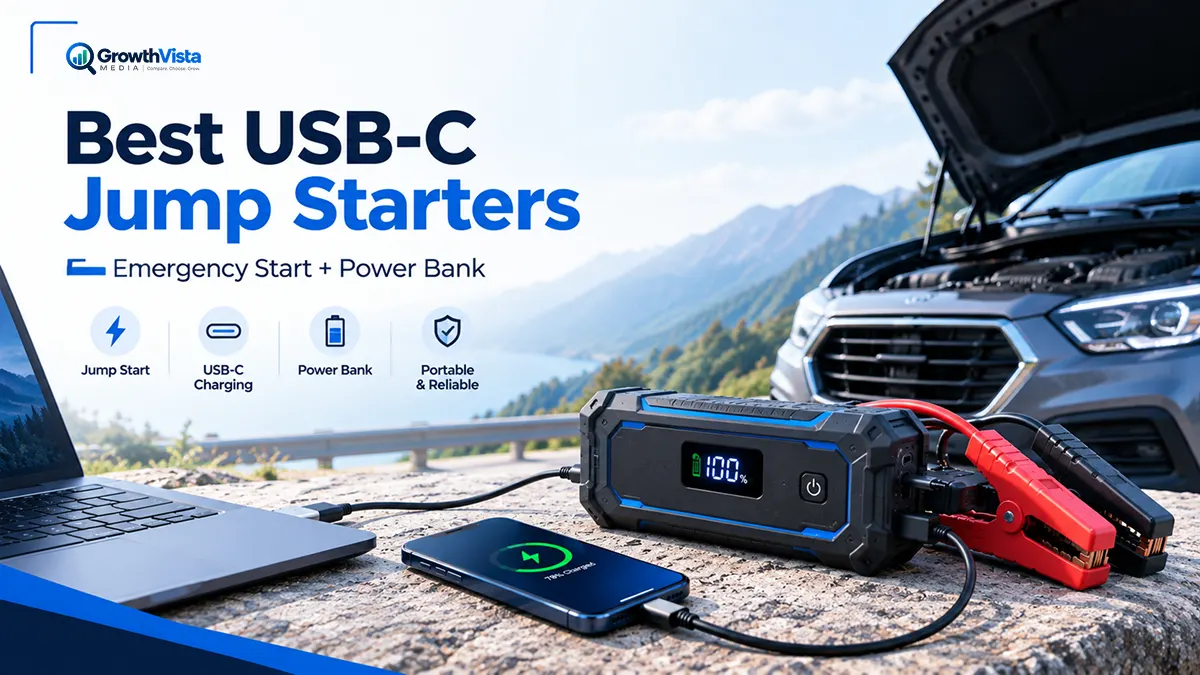
The best USB-C jump starter should do more than provide a modern connector. The strongest options combine correct engine compatibility with useful USB-C power, enough stored energy for travel, practical recharge speed and manageable size.
Explore more in our Automotive guides. For primary specifications, review the official manufacturer documentation for each exact model before purchase.
How We Compared the Best Usb-C Jump Starter
A portable jump starter can spend months waiting for a dead vehicle battery. Adding useful USB-C charging turns that emergency tool into something you may actually use during road trips, power outages and travel.
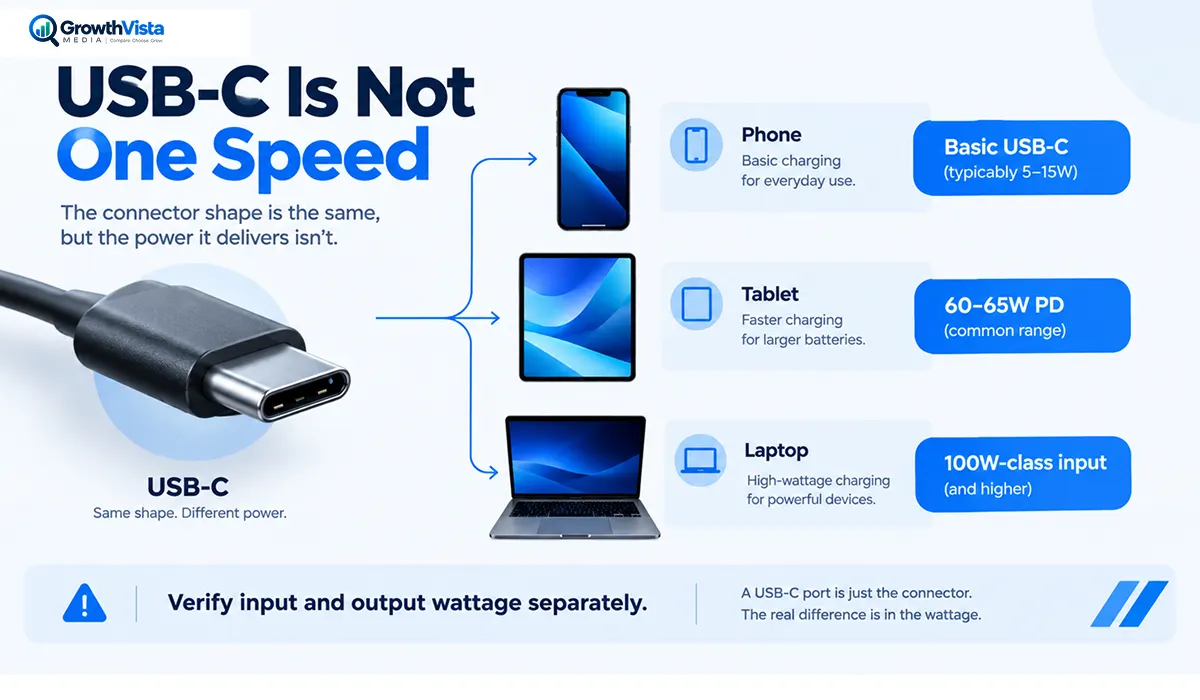
But a USB-C connector does not automatically make a jump starter a good power bank. Some products use USB-C only for modest recharging, while others support high-wattage Power Delivery capable of charging compatible laptops as well as phones and tablets.
Battery capacity matters too. A compact jump starter may be excellent for starting a passenger car but offer relatively little energy for electronics. Larger units can provide substantially more accessory power, at the cost of extra weight.
This guide focuses on finding the best USB-C jump starter through the practical intersection between jump starting and USB-C power: engine compatibility, watt-hours, USB-C wattage, recharge speed and portability.
Amazon Disclosure: As an Amazon Associate I earn from qualifying purchases. GrowthVista Media may receive a commission from qualifying purchases made through our links, at no additional cost to you.
Editorial Methodology
GrowthVista has not independently laboratory-tested every model discussed here. Specifications should be verified against the current manufacturer documentation before publication. USB-C input and output capabilities can differ even within the same product family, so do not assume a USB-C port supports laptop-class Power Delivery unless the manufacturer explicitly specifies the wattage.
Quick Shortlist
| Model / Family | USB-C Direction | Engine Positioning | Why Consider It | Check Price |
|---|---|---|---|---|
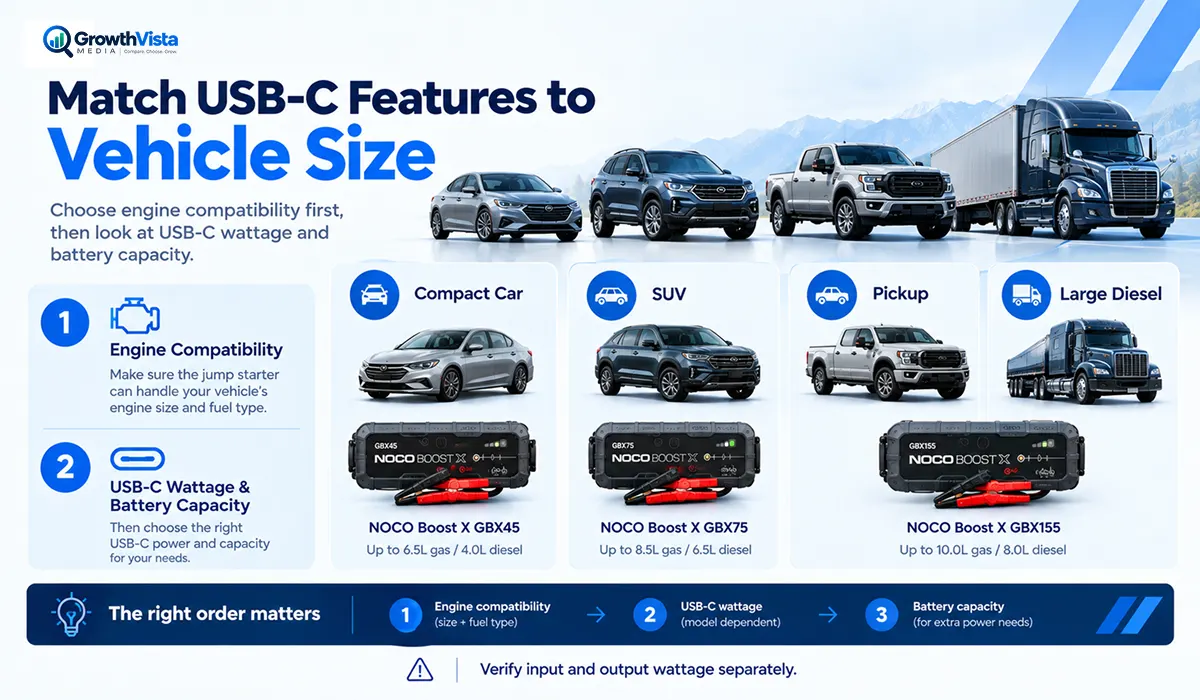
| NOCO Boost X GBX45 | Modern USB-C PD | Up to 6.5L gas / 4.0L diesel | Compact Boost X entry point | Check Price → |
| NOCO Boost X GBX75 | High-power Boost X charging | Up to 8.5L gas / 6.5L diesel | Large-engine travel option | Check Price → |
| NOCO Boost X GBX155 | High-capacity Boost X | Up to 10.0L gas / 8.0L diesel | Very large-engine coverage | Check Price → |
| GOOLOO GT3000 | Up to 100W USB-C input in current technical table | Up to 10.0L gas / 8.0L diesel | Fast recharge + large-engine focus | Check Price → |
| GOOLOO GT4000 | Up to 100W USB-C input in current technical table | Verify exact current engine documentation | Large battery + cold-weather feature | Check Price → |
| WOLFBOX MegaVolt 24 | 65W bidirectional USB-C | Up to 10L gas / 10L diesel manufacturer rating | 88.8Wh travel power | Check Price → |
| LOKITHOR JA301 PRO | Up to 60W bidirectional USB-C | Up to 8.5L gas / 6.5L diesel | Balanced power + portability | Check Price → |
| LOKITHOR JA3000 PRO | Up to 60W bidirectional USB-C | Up to 9.0L gas / 7.0L diesel | LiFePO4 battery + fast charging | Check Price → |
This best USB-C jump starter shortlist is feature-based, not a ranking. The right model depends first on the vehicle and then on how much USB-C power you actually need.
1. NOCO Boost X GBX45 — Compact Entry Into Modern USB-C
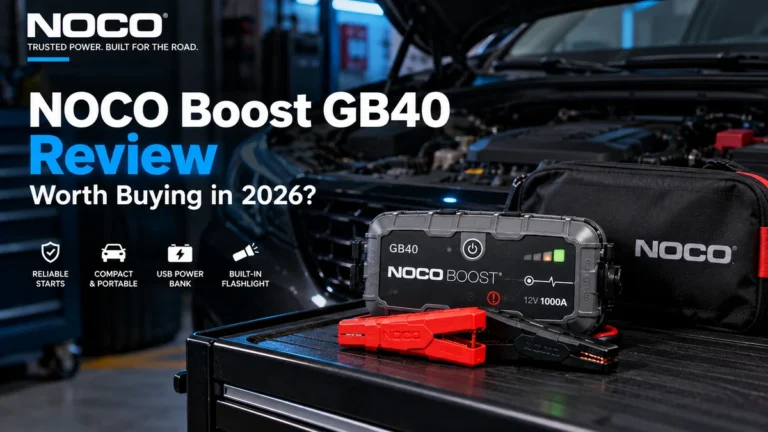
The GBX45 is a useful starting point for buyers who like NOCO's Boost concept but want a more modern charging architecture than the original GB-series products.
NOCO currently rates the GBX45 at 1,250A and for gasoline engines up to 6.5L and diesel engines up to 4.0L.
Boost X products use USB-C Power Delivery for faster recharging and accessory charging. That makes the GBX45 more useful on a road trip than a basic jump starter that relies on slow 5V input.
Its engine range is broad enough for many passenger cars, crossovers and compatible SUVs without requiring the physical size of NOCO's larger Boost X units.
For buyers who want a jump starter first and a useful USB-C battery second, the GBX45 is a logical model to investigate.
Check Current NOCO GBX45 Price →
2. NOCO Boost X GBX75 — USB-C for Larger Engines
The GBX75 moves the same Boost X idea into a larger-engine class.
NOCO currently rates it at 2,500A and for gasoline engines up to 8.5L and diesel engines up to 6.5L.
That makes it relevant to pickup and large-SUV owners who also want faster USB-C recharging and portable-device power.
The practical advantage of high-power charging is not just charging a laptop. It also means the jump starter itself can be replenished much faster with compatible hardware, which matters after a jump start or extended accessory use.
The downside is the usual one: larger engine coverage and battery capacity mean more size and weight.
Check Current NOCO GBX75 Price →
3. NOCO Boost X GBX155 — When Vehicle Compatibility Comes First
For very large engines, the GBX155 pushes Boost X into a much higher capacity tier.
NOCO currently lists it at 4,250A with compatibility up to 10.0L gasoline and 8.0L diesel.
This is not the model to buy simply because you want to charge a phone. Its value comes from combining very large-engine jump-start capability with the newer Boost X charging platform.
For households or businesses with multiple large vehicles, that combination can be useful. For a small sedan, it is likely unnecessary bulk.
Check Current NOCO GBX155 Price →
4. GOOLOO GT3000 — 100W-Class Recharging Emphasis
GOOLOO's GT3000 is interesting for buyers who care about recharge speed.
GOOLOO's current technical table lists the GT3000 at 3,000A with an 84.36Wh battery and USB-C Power Delivery input up to 100W. Its current FAQ rates the model for engines up to 10.0L gasoline and 8.0L diesel.
An 84Wh-class battery gives the device meaningful stored energy for phones and other electronics, while 100W-class input can make recharging the jump starter much less tedious than basic USB.
Check the exact USB-C output specification for the current SKU if laptop charging is a requirement; high input wattage does not automatically mean identical output wattage.
Check Current GOOLOO GT3000 Price →
5. GOOLOO GT4000 — Large Battery and Cold-Weather Feature Set
The GT4000 sits higher in GOOLOO's feature range and combines high advertised starting output with a substantial internal battery.
GOOLOO's current documentation describes 100W-class fast charging on the GT4000 and an intelligent pre-heating system intended for severe cold.
The company's current technical and FAQ pages have shown differing battery-capacity references for closely related GT4000 entries, so this is exactly the type of product where the final article should be checked against the current manual and exact retail SKU.
The larger point remains useful: premium jump starters increasingly behave like high-capacity power banks, but model verification becomes more important as the feature list grows.
Check Current GOOLOO GT4000 Price →
6. WOLFBOX MegaVolt 24 — 65W Bidirectional USB-C
WOLFBOX's MegaVolt 24 is one of the clearer examples of a jump starter designed to serve as travel power.
WOLFBOX currently specifies an 88.8Wh internal battery and 65W USB-C input/output. The company also markets the unit for engines up to 10L gasoline and 10L diesel.
Sixty-five-watt output is enough to make the USB-C port relevant to many compatible laptops, not just phones.
The 88.8Wh battery is also large enough to make accessory charging more meaningful, although every watt-hour used for electronics reduces the reserve remaining for emergency starting.
For a road-trip kit, that dual role can be valuable if you maintain the battery properly.
88.8Wh manufacturer battery specification
65W bidirectional USB-C
Large-engine manufacturer positioning
Emergency light and accessory-power functions
Check Current WOLFBOX MegaVolt 24 Price →
7. LOKITHOR JA301 PRO — 60W USB-C in a Balanced Package
The LOKITHOR JA301 PRO combines jump starting, an air compressor and up to 60W bidirectional USB-C.
LOKITHOR currently lists it at 2,500A, with a 74.37Wh battery and engine compatibility up to 8.5L gasoline and 6.5L diesel.
The integrated compressor adds another layer of roadside utility, making this more of an all-in-one emergency device than a dedicated jump starter.
Sixty-watt USB-C is a useful middle ground for compatible laptops and faster device charging without moving into a very large power-station format.
The trade-off is complexity and size: if you already own a good tire inflator, a dedicated jump starter may be more efficient.
Check Current LOKITHOR JA301 PRO Price →
8. LOKITHOR JA3000 PRO — LiFePO4 Plus 60W USB-C
The JA3000 PRO is notable because LOKITHOR uses LiFePO4 battery chemistry rather than the more common lithium-ion chemistry found in many compact jump starters.
LOKITHOR currently rates it at 3,000A, up to 9.0L gasoline and 7.0L diesel, with a 46.08Wh battery and up to 60W bidirectional USB-C.
The manufacturer claims more than 2,000 battery cycles under good-condition use. That can matter to buyers who expect frequent charging and discharging rather than rare emergency use.
It also includes a 150 PSI compressor, so the JA3000 PRO competes as a multifunction roadside tool rather than only as a jump starter/power bank.
Check Current LOKITHOR JA3000 PRO Price →
What Watt-Hours Tell You
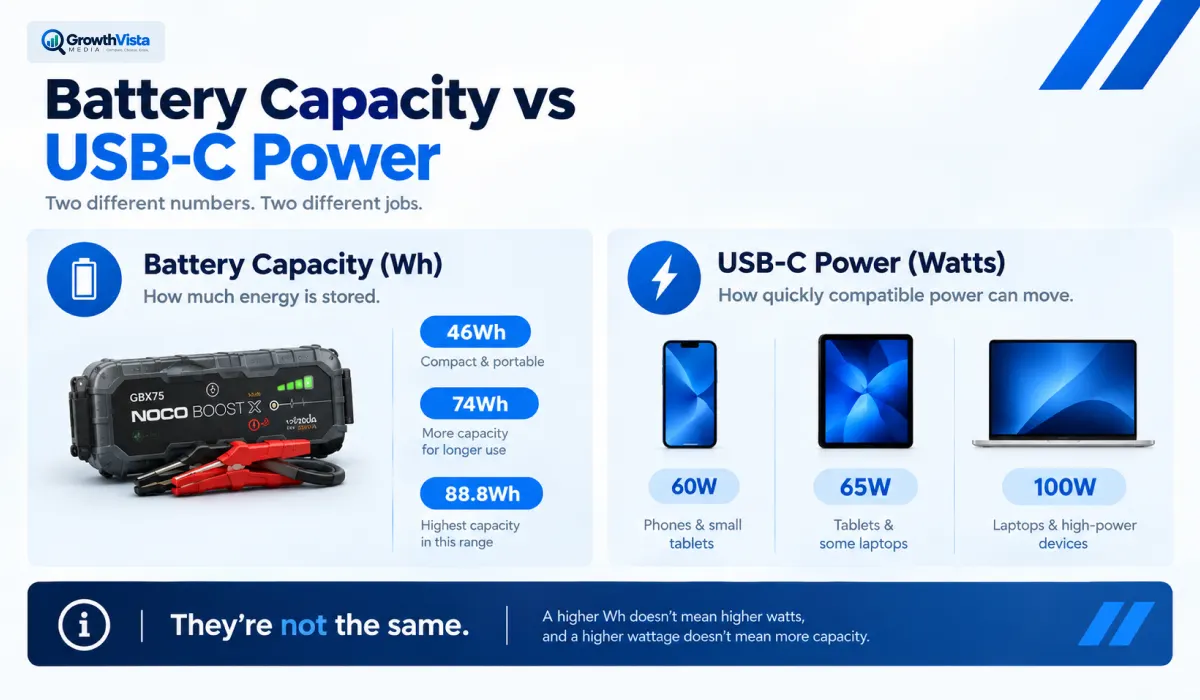
Watt-hours describe stored energy. They are useful when comparing how much accessory power different jump starters can provide.
A larger Wh figure can support more phone charging, longer lighting use or more laptop energy, but it usually increases product size and recharge time.
Watt-hours do not directly tell you how well the unit will crank an engine. Starting performance depends on the battery system, output design, cables, temperature and vehicle.
What USB-C Wattage Tells You
USB-C wattage describes power-transfer capability, not battery capacity.
A 60W or 65W USB-C output can support many compatible laptops. A 100W input can dramatically speed up recharging of a large jump starter when paired with a suitable charger and cable.
Always check input and output separately. A product can support high-power USB-C charging into the jump starter without providing the same wattage out to a laptop.
Can a Jump Starter Replace a Dedicated Power Bank?
Sometimes, but not always.
If your main need is charging a phone every day, a dedicated power bank is usually smaller and more convenient. A jump starter carries heavy clamps, safety electronics and an enclosure designed for automotive use.
The jump starter becomes more compelling as a power bank when it already needs to be in your vehicle and offers 60W-or-higher USB-C plus a substantial battery.
For travel, that can reduce the number of batteries you carry. For everyday pocket use, it is usually overkill.
Can It Charge a Laptop?
Only if the exact USB-C output supports the voltage and wattage your laptop expects. A USB-C connector alone is not enough. Many ultrabooks can use 45W–65W USB-C PD, while higher-performance laptops may require substantially more power or proprietary adapters. Check both devices before relying on the jump starter.
Why Recharge Speed Matters After an Emergency
A jump starter should return to its emergency role after you use it.
If a device takes many hours to recharge, it is easy to put it back in the vehicle before it is fully ready. High-power USB-C reduces that friction.
This is one of the strongest reasons to consider Boost X, GOOLOO GT, WOLFBOX or LOKITHOR PRO-class products over older basic-USB designs when you expect regular use.
Do Not Drain Your Emergency Reserve
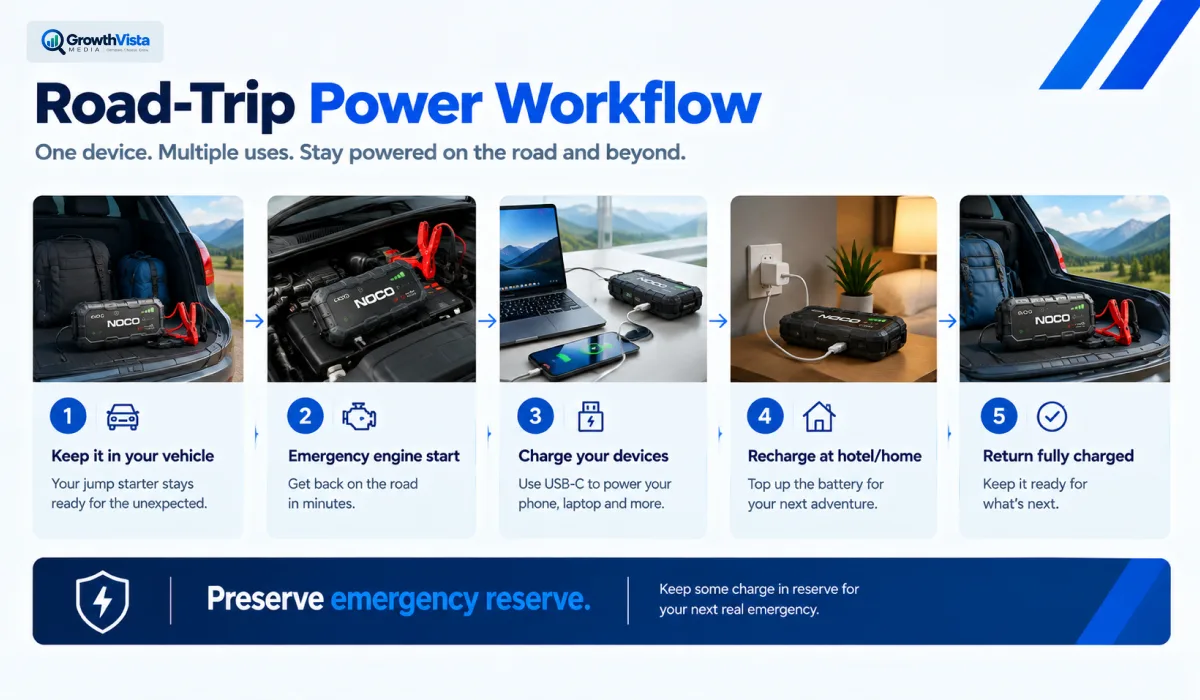
The power-bank function creates a new risk: using the battery for convenience and forgetting that it is also your emergency starter.
Do not routinely run the unit near empty charging laptops and then leave it in the vehicle.
A simple rule is to recharge after significant accessory use and check the battery before long trips. Follow the manufacturer's storage-maintenance schedule.
Which Type Fits You?
| Use Case | What to Prioritize | Models/Families to Investigate |
|---|---|---|
| Normal passenger car + phone charging | Correct engine rating, compact size | NOCO GBX45 or comparable compact USB-C model |
| Large SUV / pickup | Higher engine rating + fast recharge | NOCO GBX75, GOOLOO GT class |
| Very large diesel | Explicit diesel rating | NOCO GBX155 or another verified high-capacity model |
| Laptop charging | 60W+ verified USB-C output | WOLFBOX MegaVolt 24, LOKITHOR PRO models, other verified options |
| Fastest jump-starter recharge | High USB-C PD input | GOOLOO GT class / compatible high-power models |
| Need tire inflation too | Integrated compressor | LOKITHOR JA301 PRO / JA3000 PRO or equivalent |
| Frequent battery cycling | Battery chemistry/cycle-life documentation | LiFePO4-based JA3000 PRO class |
| Only occasional emergency starting | Engine fit + simplicity | Do not overpay for laptop-class USB-C if unused |
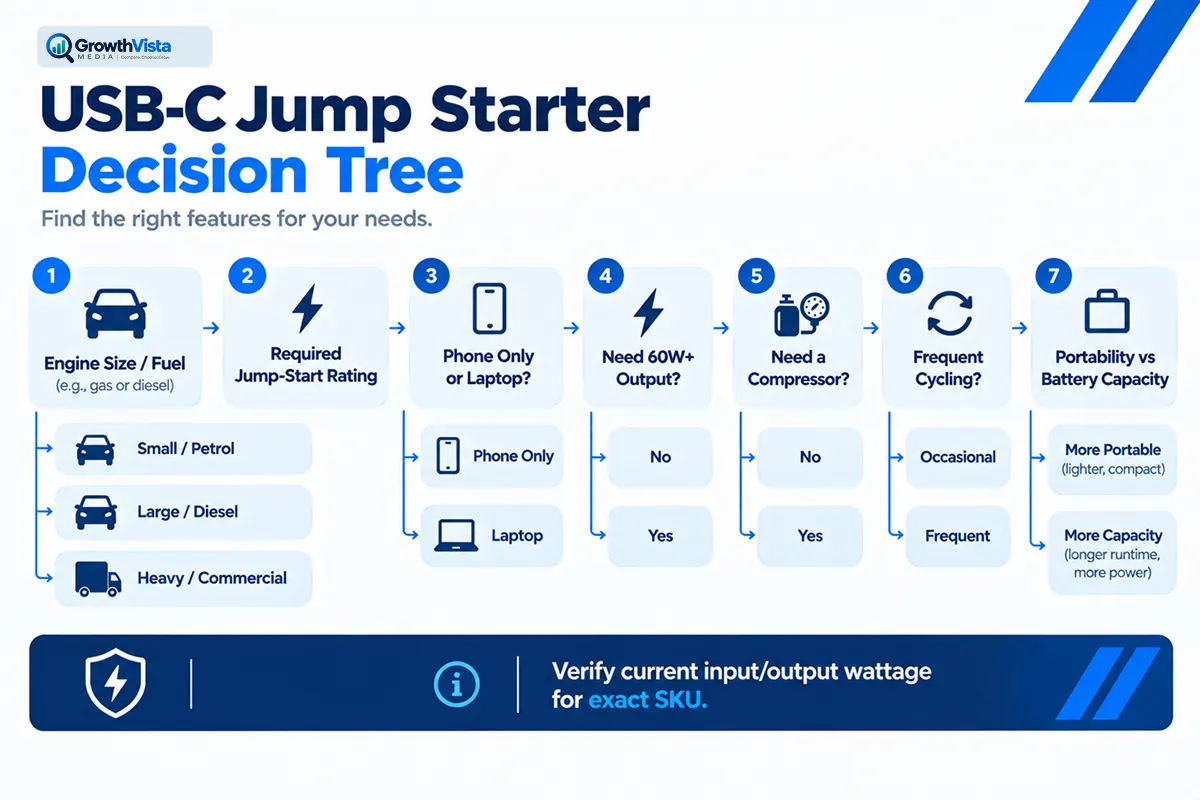
Best Usb-C Jump Starter Buying Checklist
Confirm 12V vehicle compatibility.
Match the published gas/diesel engine rating to your exact engine.
Check battery capacity in watt-hours.
Check USB-C input wattage.
Check USB-C output wattage separately.
Confirm that your laptop supports USB-C PD if laptop charging matters.
Review included charger/cable requirements for maximum charging speed.
Check weight and storage dimensions.
Review operating and storage-temperature limits.
Recharge after substantial phone/laptop use.
Use live pricing rather than hard-coded affiliate prices.
Frequently Asked Questions
What is the best USB-C jump starter?
There is no single model for every vehicle. Start with engine compatibility, then compare USB-C output wattage, battery capacity and portability.
Can a jump starter charge a laptop?
Some can. Look for a verified USB-C Power Delivery output such as 60W or 65W and confirm that it matches your laptop's charging requirements.
Is 100W USB-C better than 65W?
Not automatically. Higher wattage can support faster charging or more demanding devices, but the laptop and cable must support it. Also check whether the figure applies to input, output or both.
What does 88.8Wh mean?
It is an energy-capacity figure. It helps compare how much stored energy a battery has, but it is not the same as jump-starting current.
Can I charge my phone from a jump starter?
Many modern jump starters include USB outputs. Check the exact port type and charging specification.
Does using it as a power bank reduce jump-start capability?
It reduces the remaining battery charge, so yes, heavy accessory use can leave less emergency reserve until the unit is recharged.
Should I buy a jump starter instead of a normal power bank?
For vehicle emergency use plus occasional device charging, it can consolidate gear. For everyday phone charging, a dedicated power bank is usually smaller.
Do all USB-C jump starters support Power Delivery?
No. USB-C describes the connector. Check the manufacturer's wattage and protocol specifications.
Why is fast USB-C input useful?
It can reduce the time needed to recharge the jump starter itself after use.
Should I keep the jump starter at 100% all the time?
Follow the manufacturer's maintenance guidance. The important practical point is to check and recharge it periodically so it is ready for emergencies.
Final Thoughts on the Best Usb-C Jump Starter
The best USB-C jump starter becomes much more useful when its USB-C implementation matches what you want to power.
For a normal car, a compact Boost X model can combine emergency starting with faster modern charging without becoming unnecessarily large. Large-vehicle owners can move into GBX75/GBX155 or comparable high-capacity products.
GOOLOO's GT family is particularly relevant when fast USB-C input matters, while WOLFBOX's 65W bidirectional implementation and LOKITHOR's 60W PRO models are useful examples for buyers who specifically want laptop-capable output.
When selecting the best USB-C jump starter, the most important distinction is between connector, power and capacity. USB-C is the connector; watts describe charging power; watt-hours describe stored energy. Compare all three only after the jump starter is correctly rated for your vehicle.
That produces a better roadside tool—and a much more useful power bank—than buying on peak amps alone.