How to Choose a Portable Jump Starter: Amps, Engine Size & Safety Explained
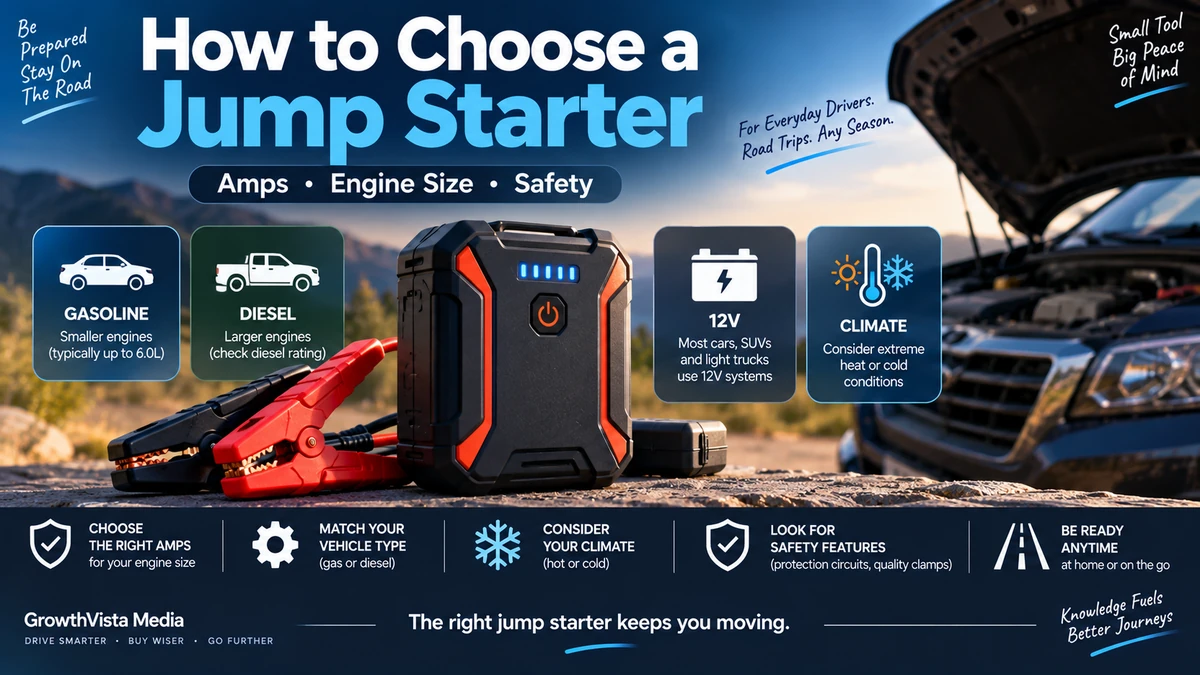
If you are learning how to choose a jump starter, start with your vehicle rather than the largest peak-amp number. Voltage, fuel type, engine displacement and climate should narrow the shortlist before convenience features or price.
See more automotive buying guides. For vehicle-specific jump-start procedures, always consult your owner’s manual.
How to Choose a Jump Starter: Complete Buying Guide
Portable jump starters are easy to shop for badly. Product pages compete with numbers such as 1,500A, 3,000A or 5,000A, but the largest number on the box is not automatically the best choice for your vehicle.
A useful jump starter must match the vehicle's electrical system and engine, provide enough starting capability for the conditions where you drive, connect safely, remain charged during storage and fit comfortably in your emergency kit.
Features such as USB-C charging, tire inflators and digital displays can be useful, but they should come after the core vehicle match.
This guide gives you a practical selection process so you can narrow the market without relying on peak-amp marketing alone.
Affiliate Disclosure: As an Amazon Associate I earn from qualifying purchases. GrowthVista Media may receive a commission from qualifying purchases made through our links, at no additional cost to you.
The 30-Second Buying Rule
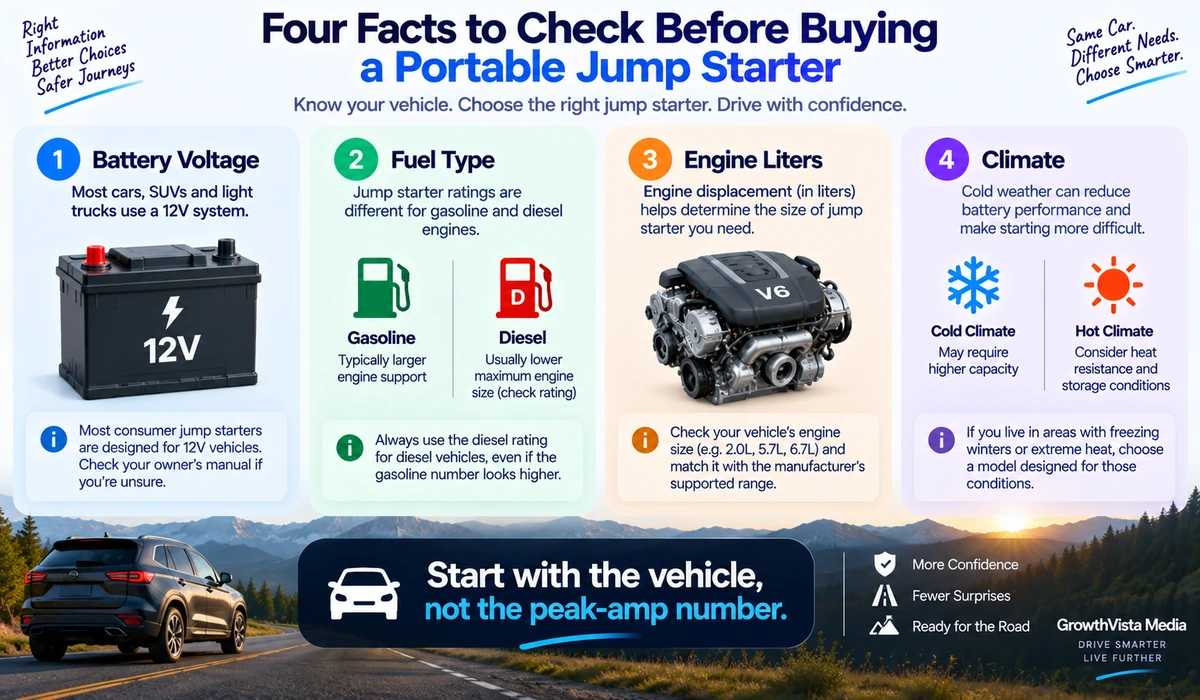
Before comparing brands or prices, identify four things: your vehicle's battery voltage, fuel type, engine displacement and the climate in which you expect to use the jump starter.
| Question | Example | Why It Matters |
|---|---|---|
| Battery system? | 12V | The jump starter must be compatible with the vehicle's starting system. |
| Gasoline or diesel? | Diesel | Manufacturers often publish lower maximum diesel-engine sizes. |
| Engine displacement? | 2.0L / 5.7L / 6.7L | This is one of the clearest manufacturer compatibility filters. |
| Climate? | Mild / freezing winter | Cold conditions can reduce practical battery performance. |
Once you know these four facts, you can eliminate unsuitable products before comparing displays, USB ports or promotional prices.
1. Confirm the Vehicle's Battery Voltage
Most passenger cars, SUVs and light trucks use a 12V starting system, and many consumer lithium jump starters are designed specifically for 12V vehicles. That does not mean every vehicle is identical. Commercial vehicles, specialty equipment, hybrids and newer electrical architectures can have different procedures or restrictions.
Check the vehicle owner's manual before purchasing or connecting a jump starter. It may identify designated jump points and precautions intended to protect sensitive electronics. Never assume that a consumer 12V jump starter is suitable for a 24V system.
2. Match Gasoline vs Diesel Correctly
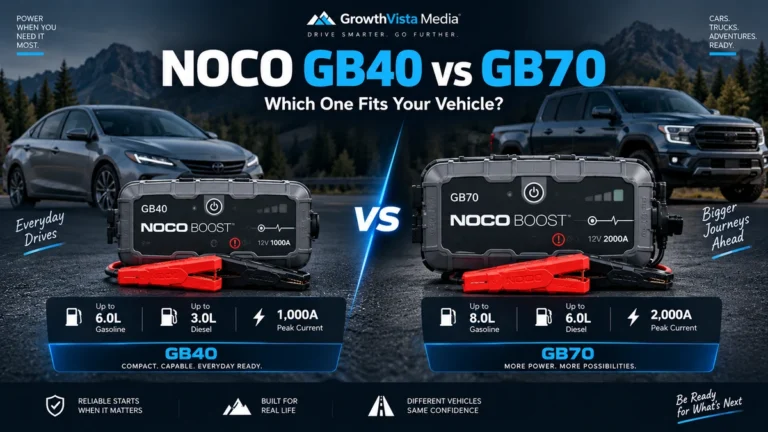
Manufacturers commonly rate the same jump starter for a larger gasoline engine than diesel engine. If a product is rated for 8.0L gasoline but only 6.0L diesel, a 6.7L diesel is outside that published diesel range even though the gasoline number looks large enough.
Always use the diesel rating for a diesel vehicle. This prevents one of the most common selection mistakes.
3. Use Engine Displacement as the Main Compatibility Filter
Engine displacement is normally expressed in liters. Manufacturers commonly use it to communicate the maximum gasoline and diesel engine sizes a model is designed to support.
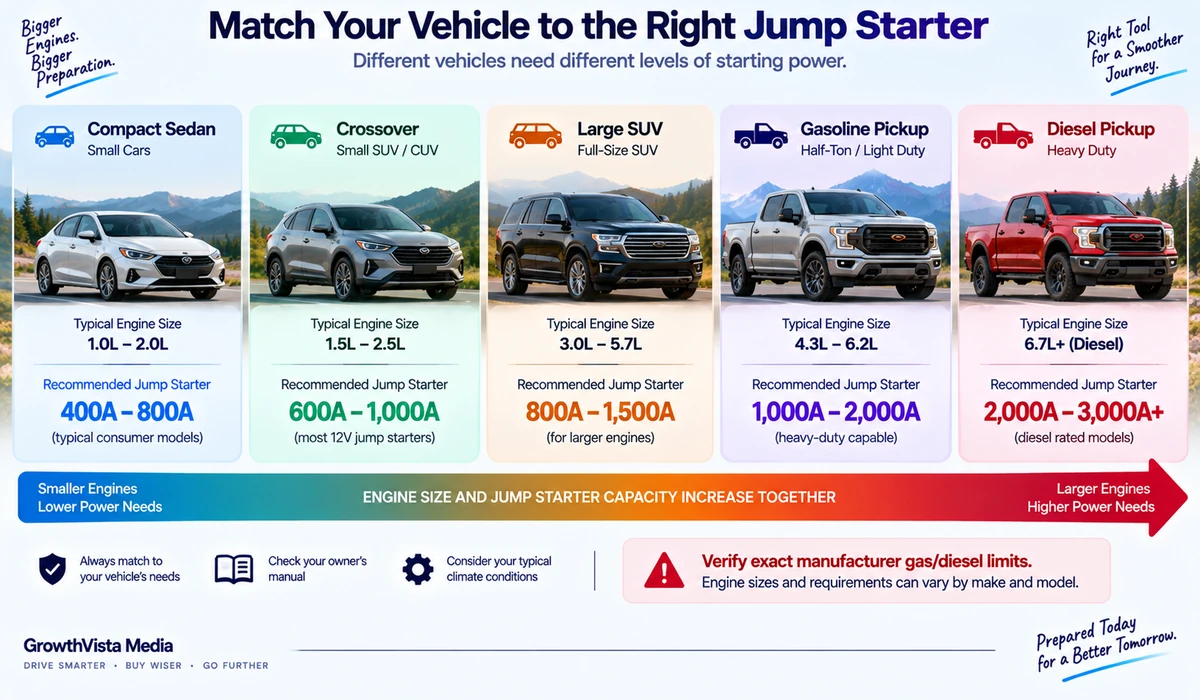
| Vehicle Example | Engine Example | Shopping Direction |
|---|---|---|
| Small sedan | 1.5–2.5L gas | Compact correctly rated starter may be sufficient |
| Crossover / midsize SUV | 2.0–4.0L gas | Compact or mid-capacity starter |
| Full-size gasoline SUV / pickup | 5.0–8.0L gas | Higher-capacity model |
| Small diesel | 2.0–3.0L diesel | Use diesel-specific rating |
| Large diesel pickup | 6.0L+ diesel | Explicit large-diesel compatibility becomes essential |
These are examples rather than universal requirements. Use your exact engine and the current manufacturer's documentation.
4. Understand Peak Amps Without Overvaluing Them
Peak amps are one of the most heavily marketed specifications. Within a manufacturer's own lineup, a larger number generally indicates a higher-capacity model. Across brands, however, peak-current figures should be treated cautiously because measurement and reporting methods are not necessarily identical.
Real starting performance also depends on battery chemistry and state of charge, cable resistance, clamp contact, temperature and the condition of the vehicle battery. Use peak amps as supporting information rather than the sole buying criterion.
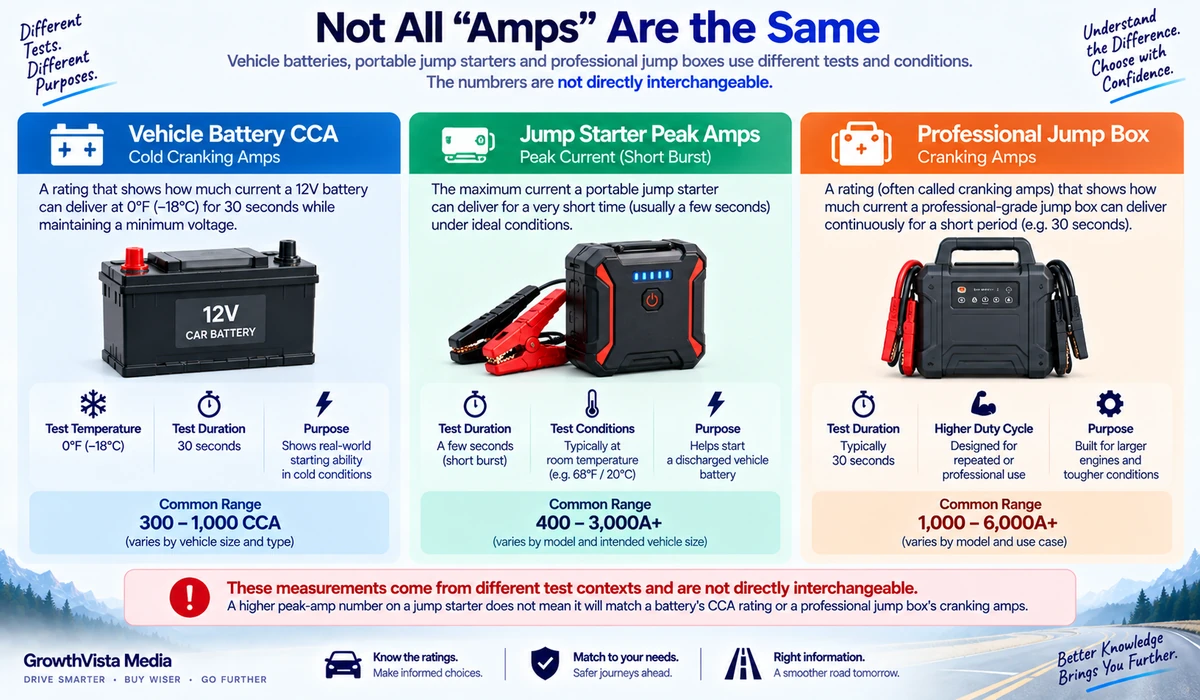
5. Peak Amps, Cranking Amps and Battery CCA Are Different
A vehicle battery's Cold Cranking Amps (CCA) describes its performance under a defined cold-temperature test. A portable jump starter's advertised peak amps are a different specification. Professional jump boxes may also publish cranking amps.
Do not treat these numbers as interchangeable. For a consumer buying decision, the product's explicit engine compatibility plus the vehicle owner's manual are usually more useful.
6. Leave Sensible Margin for Cold Weather
Cold weather can make starting harder while also reducing the useful performance of batteries. If your engine sits exactly at a jump starter's maximum published rating and you routinely drive in severe winter conditions, moving to a more capable model can provide useful margin.
Check the product's operating and charging temperature ranges. A lithium battery may have different limits for operation and charging. Cold-weather features such as pre-heating should be evaluated at the exact model level.
7. Battery Capacity Matters for Power-Bank Use
Many manufacturers publish internal capacity in watt-hours (Wh). This is particularly useful when comparing how much energy a jump starter can provide to phones, tablets, lights or other electronics.
Watt-hours do not directly measure starting capability. A larger battery can provide more accessory energy but can also increase size and recharge time.
8. Decide Whether USB-C Matters to You
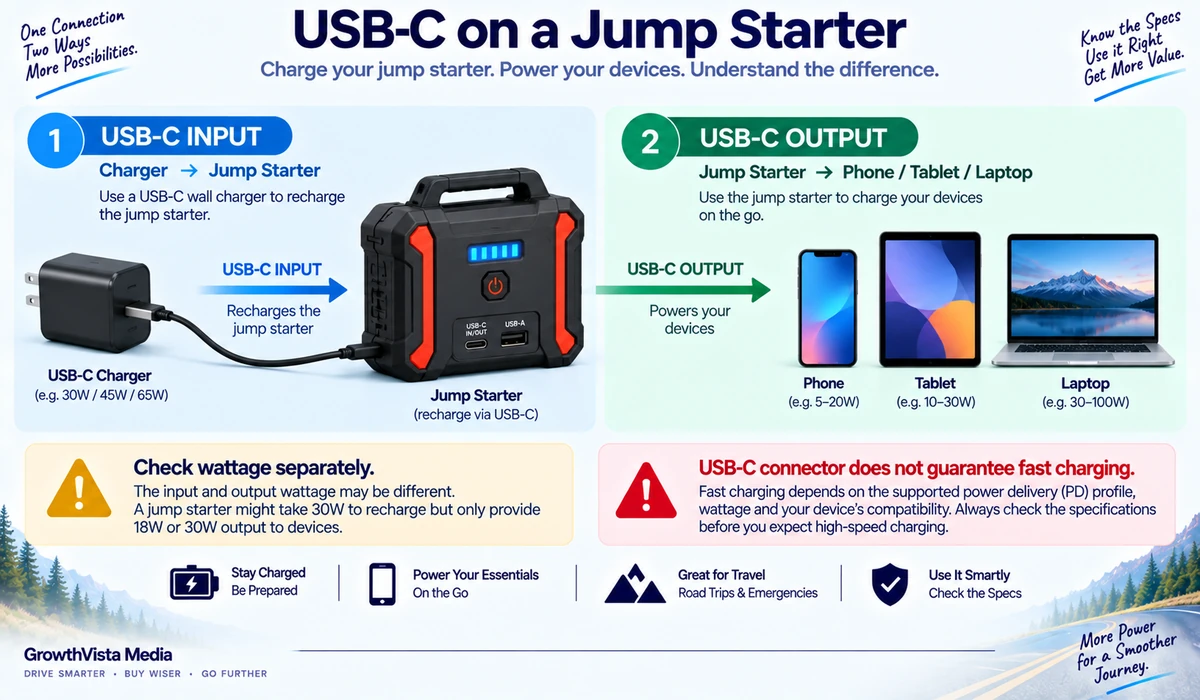
A USB-C connector can support anything from modest charging to high-power USB Power Delivery. Check input and output wattage separately.
High USB-C input can recharge the jump starter faster. High USB-C output can make it useful for compatible laptops and tablets. If you only need emergency phone charging, basic USB may be sufficient.
9. Cable Length and Clamp Quality Matter
A powerful battery pack still needs a good electrical connection. Check clamp opening, cable flexibility and whether the leads can reach the vehicle's designated jump points.
This is especially relevant on trucks and SUVs with larger engine bays. Professional jump boxes often use longer, heavier cables, while compact lithium products prioritize portability.
10. Look for Clear Connection Protection
Modern consumer jump starters commonly include smart-clamp electronics intended to reduce common connection mistakes. Depending on the model, protection can include reverse-polarity detection, short-circuit protection, over-current protection and status indicators.
These systems do not replace proper procedure. Follow both manuals. If a product includes manual override or force-start mode, use it only as documented because it may bypass normal battery-detection logic.
11. Decide Whether You Need a Built-In Tire Inflator
Combination models can cover both a dead battery and a low tire with one rechargeable device. This saves trunk space and can simplify a roadside kit.
The trade-off is shared battery capacity and greater complexity. If the battery in an all-in-one unit is empty, both cordless functions are unavailable. Separate tools provide redundancy and may offer stronger specialist compressor performance.
12. Don't Shop for an Inflator by PSI Alone
Maximum PSI is not the same as inflation speed. Most passenger-car tires operate far below the 150–160 PSI maximum figures commonly advertised.
Airflow, compressor duty cycle, heat management, hose design and automatic shut-off can be more useful. If a manufacturer publishes airflow in liters per minute, use it alongside maximum pressure.
13. Portability Is a Real Feature
A jump starter that is too large to keep in the vehicle will not help when the battery dies away from home. Check product weight, dimensions and storage case.
Buy enough capacity for the vehicle and conditions, but do not assume the heaviest product is automatically better.
14. Check Storage and Maintenance Requirements
A jump starter is a rechargeable battery, not maintenance-free insurance. Manufacturers commonly recommend checking or recharging the unit periodically during extended storage.
Recharge after meaningful use, inspect clamps and cables, and never use a battery pack that is swollen, damaged or behaving abnormally. Compare the storage-temperature range with the conditions inside your vehicle.

15. Check Documentation, Warranty and Support
Clear documentation matters for a safety-related electrical product. Look for a current user manual, warranty information, support channels and model-specific technical specifications.
Be cautious when a seller provides only large marketing numbers but little information about engine limits, battery capacity, operating temperatures or safe connection procedures.
16. Don't Treat a Jump Starter as a Battery Repair
A jump starter provides temporary energy to crank the engine. It does not repair a worn-out vehicle battery or charging-system fault.
If a vehicle repeatedly needs a jump, have the battery and charging system diagnosed. A portable jump starter is also not automatically a full battery charger or maintainer unless the manufacturer explicitly provides that function.
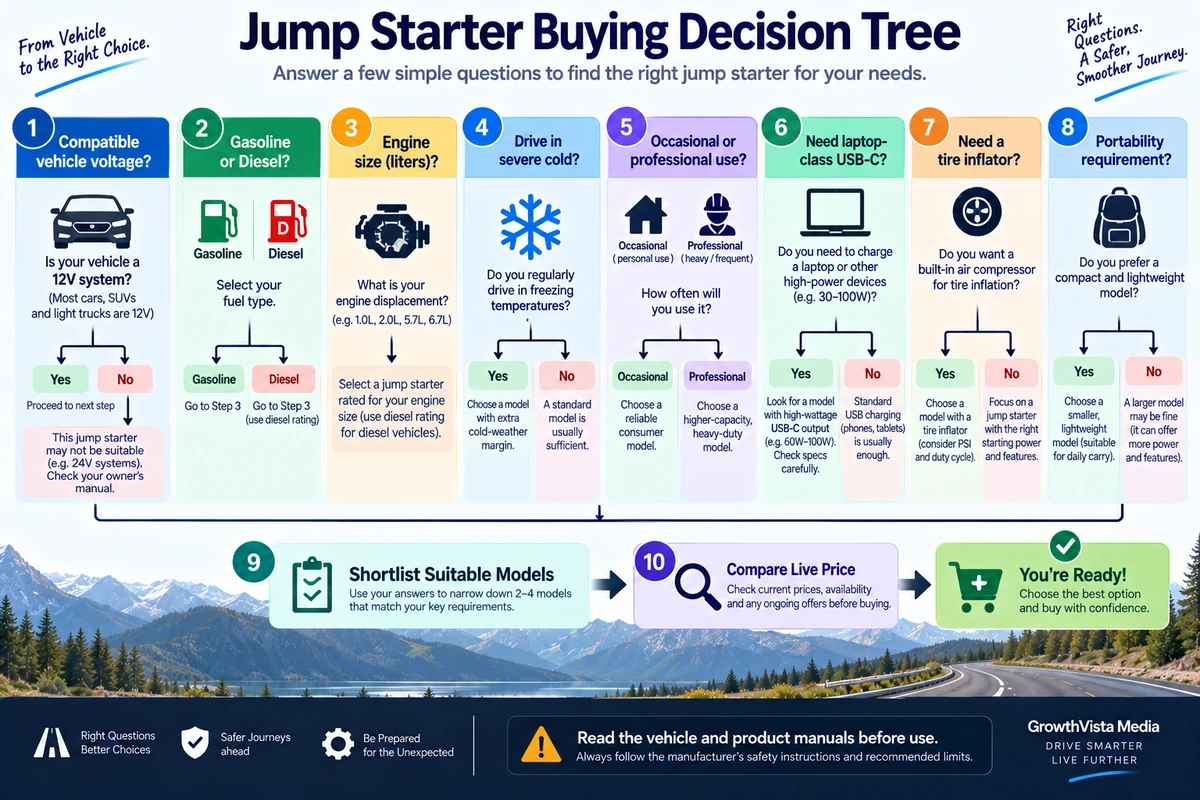
A Practical 10-Step Selection Framework
| Step | Decision |
|---|---|
| 1 | Confirm vehicle voltage and approved jump-start procedure. |
| 2 | Identify gasoline vs diesel. |
| 3 | Find exact engine displacement. |
| 4 | Shortlist models whose published engine rating comfortably covers the engine. |
| 5 | Consider additional margin for severe cold or demanding use. |
| 6 | Compare cable/clamp design and documented safety protections. |
| 7 | Choose battery capacity and USB-C features based on real accessory-power needs. |
| 8 | Decide whether an integrated tire inflator is useful. |
| 9 | Check size, weight, temperature range, warranty and documentation. |
| 10 | Compare live price only after the technical shortlist is correct. |
Example: 2.0L Gasoline Sedan
A 2.0L gasoline sedan does not need a jump starter intended specifically for an 8.0L diesel. A compact model whose published gasoline rating comfortably exceeds 2.0L can be easier to store and less expensive. Add USB-C or a compressor only if you will use those features.
Example: 5.7L Gasoline Pickup
Start with models explicitly rated above 5.7L gasoline. Then consider winter conditions, cable access in the larger engine bay and whether the device will also provide travel power. There is little reason to move to an extreme diesel-class unit unless another vehicle or use case requires it.
Example: 6.7L Diesel Pickup
Use the diesel rating. A model capped at 6.0L diesel is outside its published compatibility even if its gasoline rating is 8.0L or higher. Look for a product explicitly covering at least 6.7L diesel and consider additional margin for cold conditions.
Common Buying Mistakes
Buying solely from the largest advertised peak-amp number.
Using a gasoline engine rating for a diesel vehicle.
Assuming every USB-C port supports high-power Power Delivery.
Choosing an inflator only by maximum PSI.
Ignoring cable reach and clamp access.
Buying exactly at the engine-size limit for severe winter use.
Leaving the jump starter discharged for months.
Using manual override without understanding the instructions.
Hard-coding temporary promotional prices into a buying guide.
Assuming repeated jump starts are a substitute for diagnosing the vehicle battery.
Frequently Asked Questions
How many amps should a jump starter have?
There is no universal amp number. Start with the manufacturer's gasoline/diesel engine compatibility for your exact vehicle, then use current ratings as supporting information.
Is a 1,000A jump starter enough?
It can be for many compatible passenger vehicles. Check the exact product's published engine rating rather than relying on the amp number alone.
What size jump starter do I need for a V8?
V8 engines vary widely. Find the engine displacement and fuel type, then choose a product whose published rating covers it.
Do diesel engines need a stronger jump starter?
Manufacturers commonly publish lower maximum diesel displacement than gasoline displacement for the same model, so use the diesel-specific rating.
Should I buy more capacity than I need?
Some margin can be useful for cold weather or multiple vehicles, but excessive capacity adds cost, size and weight.
Is USB-C important?
It can be useful for faster recharging and device power. Check actual input and output wattage rather than the connector alone.
Is a jump starter with an air compressor better?
It is more convenient if you need both functions. Separate tools provide redundancy and can offer more specialized inflation performance.
Can I leave a jump starter in the car?
Only within the manufacturer's storage-temperature guidance. Vehicle interiors can become extremely hot or cold.
How often should I charge it?
Follow the exact manual and recharge after significant use. Manufacturers may also specify periodic charging during storage.
Can a jump starter damage a car?
Incorrect voltage, polarity or procedure can create risk. Use a compatible product and follow both the vehicle and jump-starter manuals.
Can I jump a completely dead battery?
Some models provide a manual override or force-start function for very low battery voltage. Use such modes only according to the manufacturer's instructions.
Do I need one if my battery is new?
A healthy battery reduces the chance of a battery-related no-start, but a portable jump starter can still serve as emergency equipment during travel.
Final Thoughts: How to Choose a Jump Starter: Complete Buying Guide
The best portable jump starter is not the model with the most impressive number on its product page. It is the one that correctly matches your vehicle and is practical enough to keep charged and available.
Start with voltage, fuel type and engine displacement. Use the manufacturer's engine rating as the main compatibility filter, then consider cold-weather margin, clamp design and safety.
After that, decide whether a larger battery, high-power USB-C, a tire inflator or a premium display will genuinely improve your roadside kit.
For a normal passenger car, a compact correctly rated unit may be all you need. Large gasoline engines and diesels justify higher-capacity products, while frequent professional use can justify a different style of jump box.
Choosing in that order keeps the decision focused on real requirements rather than marketing.