Marketing Attribution: Avoid Costly UTM Tracking Mistakes

Marketing attribution is the process of assigning credit for observed visits, leads, or conversions to marketing interactions under a defined measurement model. Consistent UTM parameters help analytics systems identify campaign traffic more reliably. Teams should standardize source, medium, campaign, and optional content values, then test tagged URLs before using attribution data for decisions.
Google documents manual campaign tagging and auto-tagging for Analytics. The exact reporting dimensions and integration behavior can change, so use current platform guidance and verify the result in your property before making budget decisions.
Key Takeaways
- Standardize UTM naming: Use controlled values for source, medium, campaign, and optional parameters.
- Connect names to stable IDs: Keep campaign links, briefs, creative, spend, and reports traceable.
- Test URLs before launch: Verify destinations, redirects, parameters, consent behavior, and analytics reporting.
- Understand auto-tagging: Check how platform-generated identifiers interact with manual campaign parameters.
- Interpret attribution carefully: Attribution describes measured credit under defined rules; it does not automatically prove causation.
What does marketing attribution measure?
Marketing attribution measures how observed marketing interactions receive credit for visits, leads, conversions, or other defined events under an attribution model. It helps teams compare channels and campaign paths, but attribution does not by itself prove that a particular campaign caused a conversion. Results depend on collection, identity, consent, and model settings.
Google Analytics documentation explains that manual UTM tagging and supported auto-tagging can provide traffic-source dimensions. Google Analytics: Manual tagging and auto-tagging Decide which source of truth applies to each platform and report. Record the model, conversion definition, and date range beside any comparison.

What Are UTM Parameters?
UTM parameters are query parameters added to URLs to help analytics systems identify campaign traffic. Common parameters describe the traffic source, marketing medium, and campaign name, while optional parameters can distinguish creative variations or other supported campaign details. Consistent naming makes campaign traffic easier to group and compare in analytics reports.
| UTM parameter | Purpose | Example |
|---|---|---|
utm_source |
Identifies the traffic source | newsletter |
utm_medium |
Identifies the marketing medium | email |
utm_campaign |
Identifies the campaign | product_guide_q4 |
utm_content |
Distinguishes creative or placement | header_cta |
utm_term |
Optional term/category information | Depends on campaign use |
How should a UTM naming standard be designed?
A UTM naming standard should define approved values and formatting rules for utm_source, utm_medium, utm_campaign, and any optional parameters the organization uses. Choose consistent capitalization and separators, document what each parameter represents, and maintain a shared campaign register so marketers do not create different labels for the same source or campaign.
Google’s examples show common manual parameters such as utm_source, utm_medium, and utm_campaign. Google Analytics: URL builders and UTM parameters Choose conventions that match your organization’s reports. A campaign called “spring_launch” in one link and “Spring Launch” in another may be grouped differently depending on the system and reporting settings.
| Field | Example convention | Validation |
|---|---|---|
| utm_source | newsletter | Approved channel source |
| utm_medium | Consistent channel type | |
| utm_campaign | q4_product_guide | Register ID and name agree |
| utm_content | header_cta_b | Creative or placement meaning |
| Destination | /guide/ | Redirect and page load verified |
When should auto-tagging be used?
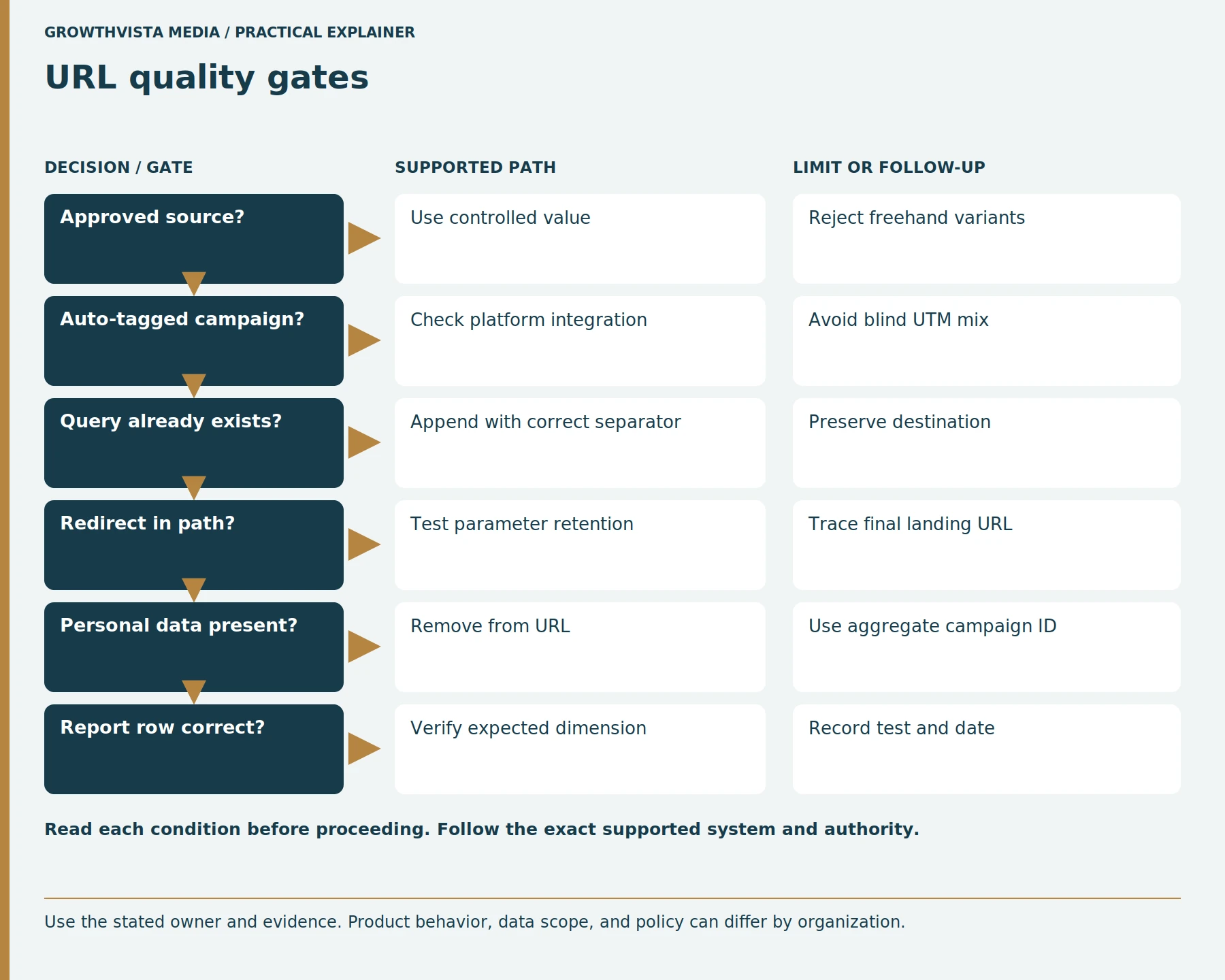
Auto-tagging should be used when a supported advertising-platform integration provides the campaign information required for measurement and is configured correctly. For Google Ads and Google Analytics, Google recommends auto-tagging for Google Ads final URLs. Teams should verify how auto-tagging and manually added parameters interact before combining the two approaches.
Use the platform’s supported integration and auto-tagging where it provides the needed detail and is configured correctly. Google recommends auto-tagging for Google Ads final URLs and describes additional analytics information it can provide. Google Ads: Tag final URLs Do not assume manual tags are a full substitute for an integration.
Before launch, decide how reports should handle links that carry both click identifiers and UTMs. Google documents that mixed tagging can affect attribution under some circumstances. Google Analytics: Scope of traffic-source dimensions Test the exact campaign type and landing path, then retain the convention and exception in the campaign register.
How can a tagged URL be checked before launch?
Auto-tagging should be used when a supported advertising-platform integration provides the campaign information required for measurement and is configured correctly. For Google Ads and Google Analytics, Google recommends auto-tagging for Google Ads final URLs. Teams should verify how auto-tagging and manually added parameters interact before combining the two approaches.
Use a URL builder or internal form that enforces approved values. Test both the final landing page and the resulting report entry. A URL can load correctly while the campaign source is missing or overwritten during redirect. Keep the test timestamp, campaign ID, and expected result for later reconciliation.
How do campaign identifiers and names work together?
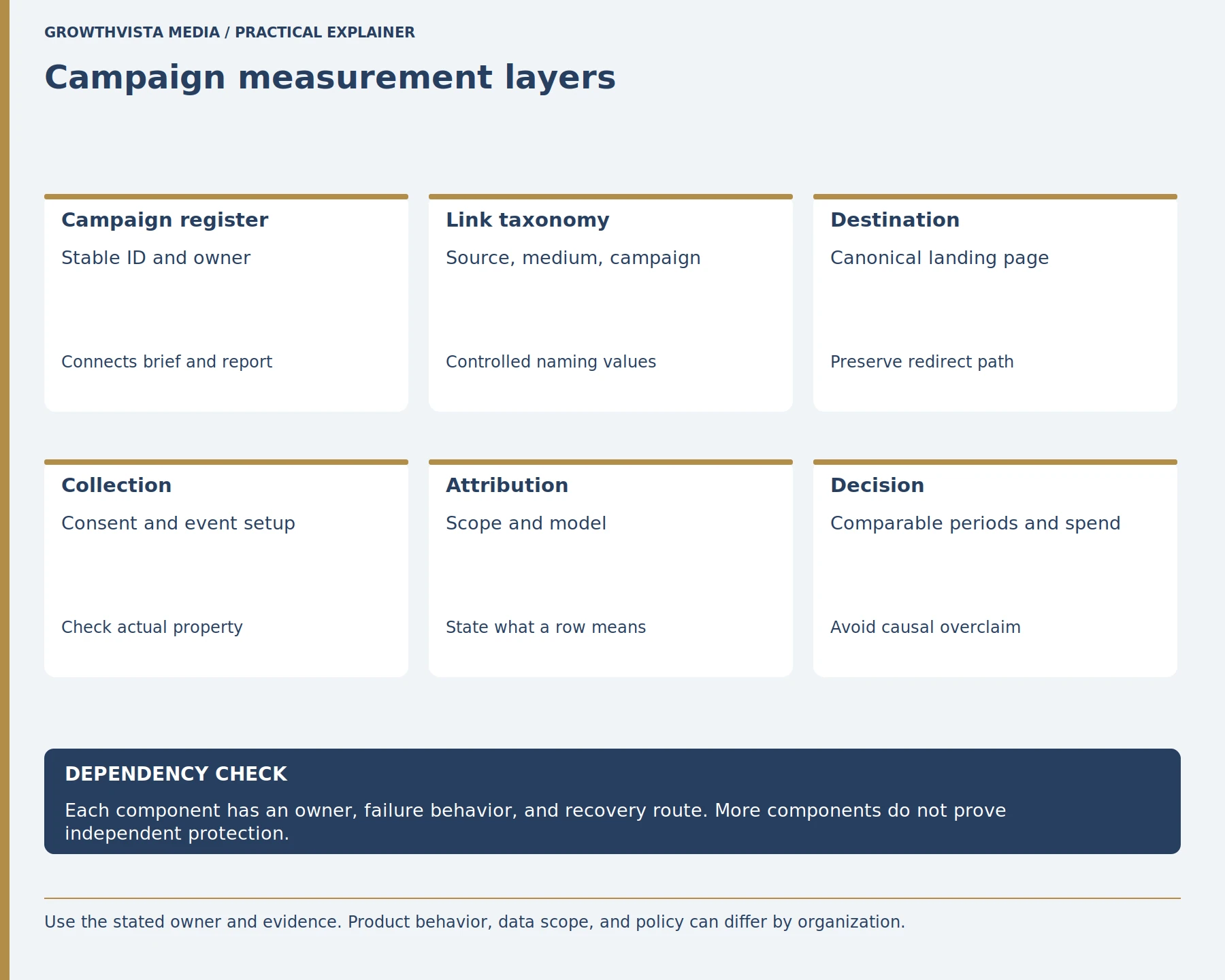
Campaign IDs and campaign names serve different purposes in marketing attribution. A stable campaign ID can connect links, briefs, creative assets, spend records, and reports even when a campaign is renamed. Human-readable campaign names help marketers understand the campaign’s purpose. Keeping both connected improves traceability across marketing and analytics systems.
Do not put confidential customer segments or personal information into a public query string. Use aggregate labels that the team can interpret. Keep the original values in the campaign source system and apply a controlled mapping for reporting.
Which attribution limits should be stated in a report?
Marketing attribution reports should state the attribution model, conversion definition, reporting period, relevant lookback or session scope, channel coverage, time zone, and known consent or data limitations. Comparisons between analytics and advertising platforms can be misleading when their attribution rules, conversion definitions, identity methods, or reporting windows differ.
Google explains how traffic-source dimensions are scoped and how manual tagging interacts with auto-tagging. Google Analytics: Scope of traffic-source dimensions Use those distinctions to explain what a row means. Avoid turning a last-click or platform-reported number into a universal causal claim.
How should a team investigate “direct” or missing campaign traffic?
To investigate direct or missing campaign traffic, trace the full measurement path from the original link through redirects, landing-page parameters, consent state, session handling, and event collection. Check for stripped, misspelled, or overwritten parameters and confirm that the report uses the intended property and traffic-source dimension before changing attribution labels.
Do not “fix” an unattributed visit by inventing a source. Correct the underlying link or measurement setup and label historical data that cannot be recovered. Keep a test case for each common redirect or in-app browser path.
How can channel comparisons support a decision?
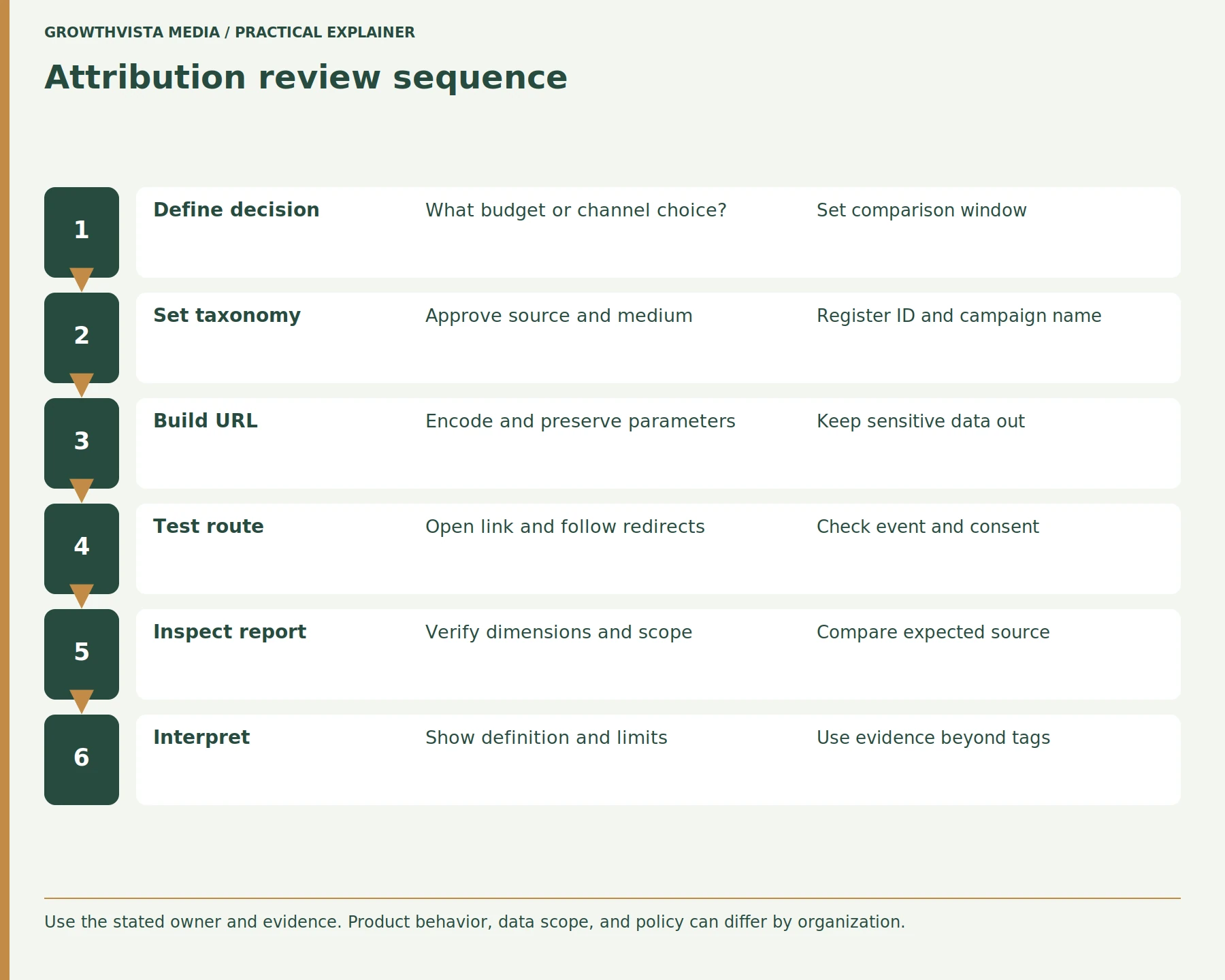
Marketing channels should be compared only after campaign values, conversion definitions, reporting periods, spend scope, and relevant audience conditions are made reasonably comparable. Review both volume and rate metrics where appropriate and keep denominators visible. Attribution can support budget decisions, but campaign tags alone should not be interpreted as proof of incremental causal impact.
Use attribution as one input with incrementality experiments, customer research, or other evidence where the decision warrants it. Record uncertainty and avoid claiming exact causal lift from a naming parameter. Review the taxonomy when the channel mix changes.
Worked naming example: a newsletter promoting a product guide could use a stable internal campaign ID, `utm_source=newsletter`, `utm_medium=email`, and a registered `utm_campaign=product_guide_q4`. Two creative placements can use `utm_content=header` and `utm_content=footer` if the team will compare those placements. The exact values are conventions, not universal standards. Keep the destination URL free of subscriber identity, preserve existing query parameters, and verify the resulting report row with an internal test. If the campaign uses an ad platform integration, document whether auto-tagging or manual tags govern the report.
What Should You Check Before Launching a UTM-Tagged Campaign?
Before launching a UTM-tagged campaign, verify that campaign parameters follow the approved naming convention, the destination URL works correctly, redirects preserve required values, and analytics records the expected dimensions. Testing the complete path before launch can prevent fragmented campaign reporting and make later attribution analysis easier to interpret.
UTM Tracking Checklist
-
Confirm the canonical destination URL.
- Use an approved
utm_sourcevalue. - Use an approved
utm_mediumvalue. - Match
utm_campaignto the campaign register. - Add
utm_contentonly when it has a defined purpose. - Encode URL values correctly.
- Preserve existing query parameters.
- Keep personal and confidential information out of URLs.
- Check whether auto-tagging applies.
- Test redirects and the final landing page.
- Verify the expected analytics report entry.
- Record the test date and campaign ID.
Frequently Asked Questions
Do UTMs Prove That a Campaign Caused a Conversion?
No. UTM parameters provide campaign and traffic-source information that analytics systems can use under defined collection and attribution rules. They can help identify which tagged campaign received attribution credit, but they do not independently prove that the campaign caused the conversion. Causal claims generally require additional evidence.
Which UTM Parameters Are Commonly Used?
Common UTM parameters include utm_source, utm_medium, and utm_campaign. These identify where traffic came from, the marketing medium, and the associated campaign. Optional parameters such as utm_content and utm_term can provide additional distinctions when they have a clearly defined purpose within the organization’s measurement system.
Should Every Google Ads URL Use Manual UTMs?
Not necessarily. Google recommends auto-tagging for Google Ads final URLs because it can provide additional information to Google Analytics. Teams should review their Google Ads and Analytics integration before adding manual parameters and verify how mixed manual and automatic tagging affects the specific reports they use.
Why Keep UTM Campaign Names Lowercase?
Using lowercase values consistently can reduce accidental naming variations such as Newsletter, newsletter, and NEWSLETTER. A controlled naming convention makes campaign data easier to group and maintain. However, teams should verify how their analytics platform processes parameter values rather than assuming capitalization behaves identically in every reporting system.
Can UTM Query Strings Contain Customer Names or Email Addresses?
Personal or confidential information should not be placed in public campaign URLs. Query parameters can be stored, shared, logged, or exposed through different systems. Use non-identifying campaign labels and stable campaign identifiers instead, while following the organization’s privacy requirements and the relevant analytics platform’s current policies.
What Should Be Tested Before a Campaign Launch?
Before launch, test the final destination, existing query parameters, UTM values, redirects, consent behavior, analytics collection, and resulting traffic-source dimensions. Confirm that the campaign appears under the expected source, medium, and campaign values. Record the test result so unexpected attribution can be investigated after launch.
Conclusion: Build Consistent Marketing Attribution Before Launch
Reliable marketing attribution starts with consistent campaign naming, correctly constructed URLs, documented tagging rules, and pre-launch testing. UTMs can make campaign traffic easier to interpret, but the resulting reports still depend on analytics configuration, attribution rules, consent, and platform-specific behavior.
Next step: Review your current UTM naming convention and create one shared campaign register for source, medium, campaign name, campaign ID, destination URL, owner, and test result.
Sources and further reading
Official documentation supports the technical guidance. Examples and worksheets are editorial methods, not hands-on product benchmarks. Reviewed October 2026.
- Google Analytics: Manual tagging and auto-tagging
- Google Analytics: URL builders and UTM parameters
- Google Ads: Tag final URLs
- Google Analytics: Scope of traffic-source dimensions