Best Car Battery Chargers & Maintainers in 2026
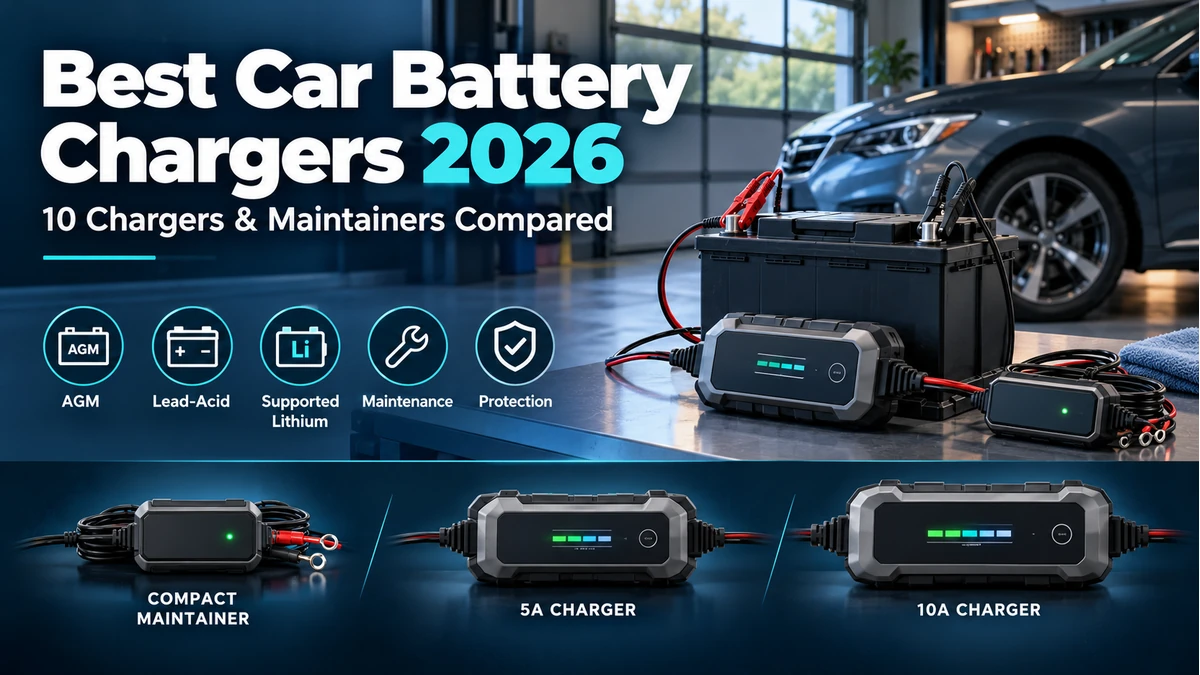
A car battery charger can restore a discharged battery over time, while a maintainer is designed to keep a healthy battery at an appropriate state of charge during storage. Modern smart chargers often perform both jobs automatically.
The best car battery chargers are selected by battery chemistry and capacity first, then by charging current, maintenance features and how the vehicle is used. A low-current maintainer can be ideal for a classic car stored for months, while a higher-output smart charger is more practical when a larger automotive battery actually needs recharging.
AGM, flooded lead-acid, EFB and lithium iron phosphate batteries do not all use the same charging profile. Some chargers support several chemistries, while others—such as the CTEK MXS 5.0—are specifically lead-acid products.
This guide compares 10 chargers and maintainers worth considering in 2026 and explains charging current, smart maintenance, battery chemistry, reconditioning modes and safe connection.
What is the best car battery charger?
The best car battery charger depends on your battery chemistry, capacity and how quickly you need to recharge it. NOCO GENIUS10 is a versatile higher-output option, NOCO GENIUS5 is a practical choice for many everyday owners, and CTEK MXS 5.0 is well suited to lead-acid battery care. For vehicles stored for long periods, a lower-current maintainer such as Battery Tender Plus or NOCO GENIUS1 may be more appropriate. Before buying, check the battery chemistry, voltage, capacity and charger compatibility.
Quick Comparison: Best Car Battery Chargers
| Charger / Maintainer | Best For | Output Class | Battery Support* | Key Advantage | CTA |
|---|---|---|---|---|---|
| NOCO GENIUS10 | Overall / faster charging | 10A | 6V/12V lead-acid + supported lithium | Versatile high-output smart charger | Check Price → |
| NOCO GENIUS5 | Most everyday owners | 5A | 6V/12V lead-acid + supported lithium | Strong balance of size and speed | Check Price → |
| CTEK MXS 5.0 | Premium lead-acid care | 4.3–5A regional | 12V lead-acid | 8-step charging + Recond | Check Price → |
| Battery Tender Plus | Long-term vehicle storage | Low-current maintainer | 12V lead-acid | Simple set-and-maintain use | Check Price → |
| Schumacher SC1281 | Garage / higher-output needs | Multi-rate | Lead-acid types; verify version | Charging + boost functions | Check Price → |
| NOCO GENIUS1 | Small batteries / maintenance | 1A | 6V/12V lead-acid + supported lithium | Compact storage maintainer | Check Price → |
| Battery Tender 4A | Faster maintaining / charging | 4A | Verify exact chemistry/version | Compact automatic charger | Check Price → |
| CTEK CS ONE | Easy premium smart charging | Higher-output smart | 12V lead-acid + LiFePO4 support | Adaptive polarity-free concept | Check Price → |
| Schumacher SC1355 | Budget automatic charger | Low/mid current | 12V lead-acid; verify listing | Accessible automatic charging | Check Price → |
| NOCO GENIUS2D | Permanent onboard installation | 2A | 12V lead-acid | Direct-mount vehicle maintainer | Check Price → |
*Battery chemistry and regional product versions must be verified before purchase. Never select a charging mode based only on battery size or vehicle type.
1. NOCO GENIUS10 — Best Overall Car Battery Charger
NOCO’s GENIUS10 is a 10-amp smart charger that supports 6V and 12V batteries and multiple lead-acid types plus supported lithium batteries. NOCO rates it for batteries up to 230 Ah for charging and all battery sizes for maintenance.
The higher current makes it more useful than a small maintainer when a normal automotive battery is genuinely discharged, while automatic maintenance allows it to remain useful after charging is complete.
It is more charger than many motorcycles or small seasonal batteries require, so buyers focused mainly on storage maintenance can save space and money with a lower-current model.
Best for: Households wanting one versatile charger for cars, SUVs and multiple battery types.
2. NOCO GENIUS5 — Best for Most Everyday Owners
The GENIUS5 occupies a useful middle ground: substantially faster than a 1-amp maintainer while remaining compact enough for a home garage.
It supports common 6V/12V lead-acid batteries and compatible lithium charging modes, making it useful across cars, motorcycles and seasonal equipment when the chemistry matches.
For many households, 5 amps is enough for routine charging without paying for the larger GENIUS10.
Best for: Owners wanting a compact all-purpose smart charger and maintainer.
3. CTEK MXS 5.0 — Best Premium Lead-Acid Battery Care
The CTEK MXS 5.0 is a lead-acid-focused 12V charger with an eight-step charging program, automatic temperature compensation, AGM support and a dedicated Recond mode.
CTEK’s North American specification lists 4.3A output, charging for batteries up to 110 Ah and maintenance up to 160 Ah. Other regional versions are rated at 5A, so the exact market version should be checked.
It does not support lithium chemistry. That is an important distinction for vehicles or powersports equipment using LiFePO4 batteries.
Best for: Drivers wanting premium automatic care for 12V lead-acid, AGM and EFB batteries.
4. Battery Tender Plus — Best for Long-Term Vehicle Storage
The Battery Tender Plus is a classic low-current charger/maintainer designed for vehicles that spend long periods parked.
Its slower output is not intended to compete with a 10-amp charger for quickly recovering a large flat battery. The strength is maintaining a compatible battery without leaving it on an old-style uncontrolled trickle charge.
It is a natural fit for classic cars, motorcycles and seasonal vehicles when the exact model matches the battery chemistry.
Best for: Stored vehicles that need long-term battery maintenance.
5. Schumacher SC1281 — Best for Garage Charging and Boost Functions
The Schumacher SC1281 is a larger garage-style unit aimed at users who want more than a compact maintainer, combining automatic charging with higher-output boost and engine-start functions.
That makes it useful when a household regularly deals with multiple conventional vehicle batteries or wants a shop-oriented charger rather than a small storage maintainer.
Engine-start and boost features are not substitutes for correct battery diagnosis, and the exact supported battery types and operating modes should be verified before use.
Best for: Home garages needing higher-output charging and additional boost functions.
6. NOCO GENIUS1 — Best Compact Battery Maintainer
The GENIUS1 is a small 1-amp smart charger and maintainer intended for batteries that do not need rapid recovery.
It is especially useful for motorcycles, lawn equipment, collector cars and other batteries that mainly need maintenance during storage.
A 1-amp unit will take much longer to recharge a large automotive battery from a deep discharge, so it should be chosen for the maintenance job rather than the lowest price alone.
Best for: Small batteries and long-term maintenance where speed is not important.
7. Battery Tender 4A — Best Compact Step-Up from a Maintainer
A 4-amp Battery Tender model offers a useful step between very low-current storage maintainers and larger 10-amp chargers.
It can be more practical when a battery occasionally needs meaningful charging but the user still wants an automatic maintenance mode afterward.
Battery Tender sells several products with different chemistry support, so verify the exact 4A model rather than assuming every version supports lithium.
Best for: Drivers wanting a compact automatic charger with more output than a traditional maintainer.
8. CTEK CS ONE — Best for Easy Premium Multi-Chemistry Charging
The CTEK CS ONE is a newer premium smart charger designed to simplify connection and automatically adapt charging for supported 12V lead-acid and LiFePO4 batteries.
Its appeal is ease of use rather than a long menu of manual modes, making it attractive to households with more than one supported battery type.
Premium convenience comes at a higher price, so buyers who only maintain one conventional lead-acid car may not need the extra capability.
Best for: Users wanting a modern, simple premium charger for supported lead-acid and lithium batteries.
9. Schumacher SC1355 — Best Budget Automatic Charger
The Schumacher SC1355 represents the straightforward automatic-charger category for drivers who want basic charging and maintenance without a premium connected ecosystem.
It can make sense as a garage backup for conventional 12V automotive batteries when its supported chemistry and capacity match the vehicle.
Because Schumacher’s model range contains many similar chargers, verify the exact current rating, modes and battery support on the current listing.
Best for: Budget-focused owners needing a basic automatic home charger.
10. NOCO GENIUS2D — Best Direct-Mount Maintainer
The GENIUS2D is designed to be mounted in the vehicle and connected directly to a 12V lead-acid battery, turning maintenance into a simple plug-in routine.
This is useful for vehicles that spend long periods parked in a garage, because the charger can remain installed instead of reconnecting clamps every time.
It is a 2-amp maintenance-oriented solution rather than a fast recovery charger.
Best for: Frequently stored cars, trucks or equipment where a permanent onboard maintainer is convenient.
Which car battery charger should you choose?
Choose NOCO GENIUS10 if you want a versatile higher-output charger for larger automotive batteries. Choose NOCO GENIUS5 if you want a balanced everyday charger that is smaller and less powerful. Choose CTEK MXS 5.0 if you primarily use compatible lead-acid, AGM or EFB batteries and want advanced charging and maintenance features. For long-term vehicle storage, consider a lower-current maintainer such as Battery Tender Plus or NOCO GENIUS1. If you use a LiFePO4 battery, choose a charger that explicitly supports lithium charging rather than assuming a 12V lead-acid charger is compatible.
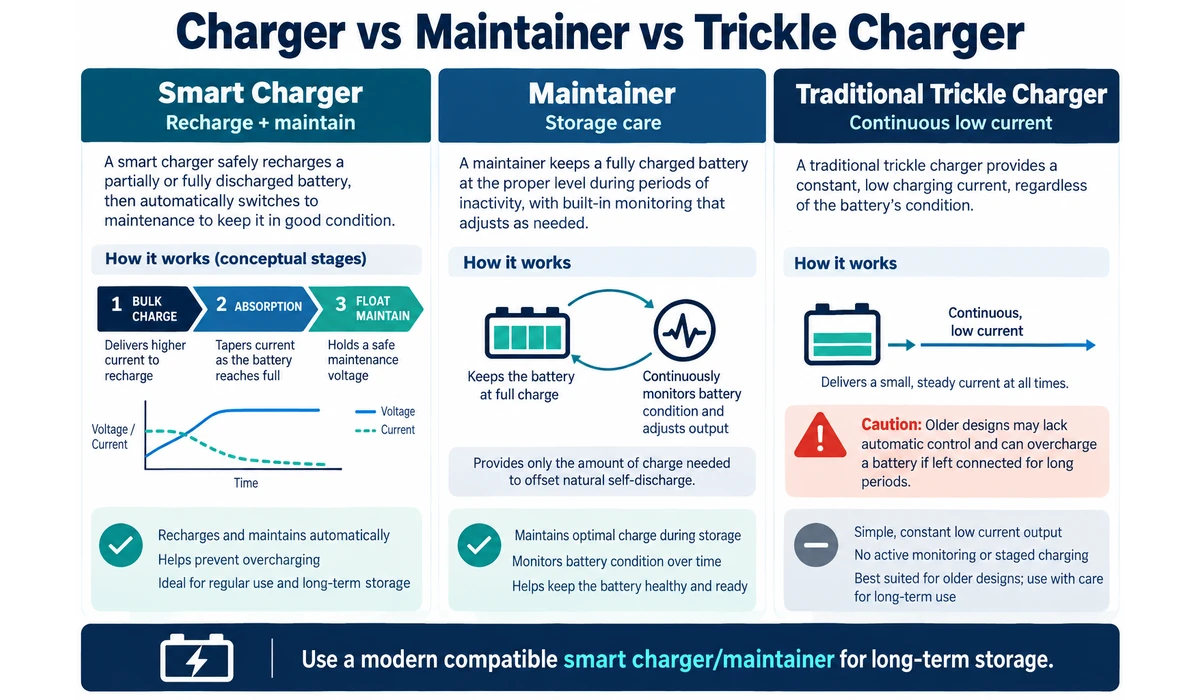
Battery Charger vs Maintainer vs Trickle Charger
| Type | Primary Job | How It Behaves | Best Use |
|---|---|---|---|
| Smart charger | Recharge + maintain | Adjusts charging stages automatically | Discharged or routinely serviced batteries |
| Maintainer | Preserve charge during storage | Monitors battery and supplies charge as needed | Seasonal / infrequently driven vehicles |
| Traditional trickle charger | Continuous low current | May lack modern automatic control | Only when specifically appropriate and monitored |
Modern smart maintainers are generally preferable to leaving an old uncontrolled trickle charger connected indefinitely.
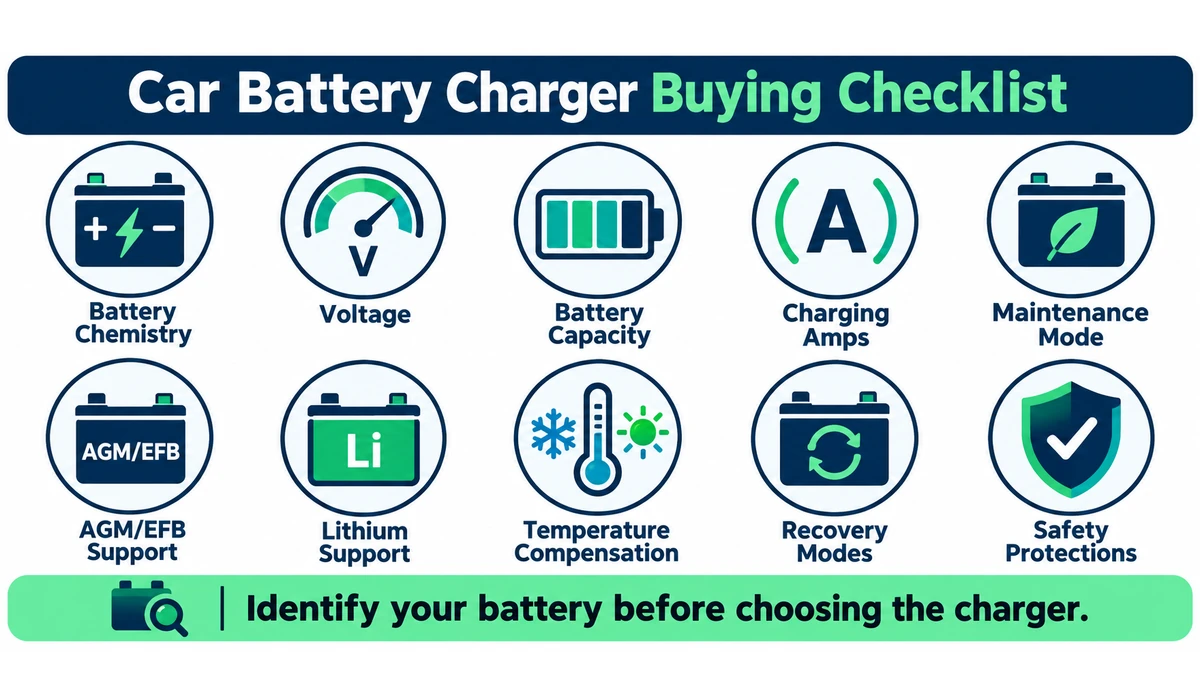
What to Look for When Buying a Car Battery Charger
1. Battery Chemistry
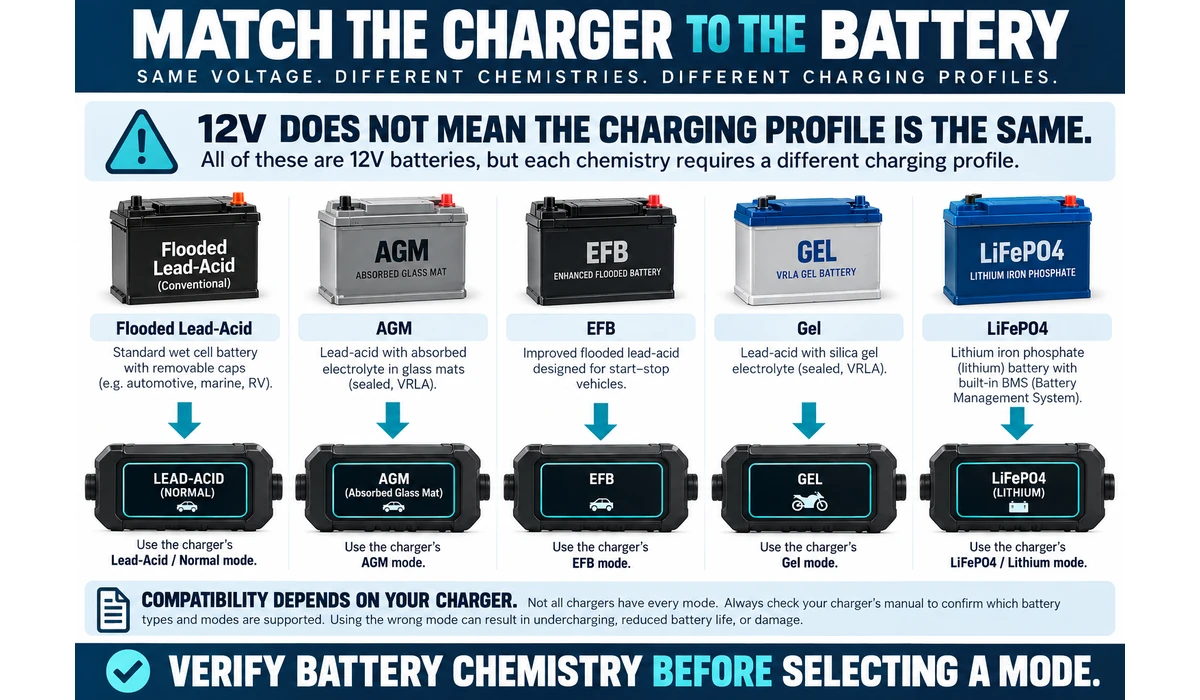
Identify whether the battery is flooded lead-acid, AGM, EFB, gel or LiFePO4. Use only a charger and mode explicitly compatible with that chemistry.
2. Battery Voltage
Most passenger vehicles use 12V starting batteries, but 6V batteries still exist in older vehicles and equipment. Some modern vehicles also use more complex electrical architectures.
3. Charging Current
Higher amperage can reduce recharge time on larger batteries, but the charger must remain appropriate for the battery capacity and chemistry.
4. Battery Capacity
Manufacturers often publish an Ah charging range. Match the charger to the battery rather than assuming any 12V charger suits every 12V battery.
5. Maintenance Mode
For storage, choose an automatic charger that transitions to a safe maintenance strategy instead of continuously forcing full charging current.
6. AGM / EFB Modes
Start-stop vehicles often use AGM or EFB batteries. Use a charger that explicitly supports the installed battery type.
7. Lithium Support
LiFePO4 batteries require a compatible lithium charging profile. Never assume a lead-acid charger supports lithium because the voltage is also 12V.
8. Temperature Compensation
Temperature affects charging behavior. Some premium chargers adjust charging voltage based on ambient conditions.
9. Recovery / Reconditioning Modes
Some chargers offer modes intended for deeply discharged or stratified lead-acid batteries. These cannot repair physical battery damage or restore every failed battery.
10. Safety Protections
Reverse-polarity, short-circuit, overheat and spark protection are valuable, but correct connection and battery inspection are still essential.
Lead-Acid vs AGM vs Lithium: Why Charger Compatibility Matters
| Battery Type | Typical Context | Charging Consideration |
|---|---|---|
| Flooded lead-acid | Conventional starting batteries | Use compatible lead-acid profile; ventilation matters |
| AGM | Start-stop / premium / powersports applications | Use AGM-compatible charger/mode |
| EFB | Some start-stop vehicles | Confirm EFB support |
| Gel | Selected vehicles/equipment | Requires compatible voltage profile |
| LiFePO4 | Powersports / specialty / some vehicle applications | Use charger explicitly supporting LiFePO4 and battery BMS requirements |
How Much Charging Current Do You Need?
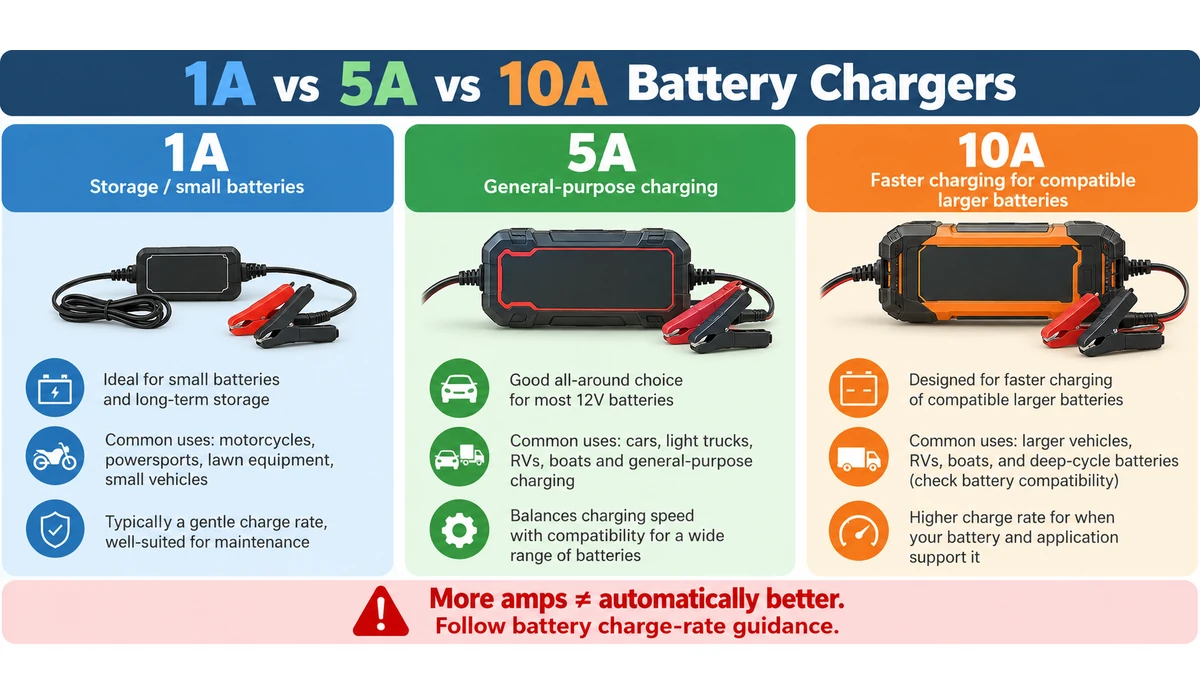
Charging current affects how quickly a compatible battery can be replenished. A 1-amp maintainer is excellent for storage but can take a long time to recover a large automotive battery. Five amps is a useful general-purpose level for many owners, while a 10-amp charger can be more convenient for larger batteries or more frequent charging.
More amperage is not automatically better. Follow the battery manufacturer’s recommended charge rate and the charger’s stated capacity range. Small powersports batteries may require lower current than a large automotive battery.
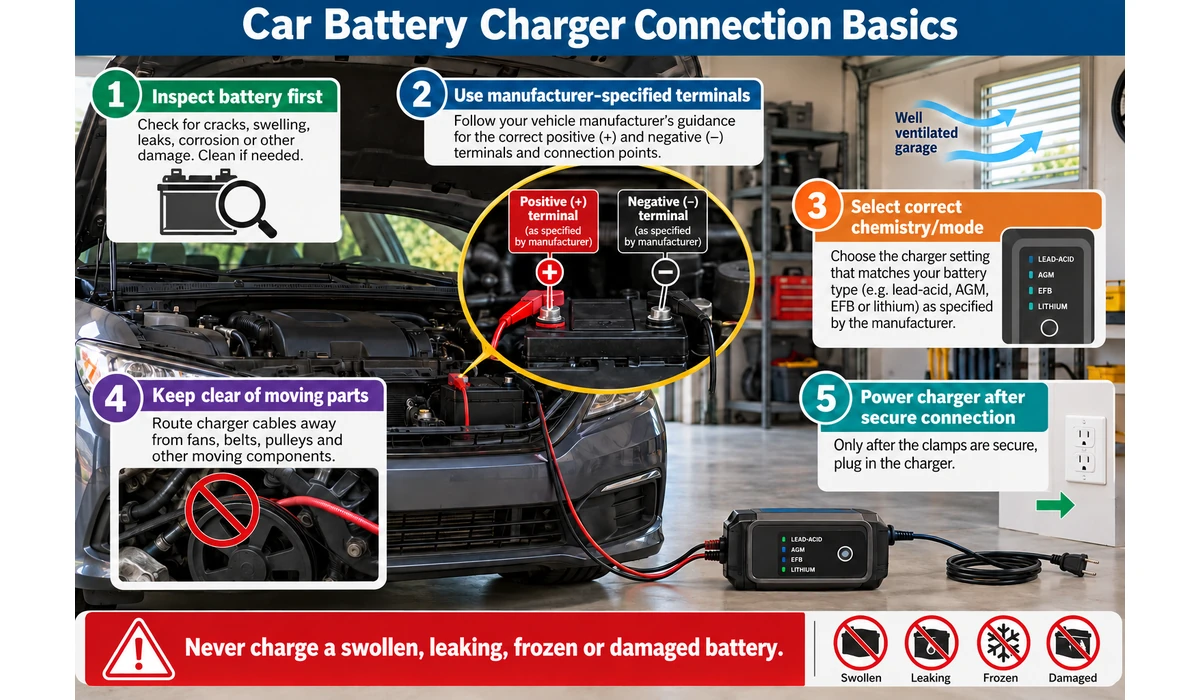
How to Connect a Car Battery Charger Safely
-
- Park in a well-ventilated area away from flames, sparks and smoking materials.
- Inspect the battery for swelling, cracking, leakage, freezing or other damage; do not charge an unsafe battery.
- Switch the charger off or leave it unplugged while making connections unless its instructions explicitly state otherwise.
- Follow the vehicle and charger manuals for clamp connection points; modern vehicles may specify dedicated charging terminals.
- Select the correct voltage and battery chemistry/mode before charging.
- Keep cables clear of fans, belts and moving parts.
- Plug in or start the charger only after connections are secure.
- When finished, follow the charger’s specified shutdown/disconnection order.
- If the vehicle has unusual high-voltage, hybrid or EV systems, use only the approved procedure for its low-voltage battery.
Can a Battery Charger Revive a Dead Battery?
Sometimes a smart charger can recover a deeply discharged but otherwise healthy battery. Some models have low-voltage detection or special recovery modes.
A charger cannot reverse physical plate damage, internal shorts, a cracked case, a failed cell or every form of sulfation. A battery that repeatedly goes flat may also indicate a parasitic drain, charging-system fault or end-of-life battery.
If the battery will not accept or retain a charge, test the battery and vehicle charging system rather than repeatedly forcing recovery cycles.
When a Maintainer Makes More Sense Than a Charger
-
- Classic or collector car stored for weeks or months.
- Motorcycle, ATV, lawn equipment or seasonal vehicle during the off-season.
- Second vehicle that is driven infrequently.
- Vehicle with small normal standby loads that gradually discharge the battery during storage.
- Garage-kept vehicle where a permanent eyelet or onboard connection can be used safely.
Frequently Asked Questions
Can I leave a smart battery maintainer connected all winter?
Many automatic maintainers are designed for long-term connection when used exactly as instructed with a compatible battery. Follow the manufacturer’s ventilation, connection and storage guidance.
Is a 10-amp charger better than a 5-amp charger?
It can charge a compatible large battery faster, but it is not automatically better for every battery. Capacity, chemistry and recommended charging current matter.
Can I charge an AGM battery with a normal charger?
Use a charger that explicitly supports AGM batteries or provides an appropriate AGM profile. Do not assume an older charger uses the correct voltage strategy.
Can I use a lead-acid charger on a lithium battery?
Only if the charger explicitly provides a charging mode compatible with that lithium chemistry and the battery manufacturer permits it. Otherwise, use a dedicated compatible charger.
Does a maintainer fix a weak battery?
No. It can keep a healthy compatible battery charged, but it cannot repair a failed cell or physical battery damage.
Should I disconnect the battery from the car before charging?
Requirements vary by vehicle and charger. Many modern smart chargers are designed for in-vehicle charging using specified connection points, but always follow the vehicle and charger manuals.
What is battery reconditioning mode?
On supported lead-acid chargers it is a specialized charging stage intended for certain deeply discharged or stratified batteries. It is not appropriate for every battery and cannot restore all failed batteries.
What is the best battery charger for long-term car storage?
A low-current smart maintainer is usually more appropriate for long-term storage than a high-output charger. Battery Tender Plus and NOCO GENIUS1 are examples of maintenance-focused options. Choose a model that is compatible with the battery chemistry and designed for long-term connection.
Is a 5-amp or 10-amp car battery charger better?
A 10-amp charger can recharge a compatible battery faster, while a 5-amp charger can be a practical middle ground for everyday use. Neither is automatically better because the correct charging current depends on the battery’s capacity, chemistry and manufacturer recommendations.
What is the best car battery charger for AGM batteries?
The best charger for an AGM battery is one that explicitly supports AGM charging or provides a compatible AGM mode. CTEK MXS 5.0 is one example discussed in this guide, while other chargers may support AGM as part of a broader lead-acid charging range. Always verify the exact charger and battery specifications before charging.
Final Thoughts
The best car battery chargers are chosen by battery chemistry, capacity and how quickly you need to recharge—not simply by the largest amperage number.
A 5-amp smart charger is a practical middle ground for many households, while 10 amps can be useful for larger batteries and faster recovery. Low-current maintainers remain excellent for stored vehicles.
The most important compatibility check is chemistry. AGM, EFB and lithium batteries need appropriate charging profiles, and products such as the CTEK MXS 5.0 are specifically lead-acid rather than universal chemistry chargers.
Before connecting any charger, identify the battery, read the vehicle charging instructions and inspect the battery for damage. A charger can maintain or recharge a healthy battery, but recurring discharge should trigger proper battery and charging-system diagnosis.