Project Dependencies: Build a Schedule That Can Move

Project dependencies are relationships between tasks, decisions, resources, or deliverables where one item affects when another can start or finish. Managing dependencies requires teams to identify the predecessor and successor, define completion evidence, assign owners, and track schedule impact. Clear dependency management helps teams identify blockers early and respond when dates, scope, or capacity change.
This guide focuses on decision quality rather than forecasting a universal critical path. Atlassian’s Jira documentation illustrates dependency links and timeline views; available features vary by plan and configuration. Use your project tool’s current instructions and validate dates with the people doing the work.
Key Takeaways
- Record meaningful dependencies: Track relationships that affect task sequence, timing, or coordination.
- Define completion evidence: Specify what must be delivered or approved before downstream work begins.
- Assign owners: Identify who delivers and who accepts each dependency.
- Track downstream impact: Record the needed-by date and which milestones could be affected.
- Review dependencies regularly: Reassess the chain whenever scope, capacity, ownership, or dates change.
What counts as a project dependency?
A project dependency exists when one task, decision, resource, or deliverable affects another task’s ability to start or finish. Common examples include legal approval before launch, an API before integration testing, or approved content before translation. A true dependency should be distinguished from a preference, informational relationship, or general coordination note.
Jira describes dependencies as links that show the order in which work items need to be done on a timeline. Atlassian: Manage dependencies on the timeline Use the project tool’s exact link types and limitations. A dependency should tell the team what is blocked, by what, and what proof would remove the block.

What Are the Main Types of Project Dependencies?
Project dependencies can be classified according to how the start or finish of one task affects another. Common scheduling relationships include finish-to-start, start-to-start, finish-to-finish, and start-to-finish. The terminology and implementation can vary by project-management method and software, so teams should verify how their chosen tool represents each relationship.
| Dependency type | Meaning | Simple example |
|---|---|---|
| Finish-to-start | Task B starts after Task A finishes | Approval → Launch |
| Start-to-start | Task B starts after Task A starts | Drafting → Review preparation |
| Finish-to-finish | Task B finishes after Task A finishes | Testing → Documentation |
| Start-to-finish | Task B cannot finish until Task A starts | Shift handover |
How should project dependencies be recorded?
Project dependencies should be recorded with the predecessor, successor, deliverable, responsible owners, needed-by date, current status, and a clear release condition. The release condition should describe observable evidence—such as an approved specification, completed test, or signed decision—rather than vague labels such as “ready” or “done.”
If the predecessor changes, notify the successor owner and update the linked schedule. A task that is “done” in one board but lacks its acceptance evidence may not release downstream work. Keep the relationship visible in both teams’ working views where the tool supports it.
| Predecessor | Release evidence | Successor and owner |
|---|---|---|
| Approve scope | Signed decision with version | Build configuration, delivery lead |
| Prepare integration | Test environment and contract | Integration test, QA owner |
| Review content | Approved copy and assets | Localization, publishing owner |
| Clear security review | Recorded findings and disposition | Release gate, security owner |
| Confirm vendor input | Accepted delivery and date | Launch task, project owner |
Which Project Dependencies Require the Most Attention?
Project dependencies deserve greater attention when they can delay a milestone, require a scarce resource, cross team boundaries, or create an irreversible commitment. Not every dependency needs the same level of monitoring. Teams should prioritize hard prerequisites and high-impact handoffs while documenting why each relationship matters to the schedule.
Do not label a path “critical” solely because it appears long on a timeline. Validate durations and dependencies with people doing the work, and consider parallel tasks and available capacity. A planning tool’s computed date is only as credible as its input assumptions.
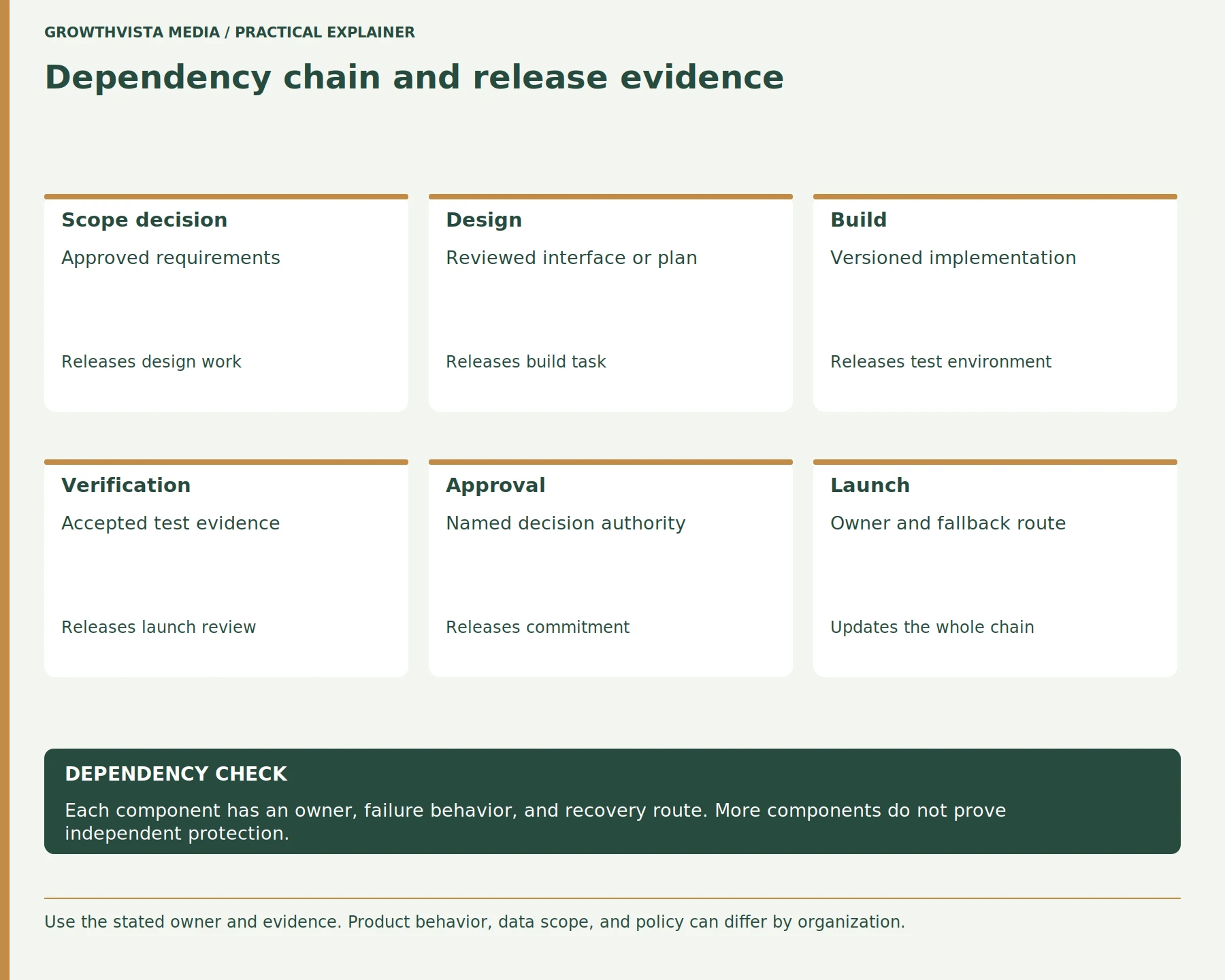
How can dependency evidence prevent false progress?
Dependency evidence prevents false progress by defining the observable condition that releases downstream work. Evidence may include an approved document, passed test, signed decision, available environment, or confirmed resource. The dependency should also identify who accepts the evidence and where it is recorded so teams do not rely solely on subjective status labels.
For example, a software handoff might require a published interface contract and a test environment. The receiving team can then check both before scheduling integration work. Record exceptions explicitly. Do not mark work complete because a meeting occurred if the required decision or artifact remains open.
What should happen when a dependency slips?
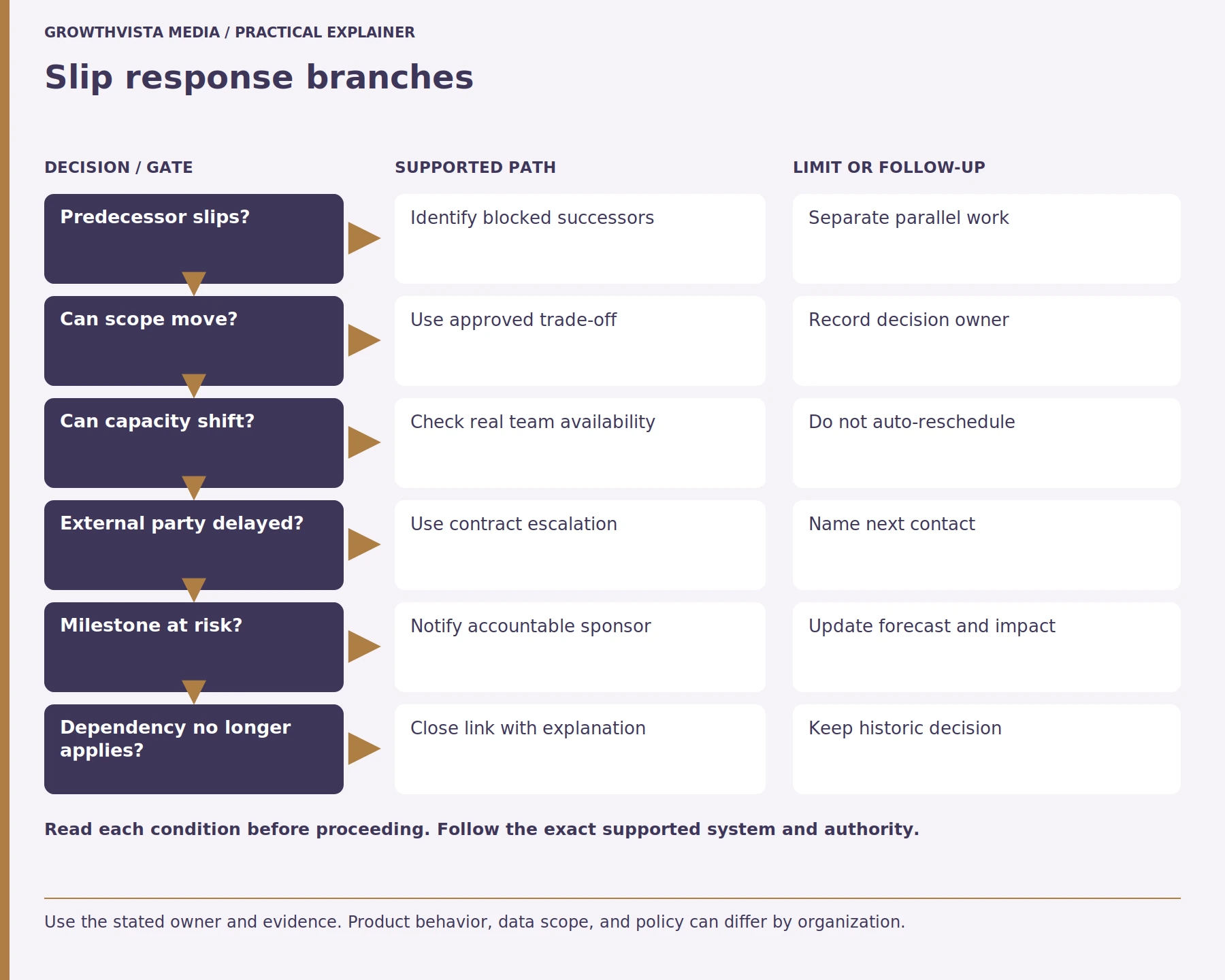
When a project dependency slips, identify which downstream tasks are actually blocked, which work can continue in parallel, and whether scope, capacity, or timing can change. Assign an owner to communicate the revised plan, preserve the original commitment for comparison, and document the new forecast and its effect on milestones.
Use a contingency only when it has an owner, cost or capacity implication, and approval. A generic “work around it” note hides risk. If the dependency affects a launch or customer commitment, escalate through the project’s agreed governance route. Update linked tasks and notify affected people rather than changing a single master date silently.
How do capacity and dependencies interact?
A completed dependency makes downstream work available to begin, but it does not guarantee that people, equipment, or other resources are available. Teams should check receiving-team capacity, specialist availability, competing projects, and external approvals before scheduling dependent work. A project plan should distinguish between work that is unblocked and work that is scheduled to start.
Avoid moving every downstream task forward automatically when a predecessor date changes. Confirm the team’s schedule, handoff readiness, and resource constraints. The plan should distinguish “unblocked” from “scheduled to start.” This difference helps a manager explain why work can be ready yet still not begin immediately.
How should cross-team dependencies be governed?
Cross-team dependencies should have clearly identified delivery and acceptance owners, an agreed decision channel, expected response times, and an escalation route. Teams should also define how scope changes will be approved. Clear ownership prevents handoffs from failing because each team assumes that another group is responsible for coordinating the dependency.
For vendors or partner teams, document dependencies outside the project tool as needed, including named contacts and notice requirements. Keep private information in approved systems. Review cross-team links at the project cadence and close stale dependencies when their reason no longer exists.
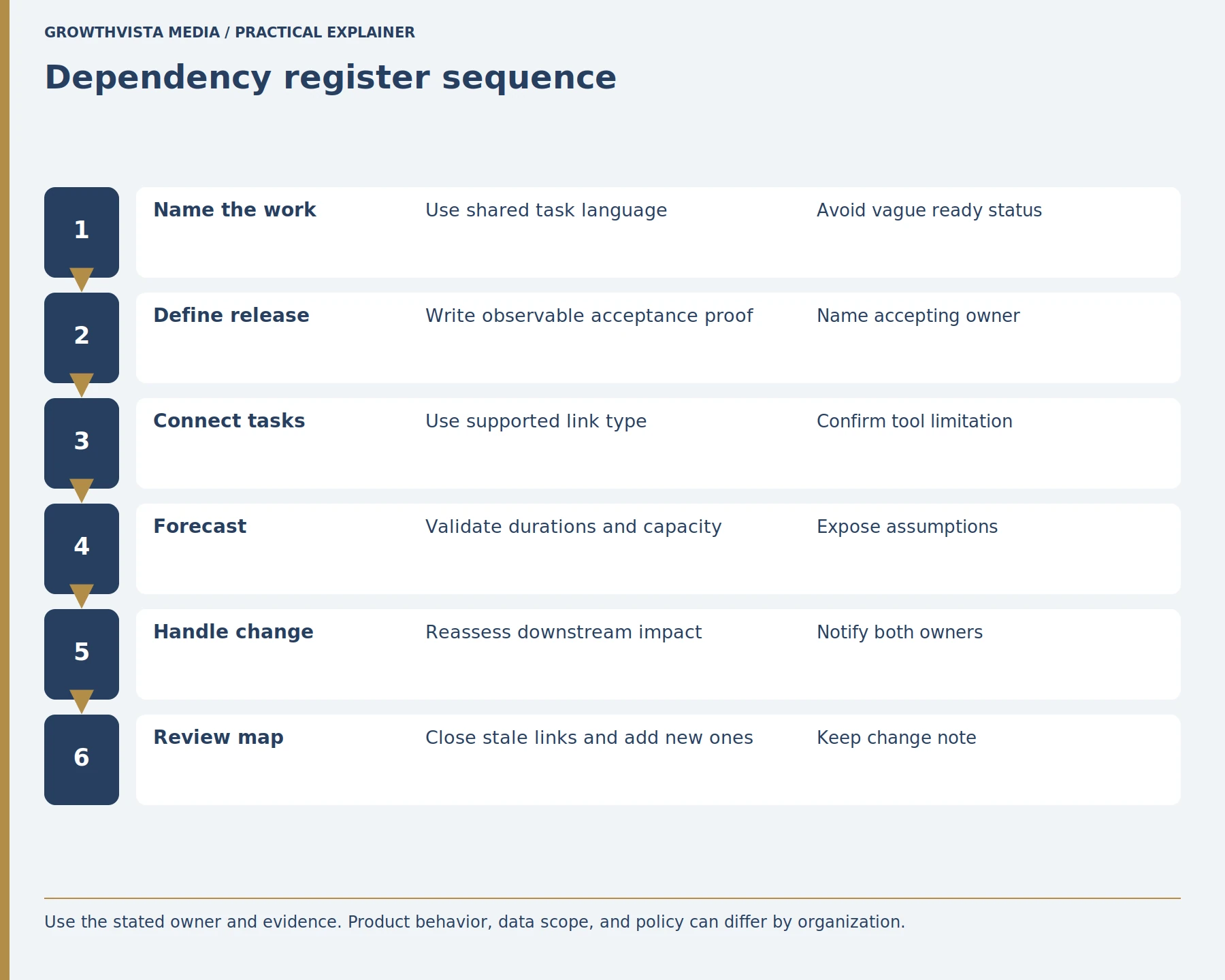
When should a dependency map be updated?
A project dependency map should be reviewed whenever scope, dates, architecture, ownership, approvals, or team capacity changes, as well as during regular planning reviews. Completed dependencies should be closed, newly discovered prerequisites added, and material changes documented so the map continues to reflect actual work rather than the original plan.
Use a short change note: what moved, why, which milestone is affected, and who accepted the response. A timeline is an operating model, not an archive of every conversation. Keep historical snapshots if the organization needs to analyze planning accuracy.
Worked planning example: suppose design approval is due on Tuesday, a vendor interface is due on Friday, and system testing is scheduled for the following week. Record the acceptance evidence for each handoff, then ask which test tasks can proceed with a mock interface and which truly require the vendor delivery. If the vendor date slips, the project owner can preserve independent test preparation while updating the dependent integration forecast. This is more useful than moving every task by the same number of days. It also makes the decision and its owner visible to the sponsor.
Project Dependency Management Checklist
- Identify the predecessor and successor.
- Explain why the dependency exists.
- Define observable release evidence.
- Assign delivery and acceptance owners.
- Record the needed-by date.
- Identify affected milestones.
- Check receiving-team capacity.
- Define escalation for delays.
- Update downstream tasks after changes.
- Close dependencies that no longer apply.
Frequently asked questions
Is Every Related Task a Project Dependency?
No. Tasks should generally be treated as dependencies when the timing, completion, decision, resource, or deliverable of one affects another. Tasks that merely share context or involve the same team may not require a formal dependency. Recording unnecessary links can make the project schedule harder to interpret and maintain.
What Is the Difference Between a Project Dependency and a Blocker?
A project dependency describes a relationship in which one task, decision, resource, or deliverable affects another. A blocker is a condition currently preventing work from progressing. A dependency can exist without causing an active blocker, while a delayed or unmet dependency may become a blocker for downstream work.
Does a dependency line prove that a task is ready?
No. Define the deliverable and acceptance evidence that releases the downstream work.
Can a tool compute a reliable critical path automatically?
Only when the modeled work, dates, dependencies, and capacity assumptions are accurate and fit the tool’s model.
What happens if a predecessor slips?
Reassess blocked work, parallel options, capacity, commitments, and the approved escalation path.
Should the successor start as soon as the predecessor is done?
Not necessarily. Confirm acceptance, resources, access, and schedule before assigning a start.
How often should dependency links be reviewed?
At the project’s agreed cadence and whenever scope, dates, ownership, or capacity changes.
Conclusion: Manage Dependencies Before They Become Delays
Effective project dependency management requires more than drawing links between tasks. Teams should define what releases downstream work, assign clear owners, validate capacity, track schedule impact, and respond quickly when assumptions change.
Next step: Review your current project schedule and identify the dependencies that could affect a milestone. For each one, document the predecessor, successor, release evidence, owner, needed-by date, and response if the dependency slips.
Sources and further reading
Official documentation supports the technical guidance. Examples and worksheets are editorial methods, not hands-on product benchmarks. Reviewed October 2026.
- Atlassian: Manage dependencies on the timeline
- Atlassian: Understand workflows and statuses
- Atlassian: What is the timeline view?