Project Handoffs: Essential Checklist for Seamless Transitions

A project handoff is the structured transfer of work, information, responsibilities, and deliverables from one person or team to another. Effective project handoffs identify the sending and receiving owners, document completed and unfinished work, define acceptance criteria, and confirm that the receiver can continue without missing context, access, or accountability.
Project handoffs succeed when the receiving person can continue the work without guessing what changed, what is complete, or who can answer questions. Define the sending owner, receiving owner, required artifacts, acceptance check, and route for gaps. “Sent” is an event; “ready to use” is a condition the receiving team should be able to verify.
This guide applies to internal teams and external partners. Adapt the checklist to the work and protect confidential information in approved systems. Tool-specific workflow features differ, so confirm the exact transition and notification behavior before relying on automation.
Key Takeaways
- Assign clear ownership: Identify one sending owner and one receiving owner for each handoff.
- Share complete context: Provide approved files, relevant decisions, current versions, and required access.
- Define acceptance criteria: Specify what the receiving team must verify before accepting the work.
- Transfer unfinished work: Document outstanding risks, dependencies, next actions, and deadlines.
- Confirm acceptance: Record whether the handoff was accepted, returned for corrections, or escalated.
Why do project handoffs fail?
Project handoffs often fail because important context, responsibilities, access permissions, or acceptance criteria are missing. A receiving team may obtain the deliverable without understanding previous decisions or outstanding commitments. These gaps create delays, repeated questions, rework, and unclear accountability, even when the project-management system marks the work as complete.
Write the intended next action and who owns it. Identify the source of truth and point to the specific version. Jira workflows are composed of statuses and transitions, which demonstrates why a visible state change should have a defined meaning. Atlassian: Work with workflows A custom workflow still needs process agreement and clear transition rules.

What should a handoff packet contain?
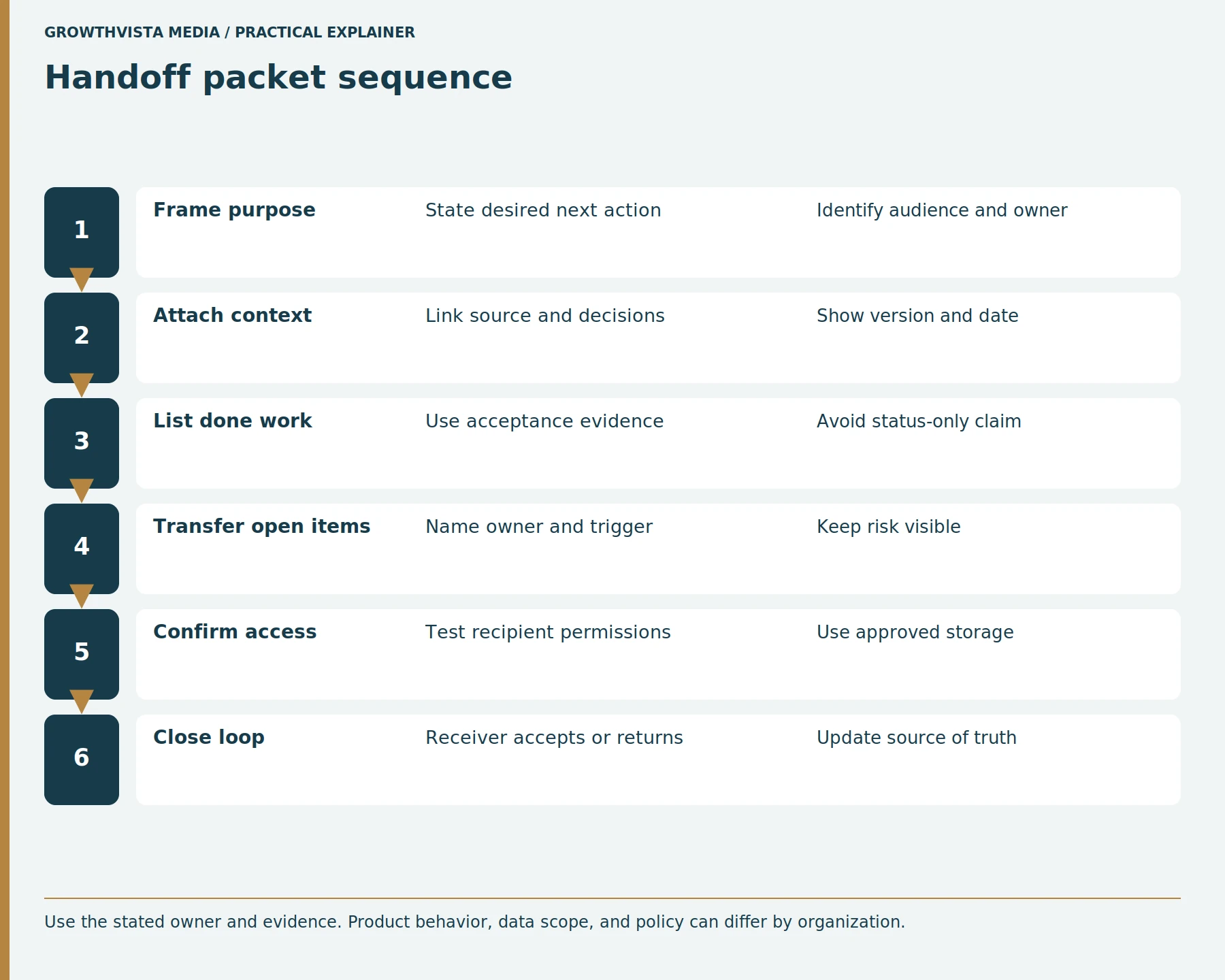
A project handoff packet should contain the project’s purpose, scope, current deliverables, approved versions, responsible owners, acceptance criteria, and next actions. It should also identify unfinished work, dependencies, risks, relevant decisions, and access instructions. The information should be sufficient for the receiving team to continue without repeatedly contacting the sender.
Tailor the packet to the work. A software release may need build and rollback information; a design handoff may need source files, dimensions, and approved copy; a customer-service transition may need contact history and next commitments. State the next owner and date so the packet produces action.
| Work item | Sender provides | Receiver verifies |
|---|---|---|
| Campaign launch | Approved copy, assets, owner | Links, timing, approvals |
| Software release | Build, change notes, rollback path | Version, access, checks |
| Customer onboarding | Goals, commitments, constraints | Next milestone and contact |
| Finance review | Source data and assumptions | Reconciliation and sign-off |
| Vendor delivery | Scope, received files, open risks | Completeness and rights |
How can ownership transfer without losing accountability?
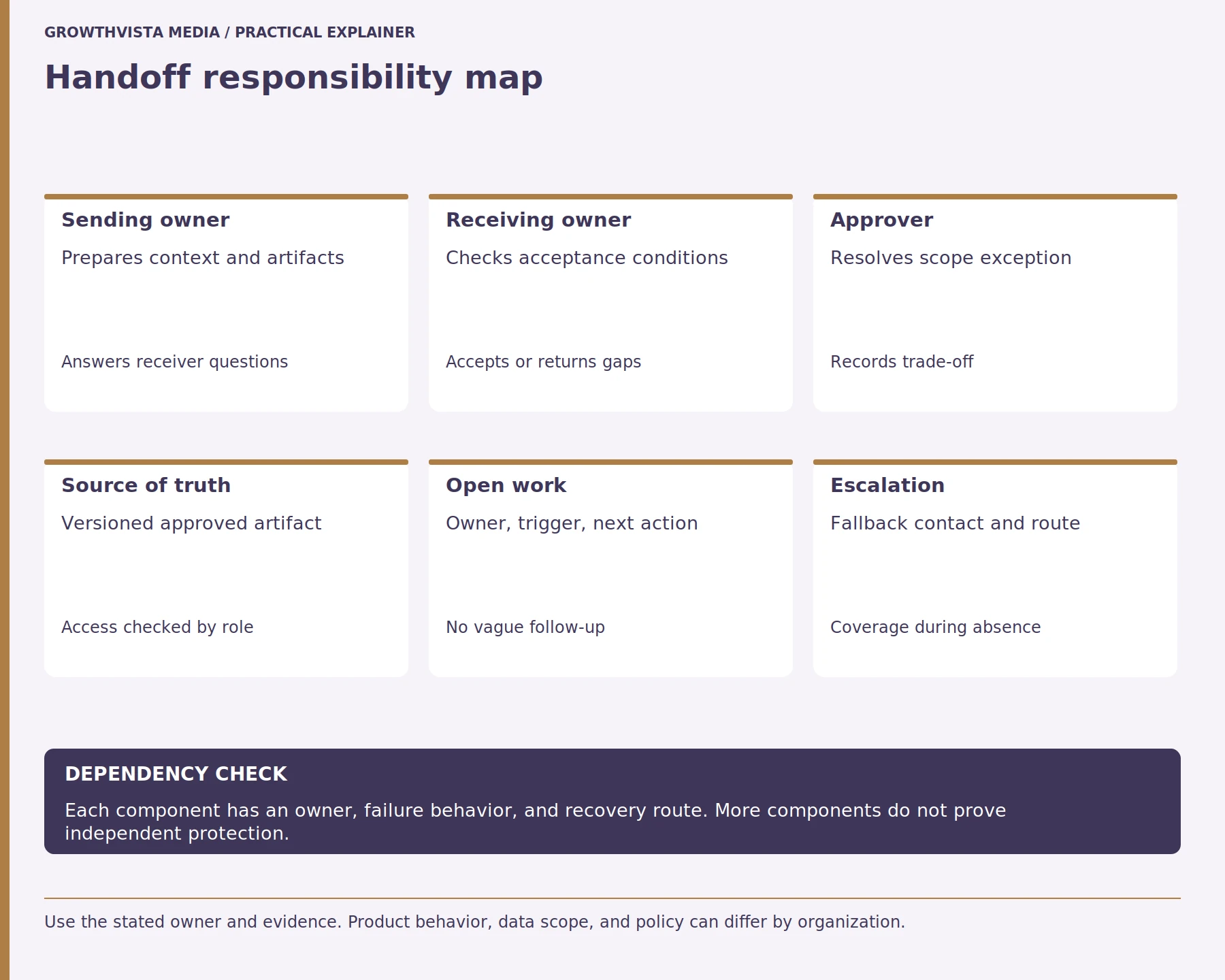
Project handoff accountability should remain clearly assigned throughout the transfer. A practical approach is for the sender to remain responsible for preparing and clarifying the work until the receiver confirms acceptance or an agreed escalation occurs. The receiving owner verifies the deliverables, identifies missing requirements, and takes responsibility for the next action.
Record one accountable owner for the next step, even when several contributors are involved. When ownership changes, update the source of truth and notify the people who depend on it. Avoid “everyone owns it” language, which makes it difficult to know who should take action.
Which acceptance criteria make a handoff testable?
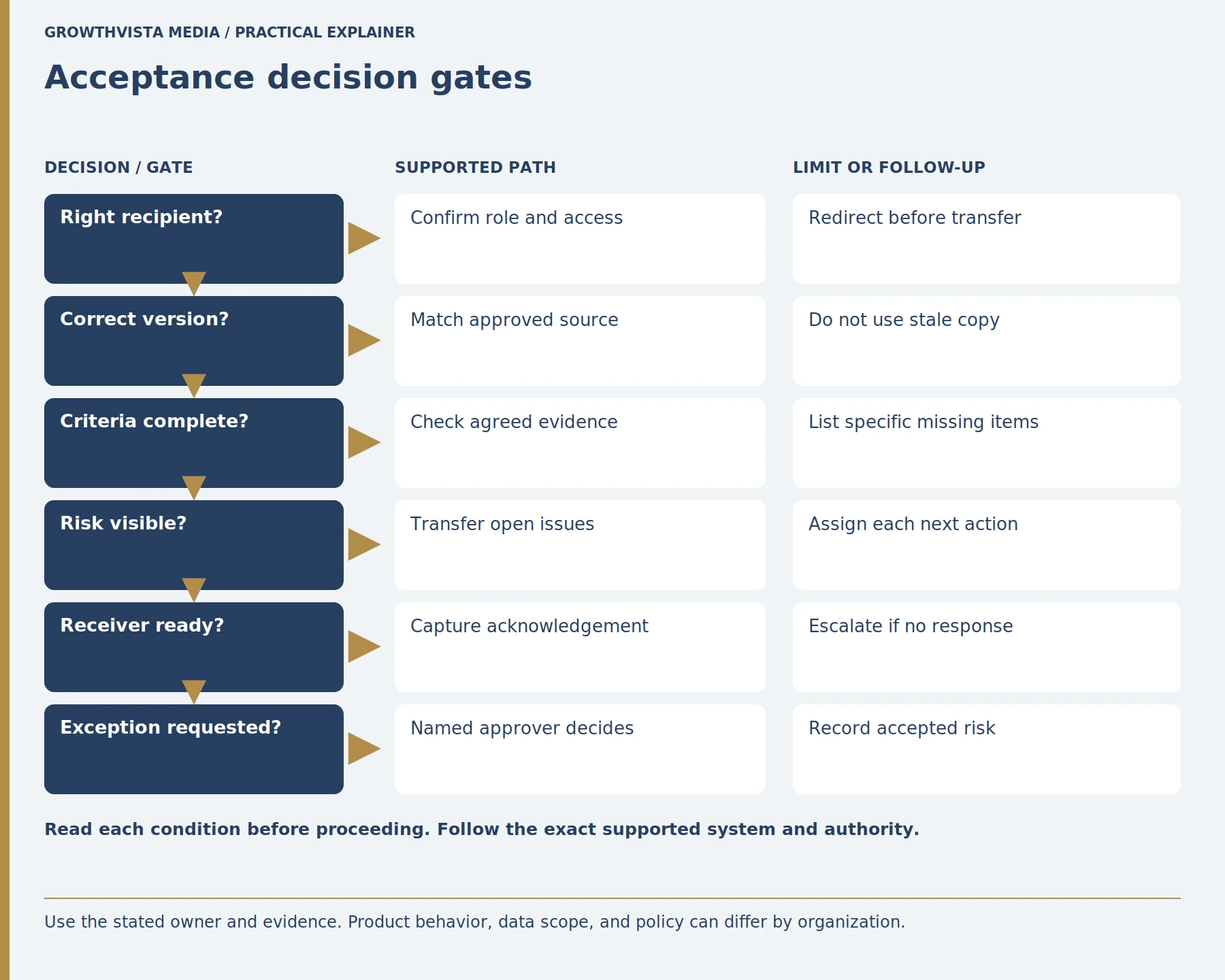
Project handoff acceptance criteria should describe observable conditions that prove the receiving team can use the deliverables. Examples include accessible files, approved versions, completed tests, documented decisions, and required information being present. Each criterion should have a clear verification method and an identified person authorized to accept the result or approve an exception.
An acceptance checklist should distinguish complete, incomplete, blocked, and not applicable. If a check fails, the receiver identifies the gap and owner. Do not silently accept a missing deliverable to meet a date unless the trade-off is approved and visible.
How should risks and unfinished work be transferred?
Unfinished work should be transferred through a documented list of open items that identifies each issue, its impact, responsible owner, next action, deadline or trigger, and escalation route. Distinguish confirmed defects from unresolved assumptions. The receiving team should know what remains incomplete, why it matters, and where supporting information can be found.
Avoid vague notes such as “follow up later.” Specify what event should cause follow-up. For example, “confirm access after vendor provisioning” names both a trigger and an action. Sensitive personal or customer details should remain in authorized systems, with only a permitted reference included in the handoff.
How should communication work across teams or time zones?
Cross-team project handoffs need a shared communication channel, documented context, expected acknowledgement time, and fallback contact for urgent issues. Written instructions should explain the next action without assuming the receiver attended earlier meetings. Teams must also confirm that recipients can access the relevant files, decisions, and project-management records.
Keep notification rules separate from work ownership. A message saying “handoff complete” does not assign a task unless the tool and team process do so. Confirm that the right group can access linked materials, especially for external collaborators or restricted projects.
Can workflow automation improve handoffs?
Workflow automation can improve project handoffs by assigning owners, checking required fields, notifying receiving teams, and creating review tasks when work changes status. However, automated notifications do not prove acceptance. Teams should first define a reliable manual process, then test automation rules, permissions, repeated triggers, and exception handling before relying on them.
Atlassian documents how Jira workflow statuses and transitions operate, but each configured project can differ. Atlassian: Workflow statuses and transitions Review permissions and rule order in the actual tool. Keep a manual exception path and monitor failed automations. A notification alone does not prove the receiver read or accepted the work.
How do you know whether handoffs are improving?
Project handoff performance can be measured using acceptance time, returned handoffs, missing deliverables, unresolved ownership, and repeated clarification requests. These indicators help identify where information or responsibility is being lost. Teams should define each metric consistently, review actual handoff examples, and adjust for differences in project complexity before comparing performance.
Review recurring gaps with the sending and receiving teams. Fix the source template, access policy, or responsibility boundary that causes the problem. Do not add checks that nobody uses. A useful measure leads to a specific process change and is reviewed with the people affected.
What Is a Complete Project Handoff Checklist?
A complete project handoff checklist verifies that responsibilities, deliverables, decisions, risks, and acceptance conditions are clear before ownership transfers. The sender prepares the information, while the receiver checks whether it is complete and usable. Any missing requirement should be corrected, explicitly accepted as an exception, or escalated before the handoff is closed.
Project Handoff Checklist
- Identify the sending and receiving owners.
- Define the purpose and expected next action.
- Link the latest approved deliverables.
- Document important decisions and changes.
- Confirm access permissions.
- Identify open risks and dependencies.
- Assign owners to unfinished tasks.
- Define measurable acceptance criteria.
- Confirm the receiver has reviewed the work.
- Record acceptance, rejection, or approved exceptions.
- Update the project-management system.
Frequently asked questions
What Is the Difference Between Sending and Accepting a Handoff?
Sending a project handoff means transferring deliverables, documentation, and relevant information to another person or team. Accepting a handoff means the receiver has checked the agreed requirements and confirmed readiness to continue. A sent handoff should not automatically be treated as accepted, especially when important files or decisions remain missing.
Who Owns a Handoff While It Is Being Reviewed?
Ownership should follow a documented transition rule. One practical approach keeps the sending owner accountable for completing the transfer until the receiving owner confirms acceptance. If the handoff is incomplete or disputed, a named manager or escalation owner should resolve the issue so responsibility does not remain unclear.
Should Every Project Handoff Use the Same Checklist?
Not every project handoff requires identical documentation. Teams can use a common checklist covering ownership, deliverables, acceptance, and unfinished work, then add requirements based on project complexity and risk. For example, a software release may require rollback instructions, while a marketing handoff may require approved creative assets and campaign dates.
Does an Automated Notification Prove a Handoff Was Received?
No. An automated notification confirms only that a configured system action occurred, not that the intended recipient read, understood, or accepted the work. When acknowledgement matters, the process should record an explicit response or acceptance decision. Automation should also account for unavailable users, missing permissions, and failed notifications.
What Should Be Included in a Project Handoff Open-Items List?
An open-items list should identify each unfinished task or unresolved issue, its business impact, responsible owner, required next action, deadline or trigger, and escalation route. It should also link to relevant evidence where appropriate. Clear descriptions help the receiving team understand what remains outstanding and avoid losing commitments during the transfer.
How Can Project Handoffs Across Teams Be Measured?
Cross-team handoffs can be evaluated using acceptance time, returned work, missing documentation, repeated clarification requests, and unresolved ownership. Define how each indicator is counted and review representative examples. Measurements should support process improvements rather than automatically assigning blame, because project complexity and workload can affect results.
What Is the Difference Between a Project Handoff and a Project Transition?
A project handoff focuses on transferring specific work, deliverables, context, or responsibility between people or teams. A project transition may involve a broader change in project phase, operating model, ownership, or delivery arrangement. A transition can include several handoffs, each requiring its own responsibilities, documentation, and acceptance conditions.
What is the difference between sending and accepting a handoff?
Sending transfers the packet or work item. Acceptance confirms the receiver checked the agreed conditions and can continue.
Who owns a handoff while it is being reviewed?
Define the transition rule. A common approach keeps the sender responsible until acceptance, with a named escalation owner.
Should every handoff use the same checklist?
Use a shared core and add work-specific requirements. Keep the checklist as short as the risk allows.
Does an automated notification prove receipt?
No. Track acknowledgement or acceptance explicitly if the process requires it.
What belongs in an open-items list?
Impact, owner, next action, date or trigger, evidence, and escalation route.
How can handoffs across teams be measured?
Use defined signals such as returns or missing items, inspect examples, and account for work complexity.
Conclusion: Make Every Project Handoff Clear and Accountable
Successful project handoffs depend on more than transferring files or changing task status. Clear ownership, complete documentation, measurable acceptance criteria, and visible unfinished work help teams continue without unnecessary confusion or delays.
Next step: Review your next project handoff using the checklist above. Confirm that the receiving owner has the correct deliverables, necessary access, and enough context to accept responsibility for the next action.
Sources and further reading
Official documentation supports the technical guidance. Examples and worksheets are editorial methods, not hands-on product benchmarks. Reviewed October 2026.
- Atlassian: Work with workflows
- Atlassian: Workflow statuses and transitions
- Atlassian: Timeline and dependent work