Best AI Writing Tools in 2026: 10 Platforms Compared
Editorial Disclosure: GrowthVista Media may receive compensation from qualifying SaaS referrals where an affiliate relationship is available. This does not change the comparison criteria used in this guide.
The best AI writing tools in 2026 can support research, long-form drafting, SEO content, marketing copy, editing and creative writing. This guide compares ten platforms by practical workflow so you can identify the type of writing assistant that fits your needs.
If you are exploring the broader software landscape, see our AI Tools guides. For primary product information, you can also review the official OpenAI website and Anthropic website.
How We Compared the Best AI Writing Tools
WordPress + SEO Setup
Featured Image
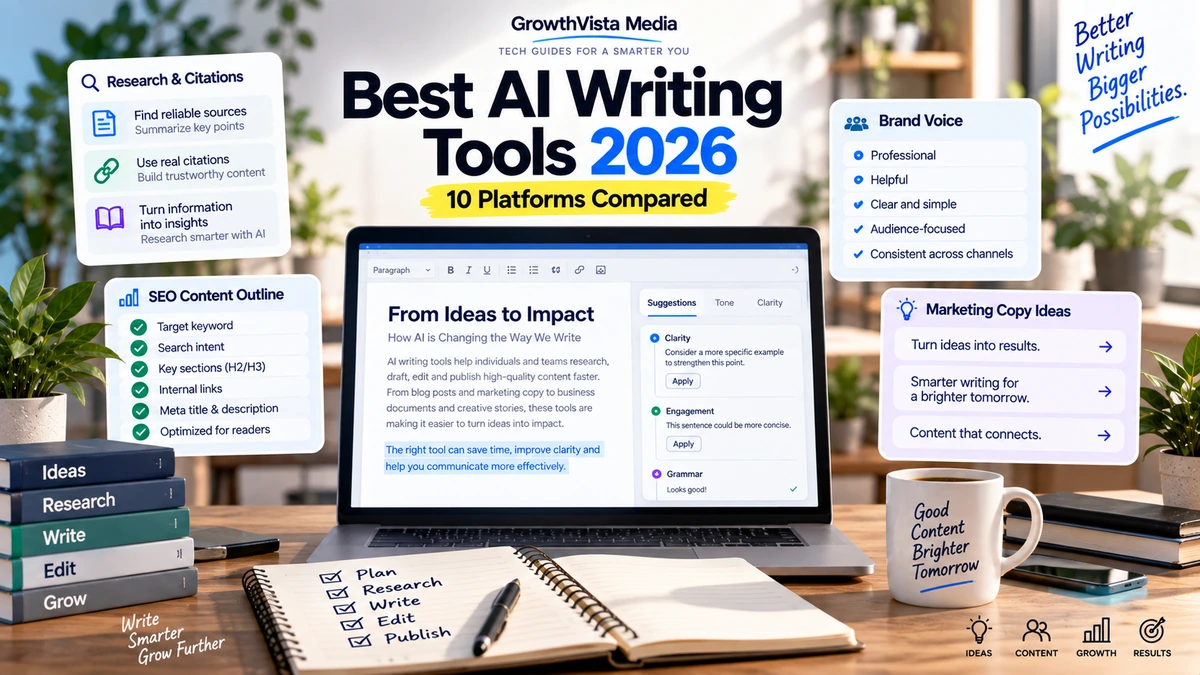
IMAGE PLACEHOLDER — Featured Image
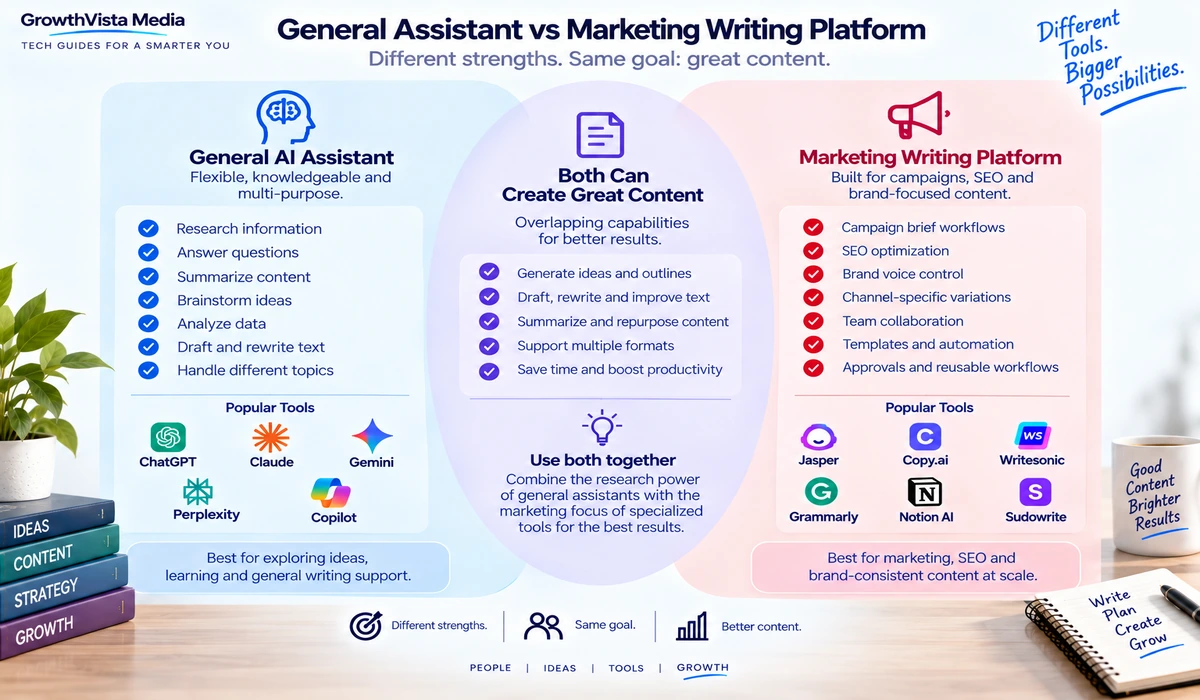
AI writing software in 2026 covers several very different jobs. A general AI assistant can research and draft across almost any topic, while specialist platforms focus on SEO workflows, marketing campaigns, grammar, brand consistency or document-heavy professional work.
That means the right tool depends less on which company claims to have the smartest writer and more on where writing slows down your workflow.
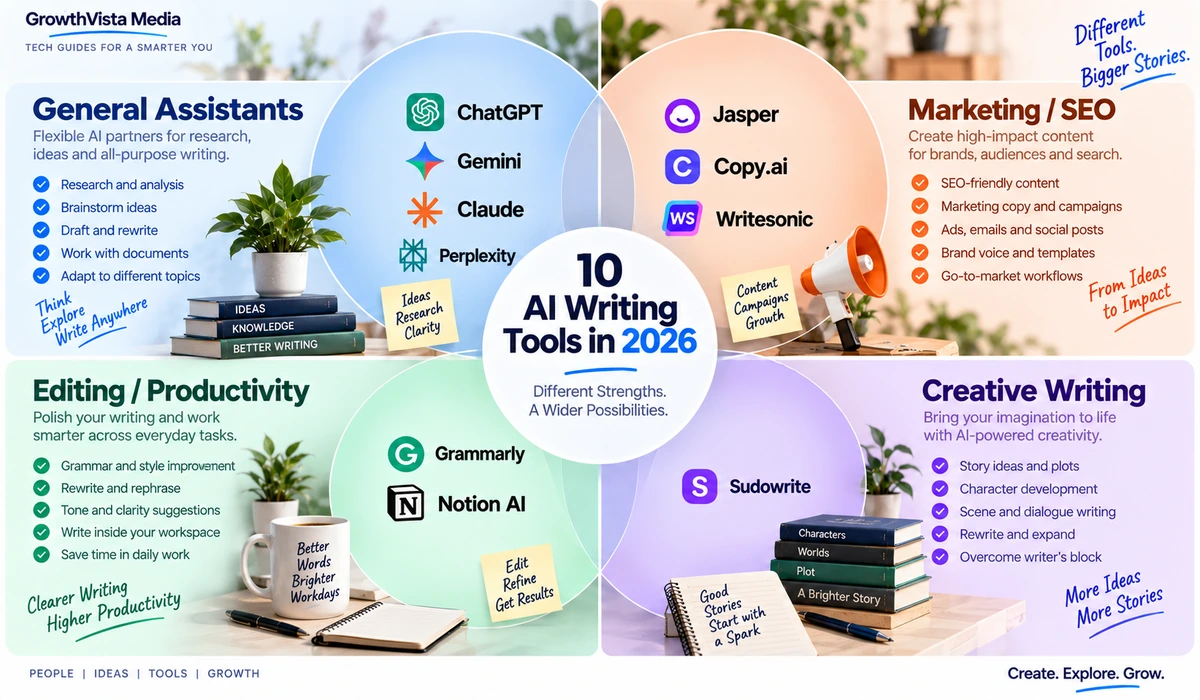
This comparison looks at 10 platforms across ideation, research, drafting, editing, SEO, marketing, collaboration and brand control. The tools are organized by use case rather than assigned a universal winner.
Editorial Disclosure: GrowthVista Media may receive compensation from qualifying SaaS referrals where an affiliate relationship is available. This does not change the comparison criteria used in this guide.
- Research and source-handling capability
- Long-form drafting and restructuring
- Editing and rewriting
- Brand voice and style controls
- SEO or marketing-specific workflow
- Document/context handling
- Collaboration and business use
- Ability to work from source material rather than inventing unsupported facts
- Current product availability and workflow in 2026
Quick Comparison
| Platform | Strong Fit | Why It Is Different |
|---|---|---|
| ChatGPT | General writing, research and multimodal work | Broad assistant for drafting, analysis, files, research and iterative editing |
| Claude | Long-form and document-heavy writing | Strong context-oriented drafting, analysis and revision workflow |
| Gemini | Google-centric research and productivity | AI writing connected to Google’s broader workspace/ecosystem |
| Jasper | Marketing teams and brand-controlled copy | Campaign-oriented workflows, brand voice and marketing content |
| Copy.ai | Go-to-market and sales/marketing workflows | Content generation connected to GTM processes |
| Writesonic | SEO and marketing content | AI writing combined with SEO/research workflows |
| Grammarly | Editing and communication refinement | Grammar, tone, rewriting and writing assistance across apps |
| Notion AI | Writing inside knowledge/workspace systems | AI embedded in documents, notes and team knowledge |
| Perplexity | Research-first writing preparation | Web research and cited source discovery |
| Sudowrite | Fiction and creative writing | Story-focused ideation, drafting and revision tools |
1. ChatGPT — For General Writing, Research and Iterative Editing
ChatGPT is a broad writing environment rather than a dedicated copywriting template library. Writers can use it to brainstorm angles, develop outlines, draft sections, analyze uploaded source material, rewrite passages and research current information in supported workflows.
Its flexibility is useful when the writing process moves between tasks. The same conversation can go from research notes to an outline, then to a draft, critique and final rewrite.
The strongest results usually come from giving the model source material, audience, purpose, examples and constraints rather than asking for a complete article from a vague one-line prompt.
For factual publishing, generated claims should still be checked against reliable sources.
Explore ChatGPT →
2. Claude — For Long Documents and Deep Revision
Claude is especially relevant to writers who work with substantial source material or long drafts. Its workflow is well suited to analyzing documents, reorganizing arguments, comparing versions, developing long-form pieces and maintaining context across extended writing tasks.
That makes it useful for reports, newsletters, scripts, research synthesis, documentation and editorial revision.
A polished long-form answer can still contain errors, so factual verification remains part of the publishing workflow.
Explore Claude →
3. Gemini — For Writers Working in Google’s Ecosystem
Gemini is relevant when writing work already lives across Google products. It can help brainstorm, draft, summarize, research and work with multimodal inputs, while Google’s broader ecosystem can reduce handoffs for users whose documents and workflows are already centered on Google.
For individual writers, the practical question is whether that ecosystem integration saves more time than using a standalone general assistant.
As with other general models, current facts and important citations should be verified before publication.
Explore Gemini →
4. Jasper — For Marketing Teams and Brand-Controlled Content
Jasper is built around marketing rather than general conversation. Its product direction emphasizes brand voice, campaign content, marketing workflows and repeatable output across teams.
This can be useful when many people need to produce landing pages, campaign copy, emails and social content while staying closer to shared brand guidelines.
A specialist marketing platform is most valuable when the organization actually uses those brand and workflow controls. A solo writer who mainly needs flexible drafting may find a general assistant sufficient.
Explore Jasper →
5. Copy.ai — For Go-to-Market Content Workflows
Copy.ai has evolved beyond simple copy templates toward go-to-market workflows. Its platform is aimed at sales and marketing teams that want AI to help create and transform content inside repeatable processes.
Typical uses can include prospecting content, campaign material, content repurposing and sales enablement.
For teams, evaluate how well the platform connects to existing GTM data and processes. For a solo blogger, many of these workflow features may be unnecessary.
Explore Copy.ai →
6. Writesonic — For SEO-Focused Content Production
Writesonic combines AI writing with SEO-oriented content workflows. It is relevant to publishers and marketing teams that want keyword research, article generation, optimization and related SEO tasks closer together.
The value of an SEO writing platform is not that it can insert more keywords. A useful workflow should help organize search intent, competitive research, structure and source material while leaving room for original expertise.
Search-engine content should be written for people first. AI-generated volume without useful information is not a durable SEO strategy.
Explore Writesonic →
7. Grammarly — For Editing, Tone and Everyday Communication
Grammarly is most useful after or during drafting. Its core role is helping writers improve grammar, clarity, tone and phrasing across documents and applications.
Its AI capabilities extend into rewriting and generation, but its strongest distinction remains the editing layer: it can sit across everyday communication rather than requiring every piece of text to begin inside a separate AI chat.
For professionals writing emails, reports, proposals and client communication, this can be more useful than another long-form generator.
Explore Grammarly →
8. Notion AI — For Writing Inside a Knowledge Workspace
Notion AI is relevant when content planning, notes, documentation and team knowledge already live in Notion. AI can help summarize, draft, restructure and retrieve information without moving the work into a separate application.
That makes it especially useful for editorial calendars, content briefs, meeting notes, internal documentation and collaborative planning.
The main value is context and workflow integration rather than being a dedicated SEO or fiction-writing platform.
Explore Notion AI →
9. Perplexity — For Research Before You Write
Perplexity is best thought of as a research layer rather than a replacement for editorial writing. Its search-oriented answers surface web sources and citations, helping writers find primary material and current information.
A strong workflow is to use it to map a topic, open the important sources, verify claims and then write from the evidence.
This is particularly useful for fast-changing topics where a writer needs current information rather than relying only on model memory.
Explore Perplexity →
10. Sudowrite — For Fiction and Story Development
Sudowrite is the most specialized platform in this list. It is designed around fiction and creative writing rather than business copy or SEO.
Story-focused tools can help with brainstorming scenes, descriptions, characters, plot development and revision while keeping the workflow centered on narrative rather than marketing templates.
For novelists and fiction writers, that specialization can be more useful than the broad feature set of a general business assistant.
Explore Sudowrite →
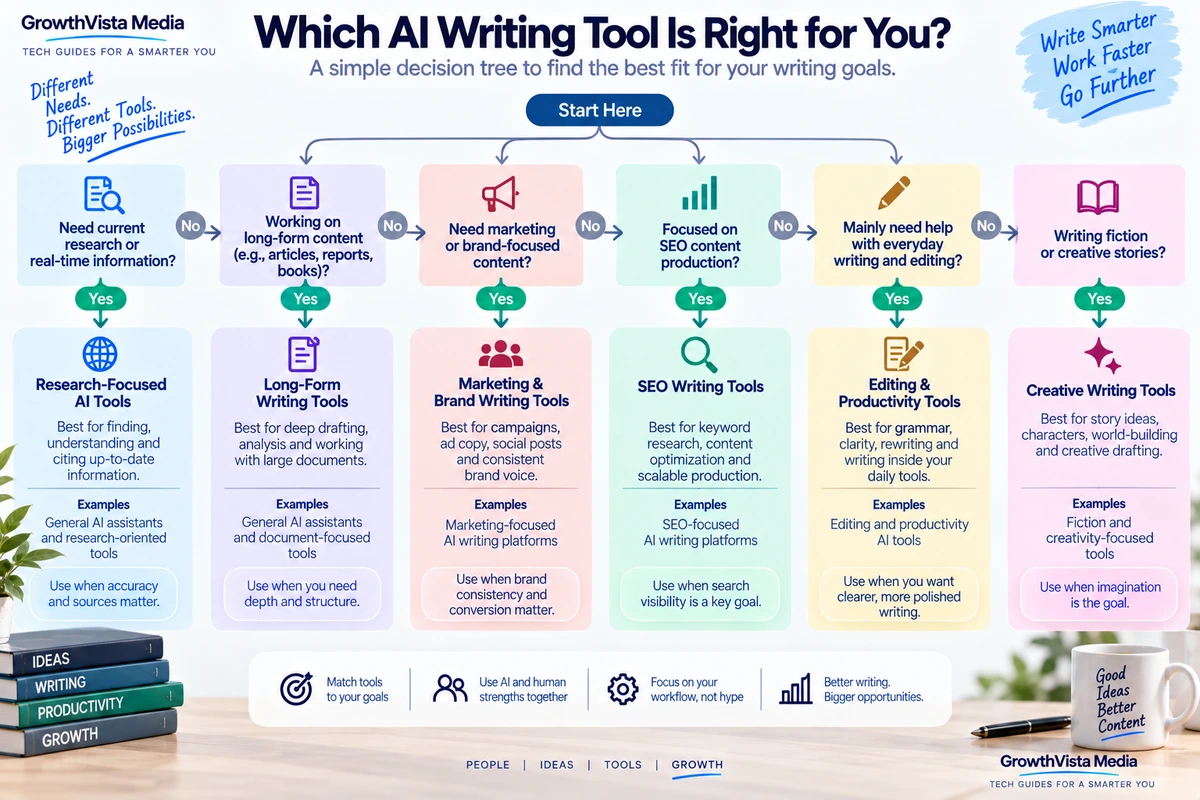
Which of the Best AI Writing Tools Fits Each Job?
| Writing Job | Tools to Investigate | Reason |
|---|---|---|
| Blog/article research | Perplexity, ChatGPT, Gemini | Research and source discovery |
| Long-form drafting | Claude, ChatGPT | Context, restructuring and iterative writing |
| SEO content workflow | Writesonic plus research tools | Search-focused structure and optimization |
| Marketing campaigns | Jasper, Copy.ai | Brand and GTM workflows |
| Emails/business writing | Grammarly, ChatGPT | Editing, tone and fast drafting |
| Team knowledge/docs | Notion AI, Claude | Workspace/context and document handling |
| Creative fiction | Sudowrite, Claude/ChatGPT | Story ideation and revision |
| Google-centric work | Gemini | Fits Google-oriented productivity workflows |
Research Tool and Writing Tool Are Not Always the Same Thing
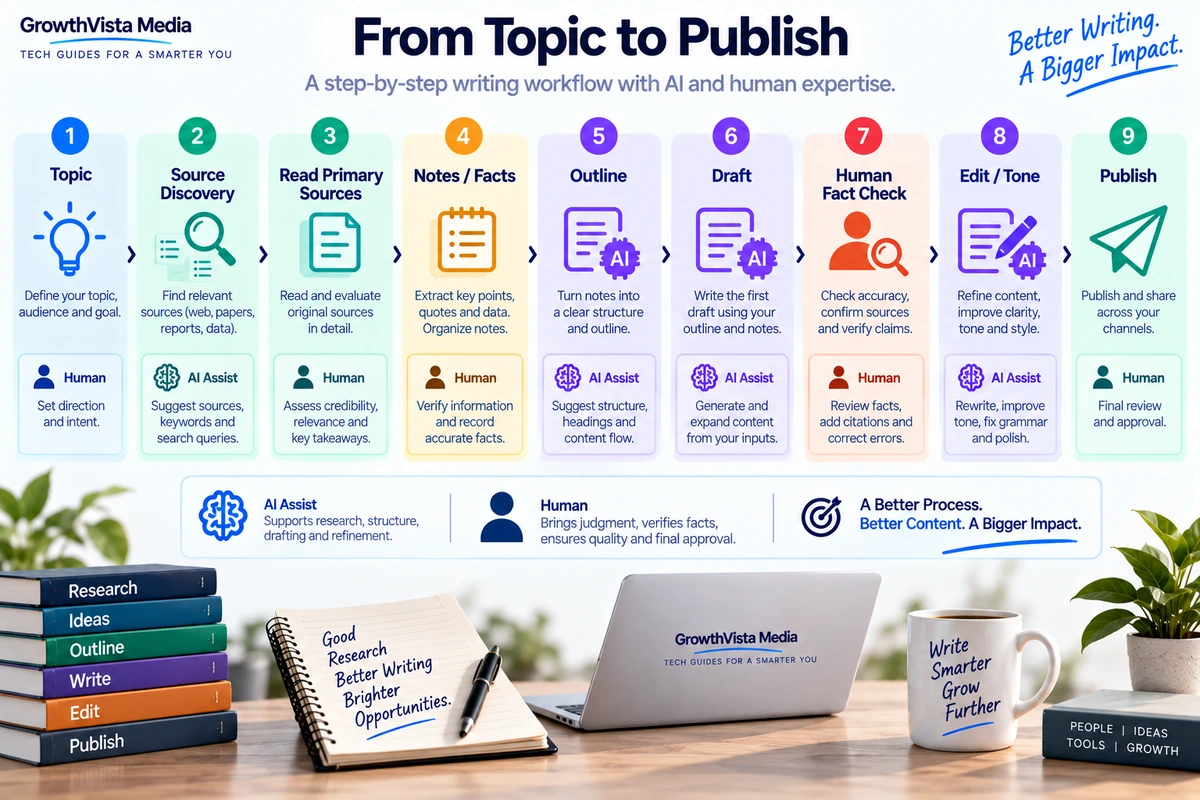
One of the most useful changes to an AI writing workflow is separating research from drafting.
A research-oriented tool can help locate current sources. A writing model can then turn verified notes into a structured article. An editing tool can provide the final grammar and clarity pass.
Trying to force one model to discover facts, write the article, fact-check itself and proofread in one prompt can hide mistakes.
AI Writing and SEO: Avoid the Volume Trap
AI makes it easy to create hundreds of articles. Ease of generation does not make those articles useful.
For search-focused content, build pages around genuine information needs. Add original comparisons, verified specifications, first-party data, examples, screenshots you have rights to use, or subject-matter expertise.
Use AI to speed up research organization, drafting and editing—not to manufacture thousands of near-duplicate pages.
Brand Voice Requires More Than a Tone Prompt
Telling a model to ‘sound professional and friendly’ is not a complete brand system.
Better brand control comes from examples: approved headlines, phrases to avoid, terminology, audience definitions, formatting rules and several pieces of writing that represent the desired voice.
Platforms such as Jasper emphasize reusable brand controls, but general assistants can also improve significantly when given strong reference examples.
Hallucinations and Factual Accuracy
All generative writing tools can produce confident statements that are incomplete, outdated or wrong. This is especially important for statistics, product specifications, laws, prices, medical information and current events.
For factual articles, keep a source trail. Verify the claims that matter and distinguish your analysis from facts supplied by external sources.
A Lean AI Writing Stack
| Stage | Possible Tool Type | Goal |
|---|---|---|
| Research | Perplexity / web-enabled assistant | Find current primary sources |
| Notes & synthesis | ChatGPT / Claude / Gemini | Organize evidence and identify gaps |
| Outline | General assistant | Build structure around search/user intent |
| Draft | General assistant or specialist platform | Create first complete version |
| SEO workflow | Writesonic or SEO tool where needed | Check topic coverage and search structure |
| Brand pass | Jasper or documented brand prompt | Apply terminology and voice |
| Copy edit | Grammarly + human editor | Clarity, grammar and consistency |
| Final review | Human | Accuracy, originality, judgment and publication |
How to Choose the Best AI Writing Tools Without Buying Too Many
- Identify the stage where writing currently slows down.
- Start with one general assistant if you need broad help.
- Add a research specialist only if source discovery is a repeated bottleneck.
- Add an SEO or marketing platform only if its workflow features are genuinely used.
- Use an editing tool if grammar and communication quality matter across many applications.
- Test the same real article or campaign in shortlisted platforms.
- Compare final editing time, not just first-draft speed.
- Review current pricing and usage limits before paying annually.
Frequently Asked Questions
What is the best AI writing tool in 2026?
There is no universal choice. ChatGPT and Claude are broad options for drafting and analysis, while Jasper, Writesonic, Grammarly, Notion AI and Sudowrite target more specialized workflows.
Which AI writer is useful for long-form articles?
Claude and ChatGPT are relevant for long-form drafting and restructuring, especially when given strong source material and a detailed brief.
Which AI writing tool is useful for SEO?
Writesonic is designed around SEO-oriented content workflows. Research and human editorial review remain important.
Which tool is useful for marketing copy?
Jasper and Copy.ai focus strongly on marketing and go-to-market workflows, while general assistants can also draft marketing copy.
Which AI tool is useful for editing existing writing?
Grammarly is strongly oriented toward grammar, clarity, tone and rewriting across everyday applications.
Which tool is useful for fiction?
Sudowrite is specifically designed for fiction and story development.
Can AI writing rank on Google?
AI use alone does not determine search performance. Content still needs to satisfy search intent, provide useful information and follow current search-engine policies.
Can AI writing tools make factual mistakes?
Yes. Generated text can contain inaccurate or outdated claims. Verify important facts against reliable current sources.
Do I need multiple AI writing subscriptions?
Often no. One general assistant plus a specialist tool for a clear bottleneck is usually more efficient than several overlapping subscriptions.
Should I publish an AI-generated article without editing?
No. Review factual accuracy, sources, originality, tone, structure, legal considerations and whether the article genuinely helps the intended reader.
Final Thoughts on the Best AI Writing Tools
The AI writing market is broad because writing itself includes many different jobs. Research, drafting, SEO, campaign production, editing and fiction are not the same workflow.
ChatGPT, Claude and Gemini provide broad assistance. Jasper and Copy.ai are oriented toward marketing processes, Writesonic toward SEO production, Grammarly toward editing, Notion AI toward workspace writing, Perplexity toward research and Sudowrite toward fiction.
The most efficient setup is usually not the platform with the longest feature list. It is the smallest combination of tools that solves your recurring bottlenecks while leaving factual judgment, expertise and final editorial responsibility with you.
Before paying annually, run one complete real project through the tool. Measure the quality of the final edited result and the time saved—not the speed of the first generated paragraph.
Image Production Summary
Use original GrowthVista graphics and permitted vendor assets only. Do not copy software interfaces, fabricate productivity claims, invent benchmark scores or imply hands-on testing that was not performed.
Source Verification Notes
- Verify each platform against its current official product and pricing documentation before publication.
- OpenAI ChatGPT — official OpenAI/ChatGPT product pages.
- Anthropic Claude — official Anthropic/Claude product pages.
- Google Gemini — official Google Gemini product pages.
- Jasper, Copy.ai, Writesonic, Grammarly, Notion, Perplexity and Sudowrite — current official product/pricing pages.
- Recheck plan names, pricing, usage limits, integrations and commercial terms immediately before publication because AI SaaS products change frequently.