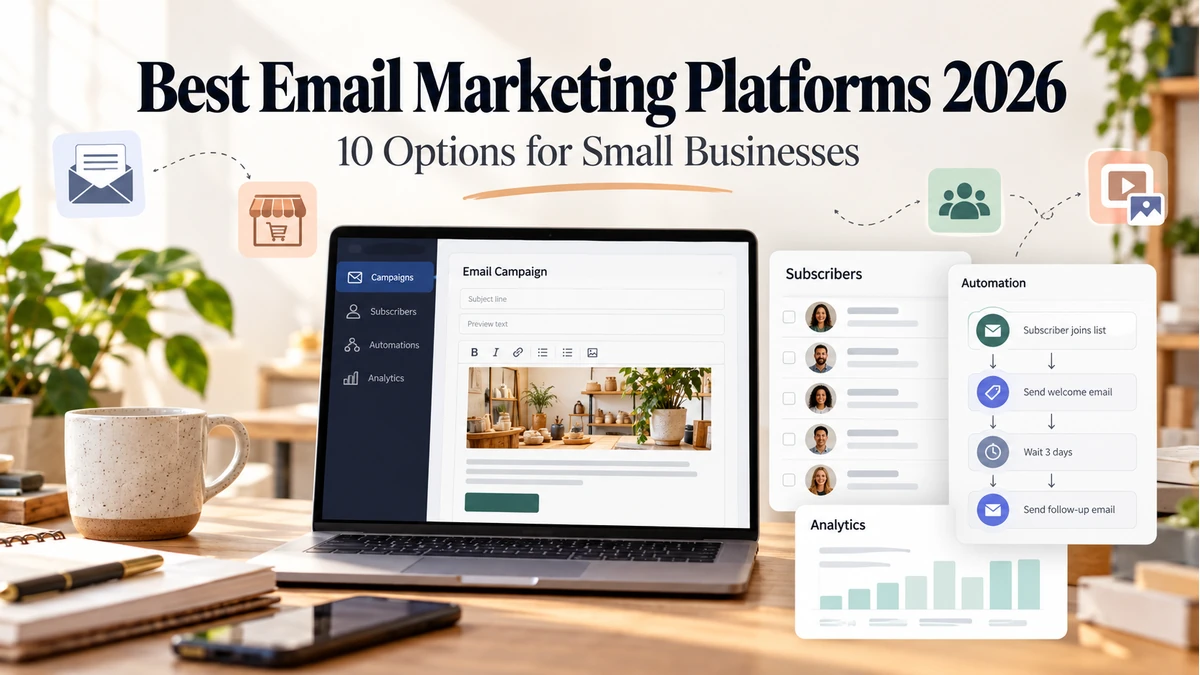
Best Email Marketing Platforms for Small Businesses in 2026
Email marketing remains one of the most controllable ways for a small business to communicate with customers because the audience relationship is not entirely dependent on a social platform’s feed or advertising auction.
The best email marketing platforms for small businesses in 2026 differ mainly in how they handle list growth, segmentation, automation, ecommerce data, CRM workflows and pricing as the database expands. A local service company does not need the same system as a Shopify store or a creator selling courses.
Automation has also moved well beyond a single welcome email. Current platforms can trigger workflows from signups, purchases, clicks, page activity and customer attributes. Brevo, for example, documents trigger-rule-action automations and transactional messaging; MailerLite supports multi-step workflows and multiple triggers; Kit focuses heavily on creator journeys and automated sequences.
This guide compares 10 platforms and explains which business types each one fits, along with the trade-offs around automation depth, ecommerce, CRM features, deliverability controls and total cost.
What is the best email marketing platform for a small business?
The best email marketing platform depends on the business model and the type of customer journey you need to manage. MailerLite is a strong choice for simplicity and value, Brevo combines email with transactional messaging and CRM features, ActiveCampaign is suited to advanced automation, Klaviyo and Omnisend are strong options for ecommerce, Kit focuses on creators, and HubSpot Marketing Hub is useful for businesses that want email closely connected to CRM and sales. Compare automation, segmentation, integrations, pricing, deliverability tools and ease of use before choosing.
Quick Comparison: Best Email Marketing Platforms
| Platform | Best For | Automation | Ecommerce | Key Strength | CTA |
|---|---|---|---|---|---|
| MailerLite | Ease of use + value | Strong | Good integrations | Simple campaigns + workflows | Try MailerLite → |
| Brevo | Email + transactional + CRM | Strong | Good | Multi-channel business platform | Try Brevo → |
| ActiveCampaign | Advanced automation | Excellent | Strong integrations | Behavioral journeys + CRM | View Plans → |
| Mailchimp | Broad small-business toolkit | Good | Good | Familiar campaign ecosystem | View Plans → |
| Kit | Creators / newsletters | Strong | Creator commerce | Creator-first automations | Try Kit → |
| Klaviyo | Ecommerce brands | Excellent | Excellent | Deep commerce data/segmentation | View Plans → |
| Omnisend | Ecommerce email + SMS | Strong | Excellent | Store-focused workflows | Try Omnisend → |
| Constant Contact | Local businesses / events | Moderate | Good | Approachable campaigns + events | View Plans → |
| GetResponse | Funnels / webinars / email | Strong | Good | Broad marketing toolkit | View Plans → |
| HubSpot Marketing Hub | CRM-led growth | Excellent | Integrations | CRM + marketing alignment | View Plans → |
1. MailerLite — Best for Ease of Use and Value
MailerLite is a strong fit for small businesses that want professional campaigns, signup forms, landing pages and automation without an intimidating interface.
Its current automation builder supports triggers such as joining a group, completing a form, clicking a link, purchasing and date-based events. MailerLite also documents multi-trigger automations and A/B testing within workflows.
The platform is particularly attractive when the business needs solid email fundamentals before enterprise-level CRM complexity.
Best for: Small businesses, bloggers and service companies prioritizing ease of use and straightforward automation.
2. Brevo — Best for Email, Transactional Messaging and CRM in One Platform
Brevo combines marketing campaigns with automation, transactional messaging and CRM-oriented capabilities.
Its current email product includes segmentation, campaign analytics, AI-assisted content and send-time features. Brevo also offers a free plan that currently allows up to 300 emails per day, although limits and included features should be rechecked before publication.
Brevo’s automation model supports triggers, rules and actions for workflows such as welcome messages, abandoned carts, anniversaries, page-visit follow-ups and lead scoring.
Best for: Small businesses wanting marketing email plus transactional and customer-management capabilities in one ecosystem.
3. ActiveCampaign — Best for Advanced Marketing Automation
ActiveCampaign is most relevant when automation logic is central to the marketing strategy rather than an occasional convenience.
It is designed for multi-step behavioral journeys, segmentation and CRM-connected follow-up, making it suitable for businesses that want leads and customers to move through different paths based on actions.
That depth creates a steeper setup burden than a newsletter-first tool, so smaller teams should only pay for the complexity they will actually use.
Best for: Growing service businesses and marketers who need sophisticated automation and CRM-connected journeys.
4. Mailchimp — Best Familiar All-Round Marketing Platform
Mailchimp remains one of the most recognizable small-business email platforms and combines campaign creation with automation, audience tools, forms, analytics and a broad integration ecosystem.
It can work well for businesses that want one familiar system and do not need the deepest automation architecture.
Pricing and feature packaging have evolved over time, so businesses with rapidly growing contact databases should model the current cost at their expected list size rather than judging only the entry plan.
Best for: Small businesses wanting a widely supported, general-purpose email marketing ecosystem.
5. Kit — Best for Creators and Audience-Based Businesses
Kit, formerly ConvertKit, is designed around creators such as authors, coaches, educators, podcasters and digital-product businesses.
Its Visual Automations can branch based on subscriber actions such as signups, clicks, purchases and engagement. Kit also provides automated email sequences and integrations with creator tools including Shopify, Thinkific and Calendly.
Businesses built around content, courses, memberships and newsletters may find this subscriber-centric workflow more natural than a traditional corporate marketing suite.
Best for: Creators and experts building newsletters, funnels, digital products and audience businesses.
6. Klaviyo — Best for Data-Driven Ecommerce Email
Klaviyo is built around ecommerce customer data and lifecycle marketing. It is particularly relevant to stores that want segmentation and automation tied closely to shopping behavior.
Typical use cases include browse and cart abandonment, post-purchase journeys, replenishment, customer win-back and product recommendations, depending on the commerce integration and data available.
For a local consultancy sending one newsletter a month, this depth may be unnecessary. For a growing online store, commerce-specific data can justify the added complexity.
Best for: Ecommerce brands that want customer-data-driven email and lifecycle automation.
7. Omnisend — Best for Ecommerce Email and SMS Workflows
Omnisend focuses on ecommerce marketing and combines email with SMS-oriented customer journeys.
It is a practical alternative for stores that want prebuilt commerce automations and segmentation without adopting a broader CRM platform.
Store owners should compare contact/send limits, SMS costs and integration depth with their exact ecommerce platform before choosing.
Best for: Small and midsize online stores wanting commerce-focused email and SMS automation.
8. Constant Contact — Best for Local Businesses and Event-Oriented Marketing
Constant Contact is aimed at small organizations that want approachable email campaigns, contact management and related marketing tools.
It can be particularly relevant to local businesses, associations and organizations that regularly promote events or recurring community activity.
Automation is available, but businesses with highly branched behavioral journeys should compare its current workflow depth with specialist automation platforms.
Best for: Local businesses and organizations prioritizing straightforward campaigns and event-oriented outreach.
9. GetResponse — Best for Broader Funnel and Webinar Tools
GetResponse extends beyond newsletters into automation, landing pages, funnels and webinar-related marketing tools.
This can reduce the number of separate products needed for businesses running lead magnets, online events and nurture sequences.
The all-in-one approach is valuable only if those extra capabilities are actually used, so compare the relevant plan rather than the longest feature list.
Best for: Businesses combining email campaigns with funnels, landing pages and webinar-led acquisition.
10. HubSpot Marketing Hub — Best for CRM-Led Marketing
HubSpot Marketing Hub makes the most sense when email is one part of a broader CRM and inbound-marketing system.
Because contacts, forms, website activity, sales processes and marketing automation can live in the same ecosystem, teams can coordinate lead nurturing with sales follow-up more directly.
Total cost can rise as requirements become more advanced, so smaller businesses should evaluate which HubSpot features they genuinely need.
Best for: B2B and service businesses that want marketing automation closely connected to CRM and sales workflows.
What is the best free email marketing platform?
The best free email marketing platform depends on your contact list, sending volume and automation needs. Brevo and MailerLite are useful options for businesses testing email marketing without immediately paying for a large plan, while other platforms offer free tiers or trials with different restrictions. Before choosing a free plan, compare contact limits, monthly or daily sending limits, automation features, branding, reporting and migration options.
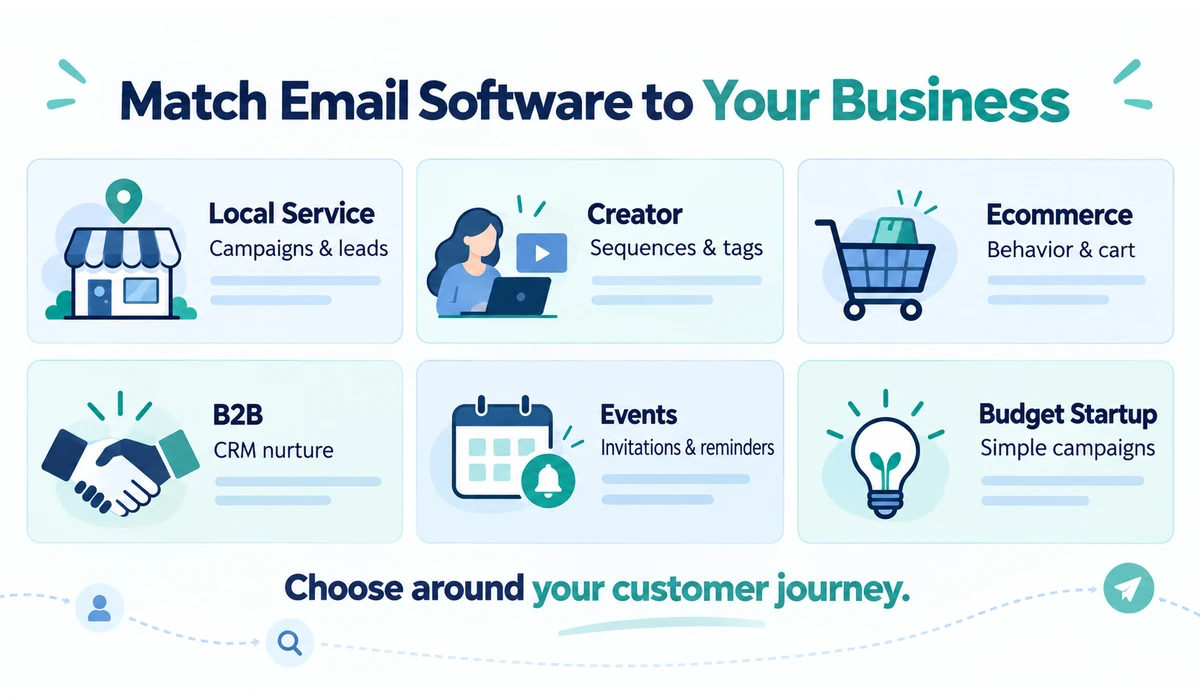
Which Email Platform Fits Your Business Type?
| Business Type | Primary Need | Platforms to Evaluate |
|---|---|---|
| Local service business | Newsletters, leads, follow-up | MailerLite, Brevo, Mailchimp, Constant Contact |
| Creator / educator | Sequences, tags, digital products | Kit, MailerLite |
| Ecommerce store | Behavioral data, cart/post-purchase | Klaviyo, Omnisend, ActiveCampaign |
| B2B service company | Lead nurturing + CRM | HubSpot, ActiveCampaign, Brevo |
| Event-led business | Invitations, reminders, campaigns | Constant Contact, GetResponse |
| Budget-conscious startup | Core campaigns + automation | MailerLite, Brevo |
What Should a Small Business Look for in an Email Marketing Platform?
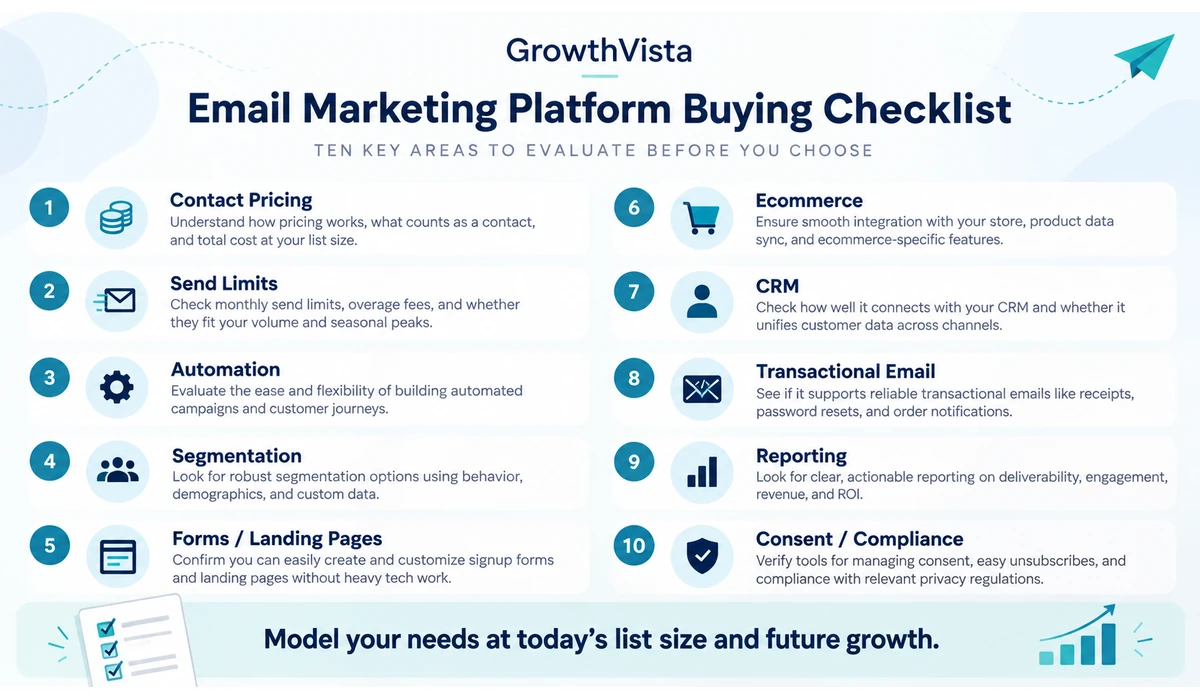
1. Contact and Send-Based Pricing
Some platforms price mainly by contacts, others by email volume, and many use a combination. Model your expected database and monthly sends 12–24 months ahead.
2. Automation Depth
A welcome series is different from a behavioral journey with branches, conditions, purchases and CRM actions. Buy the automation depth you will actually implement.
3. Segmentation
Useful segmentation can combine profile data, engagement, purchase history and custom attributes so different subscribers receive relevant campaigns.
4. Forms and Landing Pages
Built-in forms and landing pages reduce integration work when email is the main lead-capture system.
5. Ecommerce Integration
Stores should verify product, order, customer and event data available from Shopify, WooCommerce or their specific commerce platform.
6. CRM Integration
B2B and service companies should check whether sales teams can see marketing activity and whether lead status can trigger or stop automations.
7. Transactional Email
Order confirmations and password resets are different from marketing campaigns. If both matter, verify how the platform separates and prices transactional sending.
8. Deliverability Controls
No platform can guarantee inbox placement. Look for authentication guidance, reputation tools, bounce/complaint handling and clear list-quality practices.
9. Reporting
Open rates alone are increasingly imperfect. Look for clicks, conversions, revenue attribution and workflow reporting that match the business goal.
10. Consent and Compliance
The platform is only part of compliance. Businesses remain responsible for lawful list collection, consent where required, unsubscribe handling and applicable privacy/marketing rules.
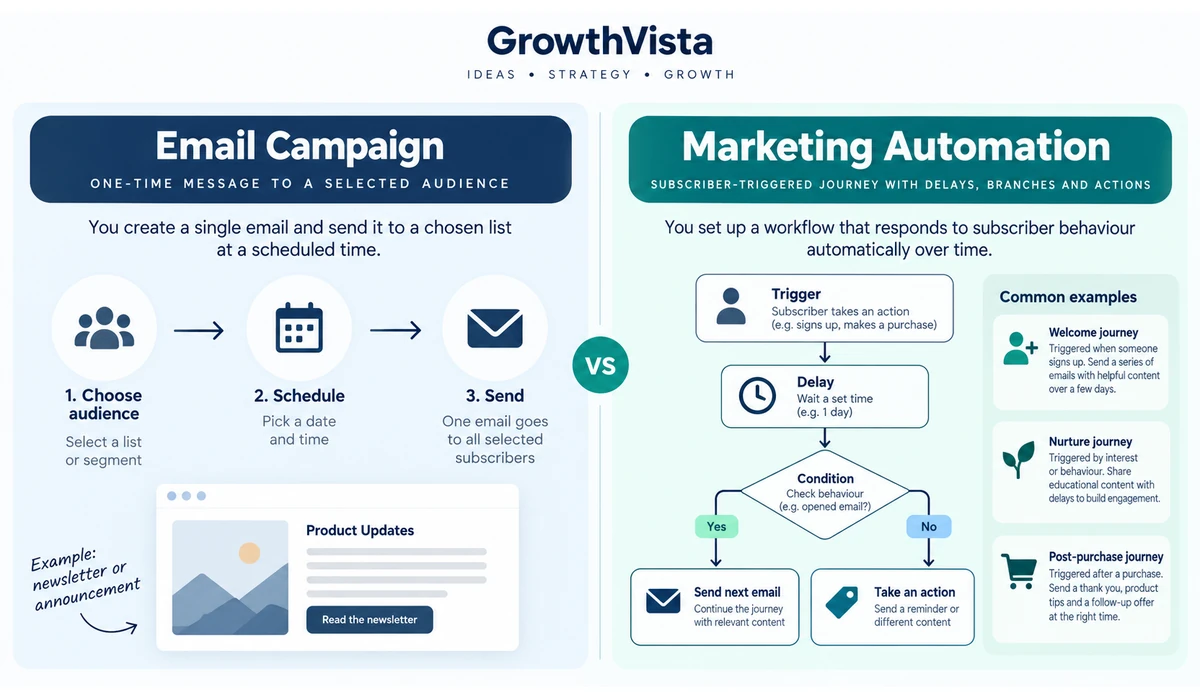
Email Campaigns vs Marketing Automation
| Campaign | Automation |
|---|---|
| One-time or scheduled send | Triggered workflow |
| Newsletter / announcement | Welcome / nurture / post-purchase |
| Audience selected for a send | Subscriber enters based on event or rule |
| Same timing for campaign audience | Timing depends on each subscriber journey |
| Useful for broadcasts | Useful for lifecycle communication |
Email Marketing vs CRM: Do You Need Both?
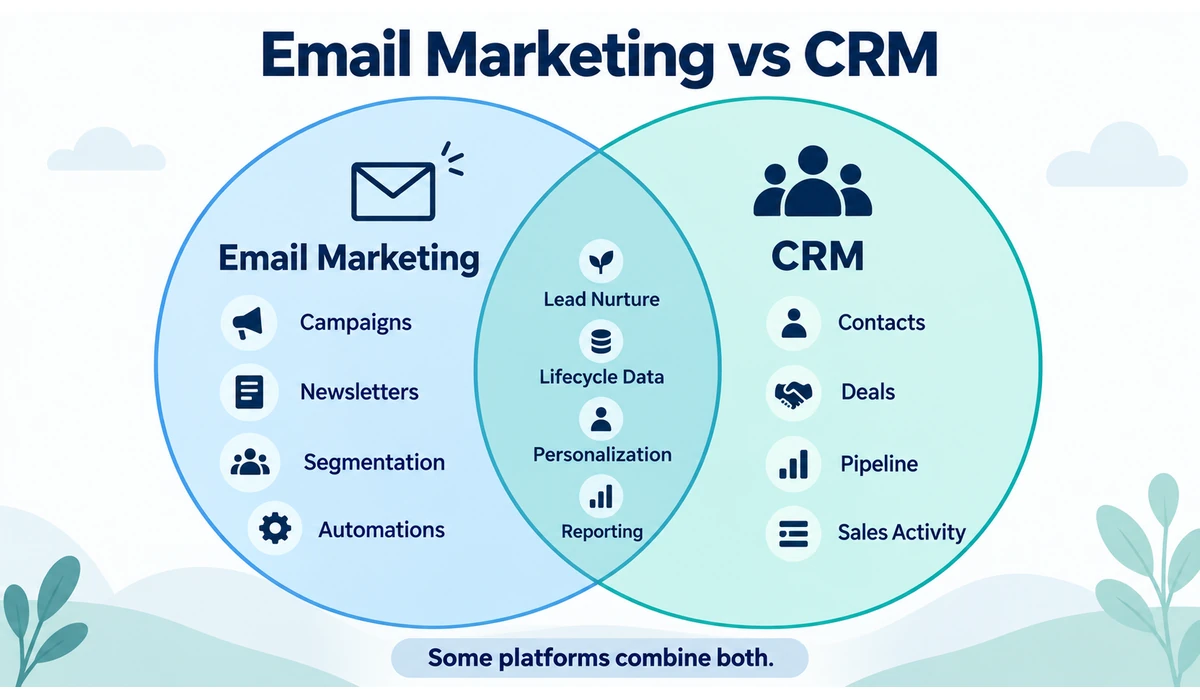
Email marketing software focuses on subscriber communication, campaigns and lifecycle messaging. A CRM focuses more broadly on customer and prospect records, sales activity, pipelines and relationship history.
A small newsletter business may not need a separate CRM. A B2B company with sales representatives often benefits from connecting email engagement with CRM records. Platforms such as HubSpot and Brevo combine parts of both categories, while other email tools integrate with dedicated CRMs.
Deliverability: What the Platform Can and Cannot Control
-
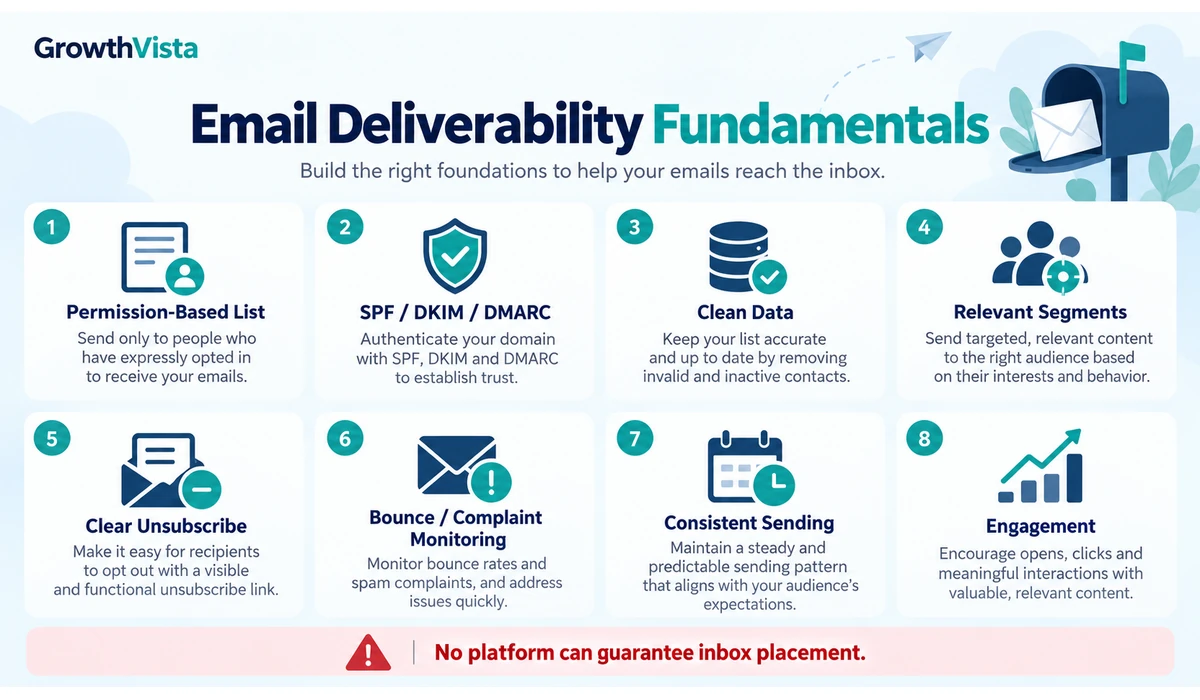
- Authenticate the sending domain using the records recommended by the provider, including SPF/DKIM and DMARC where appropriate.
- Send only to people you are permitted to contact; avoid purchased or scraped lists.
- Use clear signup expectations and make unsubscribe easy.
- Remove invalid addresses and monitor hard bounces and complaints.
- Segment inactive subscribers rather than repeatedly mailing people who never engage.
- Keep campaign content aligned with what subscribers expected when they joined.
- Warm up major sending changes carefully and follow provider guidance.
- Remember that no vendor can guarantee a fixed inbox-placement percentage across every mailbox provider.
Free Plans: Useful for Testing, Not the Whole Buying Decision
Free plans can be excellent for learning the editor and testing basic workflows, but they often limit contacts, daily/monthly sends, automation steps, templates, support or branding.
For example, Brevo currently advertises a free tier with up to 300 emails per day, while MailerLite offers a free signup path and a 14-day trial of premium features. These terms can change, so treat them as current examples rather than permanent product promises.
Before migrating a real audience, calculate the paid tier you would need at your expected list size and sending frequency.
A Simple Email Platform Decision Framework
-
- If simplicity and value matter most, start by evaluating MailerLite and Brevo.
- If complex behavioral automation is central, evaluate ActiveCampaign.
- If you run an ecommerce store, compare Klaviyo and Omnisend alongside your store platform’s native tools.
- If you are a creator, evaluate Kit and MailerLite.
- If CRM and sales alignment matter, evaluate HubSpot, ActiveCampaign and Brevo.
- If events are central to outreach, evaluate Constant Contact and GetResponse.
- If your team already knows Mailchimp and the current pricing fits your database, it remains a practical general-purpose option.
Frequently Asked Questions
What is the best email marketing platform for a small business?
There is no universal choice. MailerLite and Brevo suit many smaller teams; ActiveCampaign fits advanced automation; Klaviyo and Omnisend target ecommerce; Kit targets creators; HubSpot suits CRM-led marketing.
Is Mailchimp still good for small businesses?
It remains a capable general-purpose platform with a broad ecosystem, but businesses should compare current pricing and automation requirements with alternatives as their contact list grows.
Can I start email marketing for free?
Several providers offer free tiers or trials. Free plans are useful for testing, but check contact, send, automation and branding limits before building a long-term workflow.
Which email platform is best for Shopify stores?
Klaviyo and Omnisend are strong ecommerce-focused options for Shopify stores because they are designed around customer, product and purchase data. ActiveCampaign can also be relevant when a store needs broader automation and CRM capabilities. The right choice depends on store size, customer-data requirements, automation complexity, SMS needs and budget. Businesses should compare the actual Shopify integration and plan limits before choosing.
Do I need a CRM for email marketing?
Not always. A newsletter or small local business may only need email software. A sales-led B2B company often benefits from CRM integration.
Can an email platform guarantee deliverability?
No. Providers supply infrastructure and tools, but inbox placement also depends on authentication, sender reputation, list quality, content and recipient behavior.
Can I upload a purchased email list?
Platform policies and laws vary, but purchased or scraped lists create serious consent, reputation and deliverability problems. Build permission-based lists and follow applicable marketing/privacy rules.
What is the easiest email marketing platform for a small business?
MailerLite and Brevo can be good starting points for small businesses that want straightforward campaign creation and automation without a highly complex setup. The easiest platform ultimately depends on the team’s technical experience and the workflows it needs to build.
How much does email marketing software cost for a small business?
Email marketing costs vary based on contacts, sending volume, automation features and the number of users. Some platforms offer free tiers, while paid plans increase limits and add features such as advanced automation, reporting and integrations. Businesses should calculate the expected cost at their future list size rather than comparing only entry-level prices.
What is the difference between email marketing and email automation?
Email marketing can include one-time newsletters, announcements and promotional campaigns, while email automation uses triggers and rules to send messages based on subscriber actions or conditions. For example, a welcome email can be a simple campaign, while a multi-step sequence triggered by signup, clicks and purchases is an automated workflow.
Final Thoughts
The best email marketing platforms for small businesses are the ones that fit the customer journey without creating unnecessary complexity.
MailerLite is attractive for simplicity and value; Brevo combines campaigns with transactional and CRM capabilities; ActiveCampaign is built for deeper automation; Kit serves creators; Klaviyo and Omnisend focus on ecommerce; and HubSpot connects marketing closely with CRM.
Before choosing, map the first three workflows you actually want to run—for example a welcome sequence, lead nurture and customer follow-up—then build those workflows in a trial account.