AI Research Workflow: From Question to Verified Brief
Editorial scope: Researched practical guide. Examples are illustrative, not hands-on product benchmarks. Reviewed October 2026.
What is an AI research workflow?
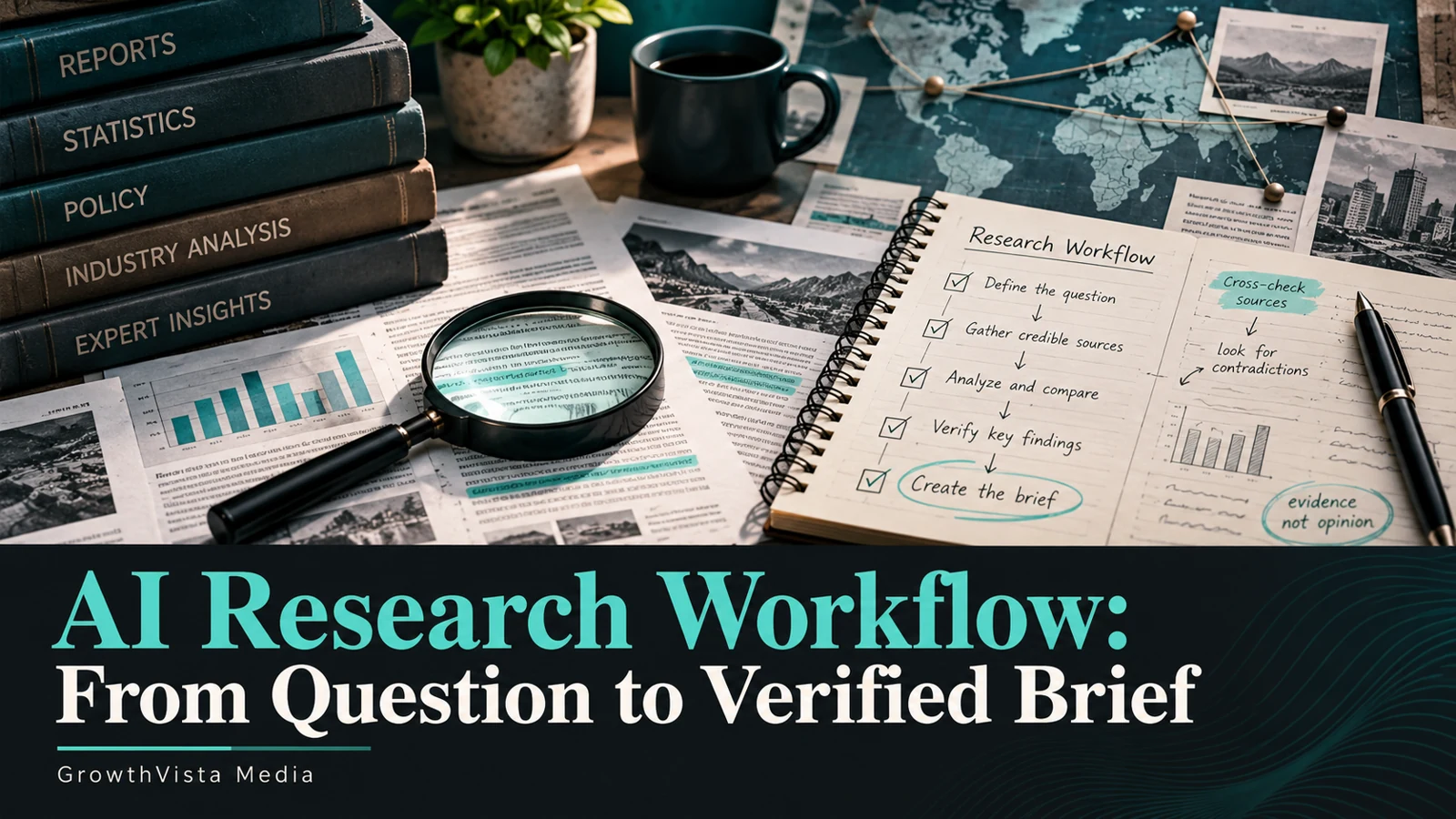
An AI research workflow is a structured process for using artificial intelligence to define research questions, organize sources, verify factual claims, and produce evidence-based reports. A reliable workflow includes defining the research scope, collecting trustworthy sources, maintaining a claim ledger, checking citations, resolving contradictions, and creating a final brief that clearly identifies verified facts and unresolved questions.
An AI research workflow is useful when it helps you ask better questions, organize evidence, and identify gaps. It becomes unreliable when a fluent answer is treated as a finished research report. The essential step is keeping the assistant’s synthesis separate from the material that actually supports it.
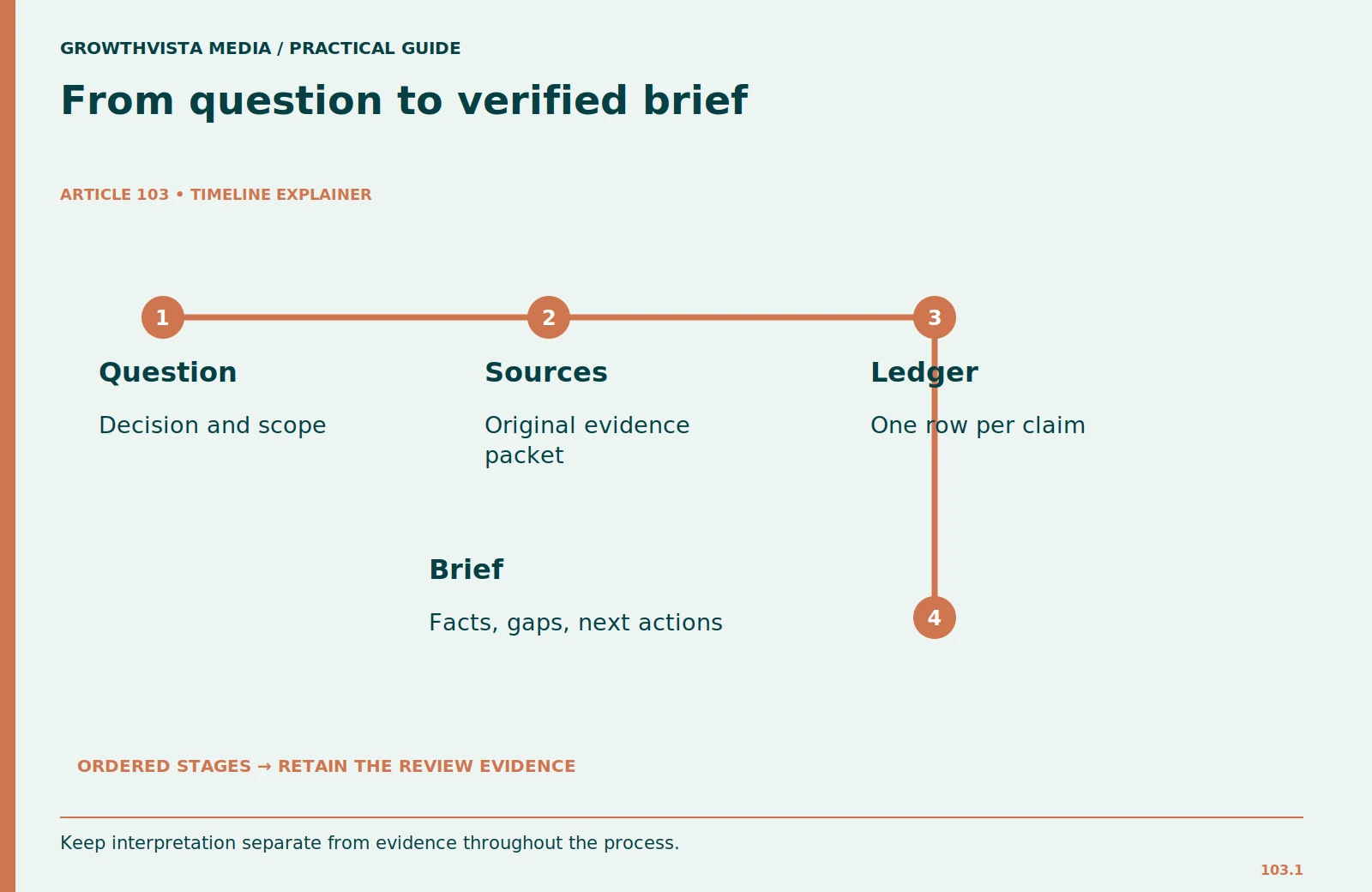
This guide shows how to build a question, gather a small source packet, maintain a claim ledger, and produce a brief with visible uncertainty. The worked scenario is an invented small-business software decision. It demonstrates a process, not a tested recommendation for a specific product.
AI Research Workflow: 8 Essential Steps
| Step | Action | Expected output |
|---|---|---|
| 1 | Define the research question | Clear decision and scope |
| 2 | Collect reliable sources | Organized evidence packet |
| 3 | Create a claim ledger | Traceable factual claims |
| 4 | Verify citations | Confirmed supporting evidence |
| 5 | Resolve contradictions | Documented uncertainties |
| 6 | Generate structured synthesis | Evidence-based research brief |
| 7 | Prepare decision document | Actionable next steps |
| 8 | Update time-sensitive claims | Maintained research record |
How Do You Define an AI Research Question?
Define an AI research question by identifying the decision, target audience, research scope, deadline, and missing information. A specific question helps the assistant focus on relevant evidence instead of generating a broad, unsupported summary.
Start with the decision, audience, and deadline. “Research customer support software” can produce an endless feature list. A sharper question is: “Which requirements must a five-person support team confirm before moving its existing email workflow into a shared support system?” The output can then be a requirements brief rather than an unsupported winner.
Write what falls outside the assignment. You might exclude pricing negotiations, migration execution, and legal review. Specify the geography and time sensitivity of any claims that matter. A product feature available in one account or region may not answer your team’s actual question.
Ask the assistant to identify missing inputs before drafting conclusions. It may need ticket volume, required integrations, export needs, or access restrictions. Answer those questions yourself or label them as unresolved. A clear research boundary prevents the model from filling operational gaps with plausible assumptions.
How Do You Find Reliable Sources for AI Research?
Find reliable sources by prioritizing original documentation, official authorities, and independently verifiable evidence. Record each source’s URL, publication date, relevant passage, and limitations before using it to support research conclusions.
Collect a small set of sources before requesting a broad synthesis. For product capabilities, use current official documentation and account-specific help pages. For regulations, use the relevant authority. For real-world usability, use clearly identified independent reporting or your own documented trial. Each source answers a different kind of question.
Do not ask a marketing page to prove measured performance. A vendor statement can establish what the vendor claims, while a repeatable test can establish what happened in your environment. Keep those labels in your notes. If you cannot find evidence for a claim, leave it unresolved rather than substituting several search snippets.
Record the source title, URL, publication or update date when available, access date, relevant section, and scope. A saved excerpt can make review easier, but retain the original link and enough context to understand exceptions. Avoid uploading documents you are not authorized to share.
What Is a Claim Ledger in AI Research?
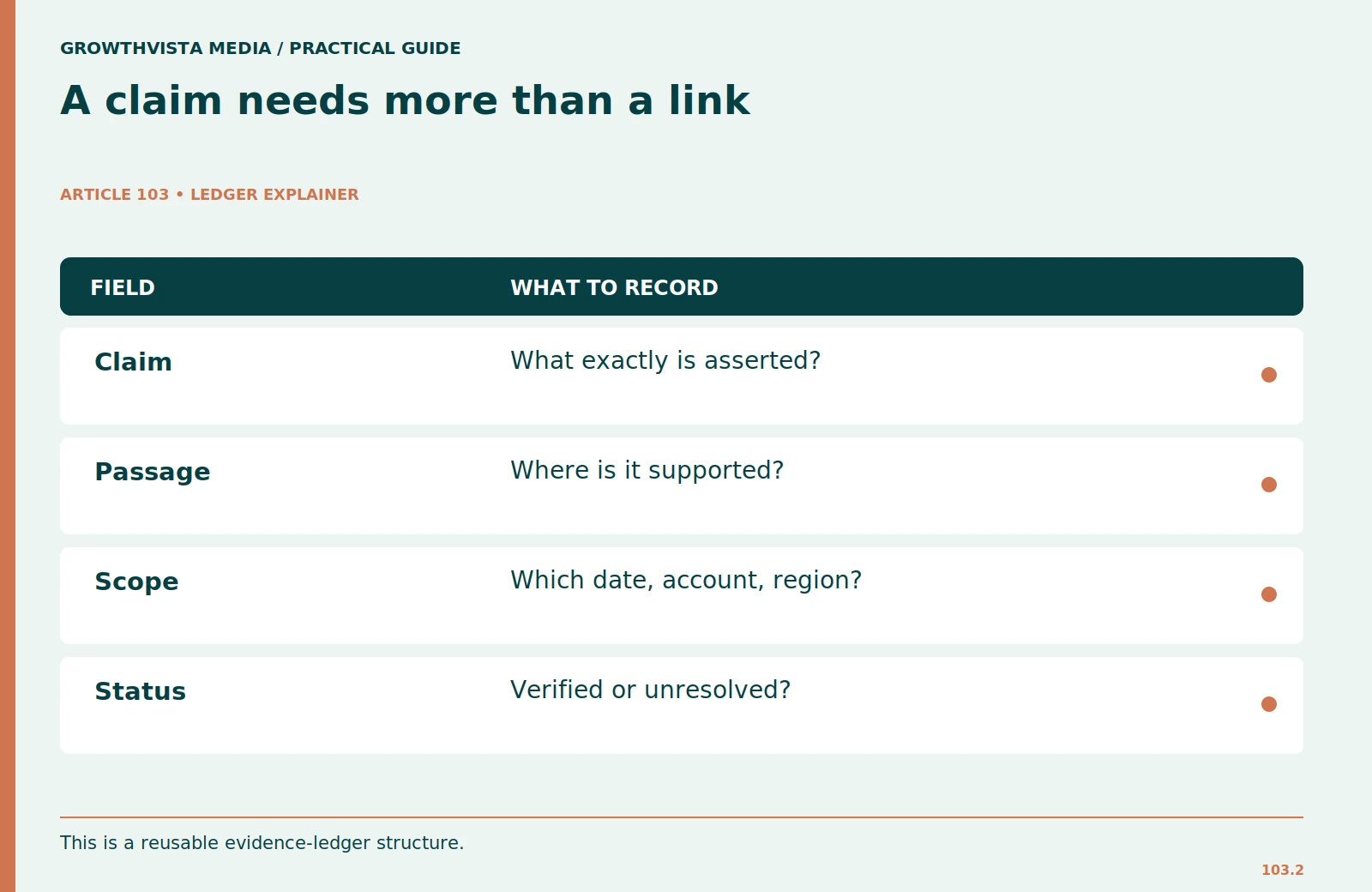
A claim ledger is a structured record that connects each important research claim to its supporting source, relevant passage, date, scope, and verification status. It helps researchers distinguish verified information from unsupported assumptions or contradictory evidence.
Give every consequential claim its own row. Include the exact claim, source, supporting passage, date, scope, and verification status. Useful statuses are verified, partly supported, contradicted, and not checked. A source list at the bottom of an answer is less informative because it does not show which source supports which sentence.
For an illustrative software decision, one row might say, “The system can export ticket data in the format required by our reporting workflow.” Until you inspect the documentation and try the export, the status should remain not checked or partly supported. Do not replace that specific question with the broader claim that the product “has reporting.”
Let the assistant help populate the ledger from the supplied source packet, but review the mappings. Ask it to quote only short relevant passages and separate direct evidence from interpretation. Your final ledger should be understandable to a colleague who did not participate in the chat.
How Do You Verify AI-Generated Citations?
Verify AI-generated citations by opening the original source, locating the supporting passage, and checking whether it accurately supports the claim. Confirm publication dates, context, product versions, geographic restrictions, and numerical details before treating the information as verified.
Open every source supporting a decision-critical claim. Check that the page exists, that the relevant passage is present, and that it applies to the correct product version, account, geography, or period. A real citation can still be attached to the wrong conclusion. Read surrounding paragraphs for limitations.
Numbers need additional care. Identify the unit, period, population, and denominator. A percentage without those details may be impossible to interpret. If an assistant performs a calculation, reproduce it independently from the stated inputs. A correct arithmetic result can still answer the wrong business question.
Prioritize verification by consequence. A decorative historical detail does not deserve the same attention as a migration requirement or cost assumption. Remove low-value claims that would consume disproportionate checking time. A narrower brief with solid support can be more useful than a long report built around uncertain facts.
What Should You Do When Research Sources Conflict?
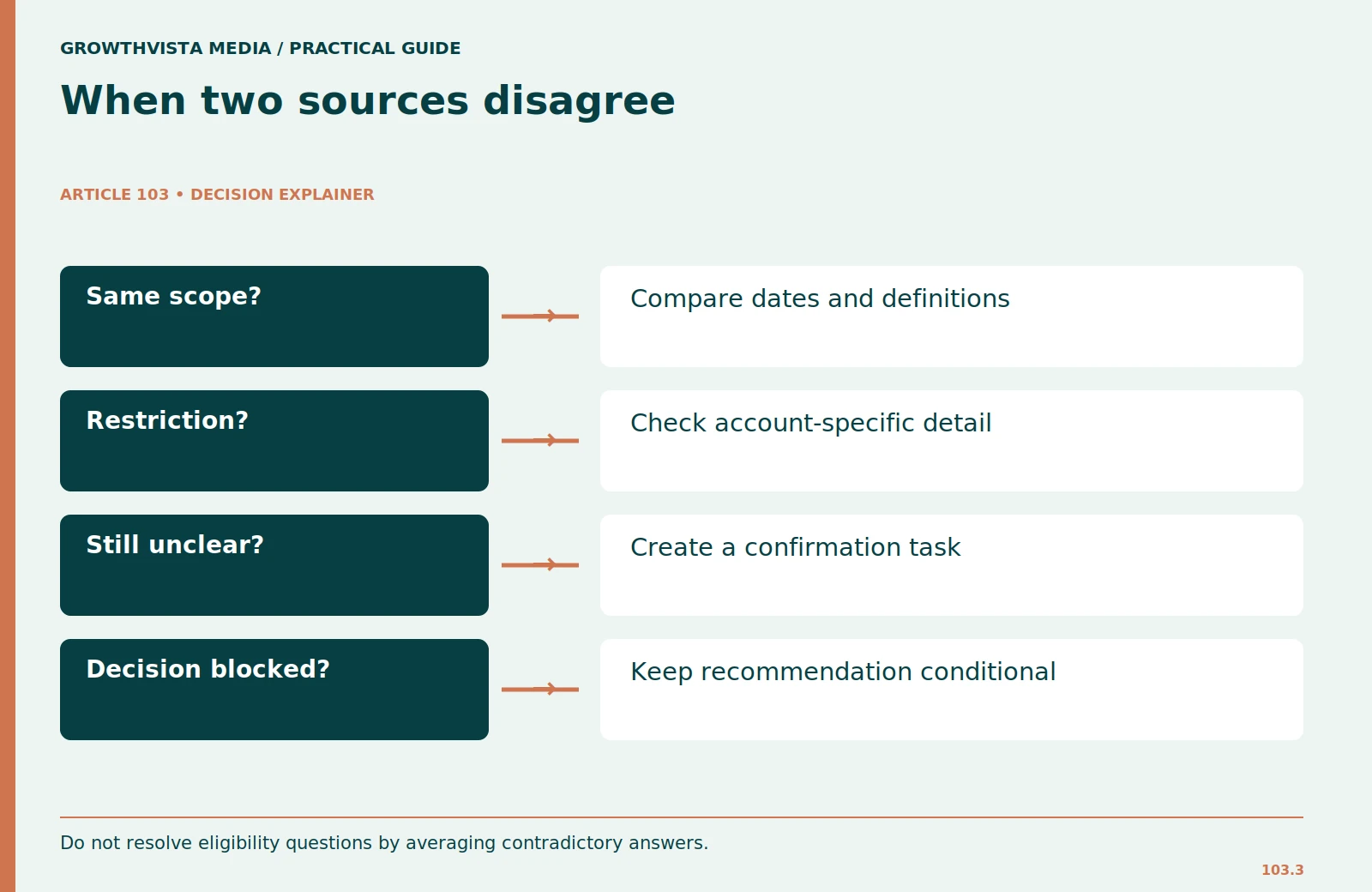
When research sources conflict, compare their dates, definitions, geographic scope, and applicable conditions. If the disagreement cannot be resolved, document the uncertainty and identify what additional evidence or testing is needed.
When two sources disagree, first check whether they discuss the same thing. They may describe different dates, plans, regions, configurations, or definitions. Put the conflict into a small comparison table rather than asking the assistant to choose the more confident wording.
For example, a public overview may mention a feature while an account-specific page describes restrictions. The account-specific restriction may be the relevant issue for your purchase. If the sources do not resolve the difference, write the question you need to ask the provider or answer through a trial.
Do not convert uncertainty into a numerical average unless averaging is meaningful for the underlying data. Product eligibility and contractual conditions are usually not resolved by taking a midpoint. Keep a separate “needs confirmation” list with an owner and an intended way to check each item.
How Do You Create an Evidence-Based AI Research Brief?
Create an evidence-based AI research brief by organizing verified claims into a clear structure containing the research question, established facts, available options, unresolved issues, and recommended next actions. Link important statements to their corresponding evidence records.
Provide the verified ledger and request a brief with five parts: decision question, established facts, options, unresolved issues, and next actions. Require claim identifiers beside important statements. Ask the assistant to keep its recommendations separate from the evidence and explain which assumptions drive them.
A useful prompt is: “Use only the attached ledger for factual claims. Reference the row IDs. Do not infer missing plan eligibility. Describe what we can decide now and what must be tested. Keep the recommendation conditional on the unresolved export requirement.” This limits the synthesis to a reviewable packet.
Read the result for compression errors. Summaries can remove exceptions or merge different requirements into one sentence. Verify that a cautious source has not become an absolute claim. The assistant’s final wording should preserve the strength of the evidence, not merely its subject.
How Do You Turn AI Research Into Actionable Decisions?
Turn AI research into actionable decisions by identifying what the evidence supports, what remains uncertain, and which actions are required before making a final commitment. Assign responsibility for verifying unresolved issues and preserve the supporting documentation.
A decision document should make the next step clear. In our illustrative support-software scenario, the outcome could be “shortlist two systems for an export and permission trial” rather than “buy the best platform.” This is a useful conclusion if the evidence is not sufficient for a purchase.
Include a small assumptions box and a list of decision blockers. Assign an owner to each blocker: operations checks workflow fit, an administrator checks permissions, and the budget owner checks current fees. These are suggested roles for the example, not universal organizational requirements.
Store the brief, ledger, and source links together. Name the files so another reviewer can identify the version and research date. If a source changes later, you can see which conclusion needs rechecking without repeating the entire project.
How Do You Keep AI Research Accurate Over Time?
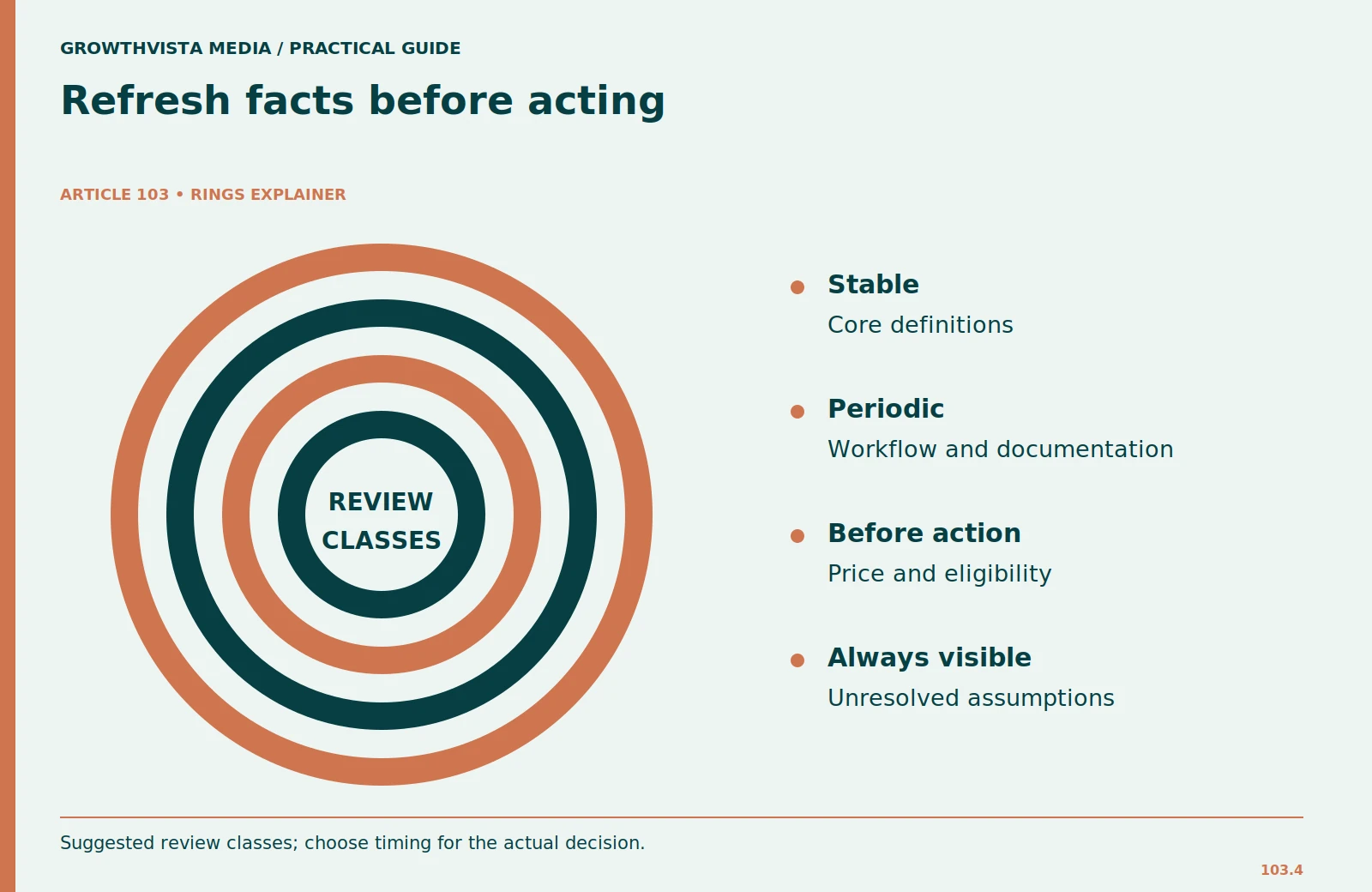
Keep AI research accurate by reviewing time-sensitive claims, updating supporting sources, and maintaining a record of changes. Recheck pricing, product capabilities, eligibility, and other decision-critical information before taking action.
Some information remains useful for months, while prices, feature limits, and eligibility can change quickly. Mark each important claim as stable, periodically reviewed, or checked before action. This is an editorial classification you assign based on the decision, not a guarantee about the source.
Before signing a contract or changing a system, revisit the claims that could invalidate the choice. Record new evidence and update the ledger status. Keep earlier versions when they explain why the original decision was reasonable. An AI research workflow is complete when its output can be checked and maintained, not merely when the assistant stops writing.
How Do You Create an Evidence-Based AI Research Brief?
AI Research Verification Prompt Template
Research question: [Enter the decision or question]
Research scope: [Define the audience, geography, time period, and exclusions]
Instructions:
- Use only the supplied sources for factual claims.
- Identify the supporting source for each important claim.
- Separate verified facts from assumptions and interpretations.
- Flag missing information and contradictory evidence.
- Do not invent statistics, citations, product features, or conclusions.
- Create a claim ledger with source references and verification status.
- Produce a research brief with established facts, unresolved questions, and recommended next actions.
Required output: A structured research brief containing traceable claims and clearly labeled uncertainty.
Important: Do not mark claims as verified unless their supporting passages have been checked.
AI Research Verification Checklist
Before using AI-generated research to support a decision, review the following:
- Research Question: Is the question specific and clearly defined?
- Source Quality: Are important claims supported by appropriate original or authoritative sources?
- Citation Accuracy: Have the original references and supporting passages been checked?
- Claim Verification: Are verified facts separated from assumptions and interpretations?
- Numerical Accuracy: Have calculations, units, dates, and percentages been independently checked?
- Contradictions: Are conflicting sources documented and investigated?
- Research Scope: Are geography, product versions, account restrictions, and relevant time periods considered?
- Uncertainty: Are missing facts and unresolved questions clearly identified?
- Decision Readiness: Does the final brief explain what can be decided and what requires further confirmation?
- Review Plan: Is there a process for updating time-sensitive claims?
Final check: An AI research report should be considered decision-ready only when its important claims are traceable to verified evidence and its remaining uncertainties are clearly documented.
Frequently asked questions
What are the steps in an AI research workflow?
An AI research workflow typically involves defining a question, collecting reliable sources, creating a claim ledger, verifying citations, resolving contradictions, synthesizing findings, preparing a decision brief, and updating time-sensitive information.
How can I prevent AI hallucinations during research?
Reduce unsupported claims by providing reliable source material, requiring evidence references, checking citations, and instructing the assistant to identify missing information rather than invent answers. Human verification remains necessary.
Can ChatGPT be used for academic or business research?
AI assistants such as ChatGPT can help organize questions, summarize supplied materials, and structure research findings. However, important factual claims, citations, calculations, and conclusions should be independently verified.
What is the difference between AI research and verified research?
AI-assisted research uses artificial intelligence to help gather, organize, or synthesize information. Verified research additionally checks important claims against appropriate evidence and documents uncertainty, limitations, and conflicting findings.
How do you know whether an AI research report is reliable?
Evaluate whether its important claims are supported by accessible sources, whether citations match the original passages, whether numerical information is correct, and whether uncertainties are clearly disclosed.
Can I use AI-generated citations directly?
Treat them as leads. Open the original sources and confirm that each supports the associated claim before using it in a decision document.
How many sources are enough?
Use enough to cover the decision-critical questions and conflicts. A fixed source count is less useful than complete, relevant evidence.
What if no source confirms a feature?
Mark the claim unresolved and define a provider question or trial. Do not turn an absent answer into an assumed yes.
Is this workflow only for product research?
No. The question, ledger, verification, and synthesis stages also work for public-policy summaries, market briefs, and internal planning when appropriate sources are available.
Sources and further reading
Official documentation supports the provider-specific and publishing guidance above. Workflows, examples, and rubrics are editorial methods, not vendor performance findings.
Related guides
Continue with these related practical guides.