Best Power Banks for Travel in 2026: 10 Portable Chargers Compared
The best power banks for travel in 2026 need to balance useful capacity, fast USB-C charging, manageable weight and airline-friendly battery limits.
Explore more in our Electronics guides. For primary product information, see the official Anker and UGREEN websites.
How We Compared the Best Power Banks for Travel
A travel power bank has to solve two competing problems: carry enough energy to matter, but remain small enough to carry everywhere.
For a weekend trip, a compact 10,000mAh model may be enough. Remote workers and laptop users often benefit from 20,000mAh or more plus 65W-140W USB-C output. Frequent flyers also need to pay attention to watt-hours, because airline rules are based on battery energy rather than the large mAh number printed on the box.
This guide compares 10 current travel-oriented options and explains how capacity, output, weight, cables and airline rules affect the choice. Exact regional models and listings can change, so verify the SKU before purchase.
What We Looked For
- Air-travel-friendly energy rating
- Useful capacity-to-weight balance
- USB-C Power Delivery output
- Laptop charging where applicable
- Fast self-recharging
- Built-in cable convenience
- Port selection and simultaneous charging
- Clear battery/status display
- Manufacturer documentation and travel suitability
Quick Comparison
| Power Bank | Capacity / Energy | Max Output | Travel Role | Check Price |
|---|---|---|---|---|
| Anker Prime Power Bank (26K, 300W) | 26,250mAh / 99.75Wh | 300W total; up to 140W single USB-C | Heavy laptop/multi-device travel | Check at Amazon → |
| Anker Prime Power Bank (20K, 220W) | 20,100mAh | 220W total; up to 140W USB-C | Performance/portability balance | Check at Amazon → |
| Anker Nano Power Bank 10K 30W | 10,000mAh class | 30W class | Compact phone/tablet travel | Check at Amazon → |
| UGREEN Nexode 25K 145W | 25,000mAh / about 90Wh | 145W total class | High-capacity laptop travel | Check at Amazon → |
| UGREEN Nexode 20K 100W | 20,000mAh / 72Wh | 100W | Laptop + phone travel | Check at Amazon → |
| UGREEN Nexode 20K 67W Built-In Cable | 20,000mAh / 72Wh | 67W | Cable-light business travel | Check at Amazon → |
| UGREEN Nexode 10K 55W Built-In Cable | 10,000mAh / 36Wh | 55W proprietary/PPS; 45W USB PD | Compact fast charging | Check at Amazon → |
| INIU 27K 140W class | 27,000mAh / near 100Wh class | 140W class | Value-oriented laptop travel | Check at Amazon → |
| INIU 25K 100W class | 25,000mAh / low-90Wh class | 100W class | High capacity with lighter carry focus | Check at Amazon → |
| Anker 20K 87W class | 20,000mAh / about 74Wh | 87W class | Phone + light-laptop travel | Check at Amazon → |
1. Anker Prime Power Bank (26K, 300W)
Anker’s current Prime 26K is designed for travelers who need unusually high output without crossing the common 100Wh airline threshold.
Anker lists a 26,250mAh battery rated at 99.75Wh, 300W total output, up to 140W from a compatible single USB-C connection and very high dual-port recharging capability. A smart display and app controls are aimed at users who want detailed charging information.
This is more power bank than a phone-only traveler needs. Its value is for users carrying high-performance laptops, tablets and multiple devices who want one battery instead of several smaller packs.
Because it sits very close to 100Wh, verify the printed Wh rating and the rules of the airline and country involved before flying.
2. Anker Prime Power Bank (20K, 220W)
The Prime 20K reduces capacity and size while keeping unusually high charging output.
Current Anker specifications list 20,100mAh capacity, up to 220W total output, up to 140W on USB-C and up to 100W USB-C input. Anker lists the unit at about 510g.
This configuration is attractive for business travelers who need to fast-charge a laptop but do not want to carry a near-100Wh battery every day.
The 220W headline is total output; individual devices remain limited by the relevant port, cable and device charging protocol.
3. Anker Nano Power Bank 10K 30W
A 10,000mAh Anker Nano-class model is better suited to travelers whose main devices are phones, earbuds and tablets rather than large laptops.
The smaller capacity cuts weight and bulk, while 30W-class USB-C charging is enough for many phones and smaller devices.
This is the kind of power bank that is easier to keep in a day bag after reaching the destination. For many travelers, consistent everyday carry is more valuable than maximum battery capacity.
Verify the exact Nano SKU because Anker sells multiple 10,000mAh configurations, including versions with built-in cables.
4. UGREEN Nexode 25K 145W
UGREEN’s 25,000mAh 145W-class Nexode is designed for laptop-heavy travel while remaining below 100Wh in current manufacturer documentation.
UGREEN lists this travel-oriented class at about 90Wh, with up to 140W available from a compatible single USB-C output and 145W-class total output.
That combination makes sense for MacBook Pro, Windows laptop and multi-device users who want high capacity but still need an airline-friendly battery class.
As with any high-wattage bank, use a cable rated for the required current and verify that the laptop supports the relevant USB Power Delivery profile.
5. UGREEN Nexode 20K 100W
UGREEN’s 20,000mAh 100W Nexode sits in a practical middle ground for laptop travel.
Current official documentation lists 20,000mAh capacity, 72Wh energy, up to 100W through USB-C1, a second USB-C port up to 30W and USB-A up to 22.5W. The power bank can recharge at up to 65W and includes a digital battery display.
At roughly 420g in current specifications, it provides substantially more laptop capability than a small phone bank without moving into the heaviest near-100Wh class.
For a MacBook Air, many ultrabooks and tablets, 100W is more than enough output; the connected device decides how much power it actually draws.
6. UGREEN Nexode 20K 67W with Built-In USB-C Cable
This model trades maximum wattage for a particularly useful travel feature: a built-in USB-C cable.
UGREEN’s current specification lists 20,000mAh / 72Wh, 67W maximum USB-C output, up to 65W self-recharging, a built-in braided USB-C cable, an additional USB-C port, USB-A and a digital display.
For travelers who use a 45W-65W-class laptop, tablet and phone, 67W can be enough while reducing the chance of forgetting the primary cable.
When multiple devices charge simultaneously, available power is shared, so do not assume each port maintains its maximum single-device rating.
7. UGREEN Nexode 10K 55W with Built-In Cable
UGREEN’s compact 10,000mAh Nexode model is aimed at users who want faster charging than a basic phone bank without carrying 20,000mAh.
Current UGREEN documentation lists 36Wh energy, a built-in USB-C cable, USB-C and USB-A connectivity, with up to 55W on compatible proprietary/PPS charging and up to 45W through standard USB Power Delivery. It weighs about 249g in the current India specification.
This is a useful short-trip option for phones, tablets and compatible lightweight laptops, but buyers should distinguish the 55W maximum protocol claim from the listed 45W USB PD output.
8. INIU 27,000mAh 140W-Class Power Bank
INIU’s 27,000mAh 140W class is worth investigating for travelers seeking near-maximum airline-friendly capacity and laptop-level output at a competitive position in the market.
Current travel comparisons place this class near the 100Wh threshold with 140W-class USB-C output. Because INIU model numbers and regional listings can vary, confirm the exact capacity in Wh, port allocation and included cable before purchase.
This category makes most sense for laptop-heavy trips. Phone-only travelers will carry unnecessary weight.
9. INIU 25,000mAh 100W-Class Power Bank
The 25,000mAh 100W class is a more moderate alternative for travelers who want high capacity and laptop charging without chasing maximum output.
A 100W USB-C connection covers many travel laptops, while the roughly 90Wh-class battery remains below the common 100Wh threshold when the exact model is rated accordingly.
Verify the exact INIU SKU and printed Wh rating on the current listing before publication and before flying.
10. Anker 20K 87W-Class Power Bank
Anker’s 20,000mAh 87W class targets the broad middle of the travel market: enough output for many light laptops and enough capacity for several phone charges without the weight of a 25K-27K flagship.
This category is particularly useful for users carrying a phone, tablet and USB-C notebook on short business trips.
Anker sells multiple 20K variants, so verify the exact model number, built-in cable configuration and port-level output before adding an Amazon product link.
Which Capacity Makes Sense for Your Trip?
| Travel Pattern | Capacity Class | Why |
|---|---|---|
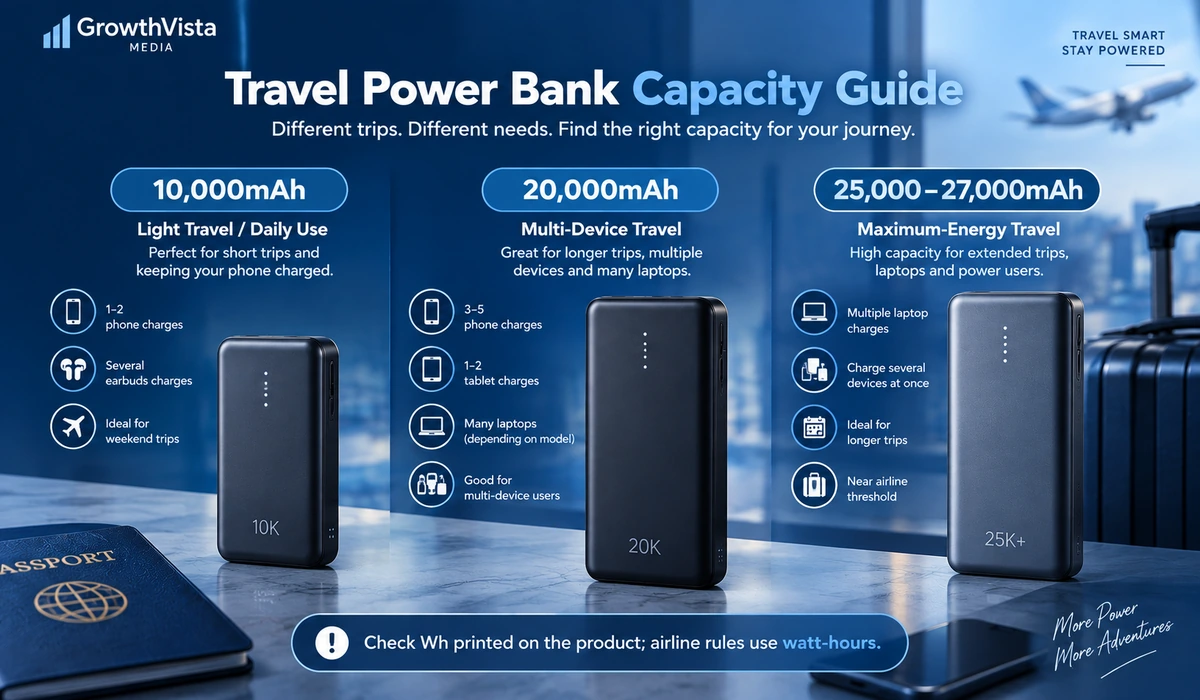
| Day trip / city travel | 5,000-10,000mAh | Lower weight; phone-focused backup |
| Weekend trip | 10,000-20,000mAh | Good balance for phone/tablet and occasional laptop use |
| Business trip with laptop | 20,000mAh / ~72-74Wh | Enough energy with 65-100W-class laptop options |
| Long-haul / power user | 25,000-27,000mAh / ~90-100Wh | More laptop energy while staying near common airline threshold |
| Outdoor trip without flights | Depends on needs | Larger batteries may make sense, but airline portability is less relevant |
Airline Rules: Look at Wh, Not Just mAh
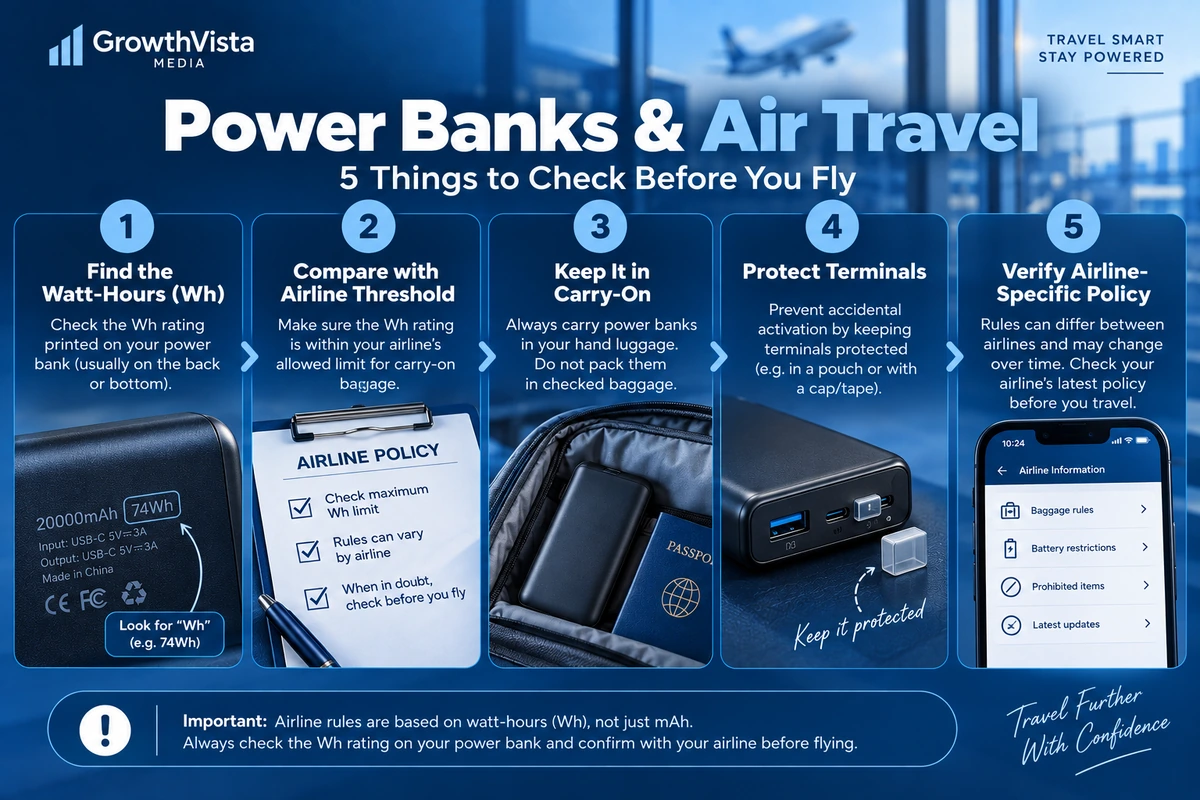
Power-bank travel rules are based on watt-hours. A manufacturer should print the Wh rating on the product or documentation.
A widely used international baseline allows spare lithium-ion batteries and power banks up to 100Wh in carry-on baggage, while larger batteries can require airline approval and additional restrictions. Power banks generally should not be placed in checked baggage.
Airline and national rules can be stricter and have changed in recent years. Always check your airline’s current policy before travel, particularly for high-capacity batteries.
Do not rely only on a retailer’s phrase such as ‘flight approved.’ The printed Wh rating and current airline rule are what matter.
Why 20,000mAh Is a Popular Travel Size
Around 20,000mAh is a useful compromise because it can store roughly 72-74Wh depending on cell design while remaining meaningfully smaller than near-100Wh flagship models.
It is large enough to support laptop charging in high-output models, but still practical in a backpack. The trade-off is weight: a 20K laptop bank can weigh roughly 400-500g depending on design.
For phone-only trips, a 10K bank is often easier to carry.
Laptop Charging: Wattage Matters as Much as Capacity
A large battery does not guarantee that a laptop will charge quickly.
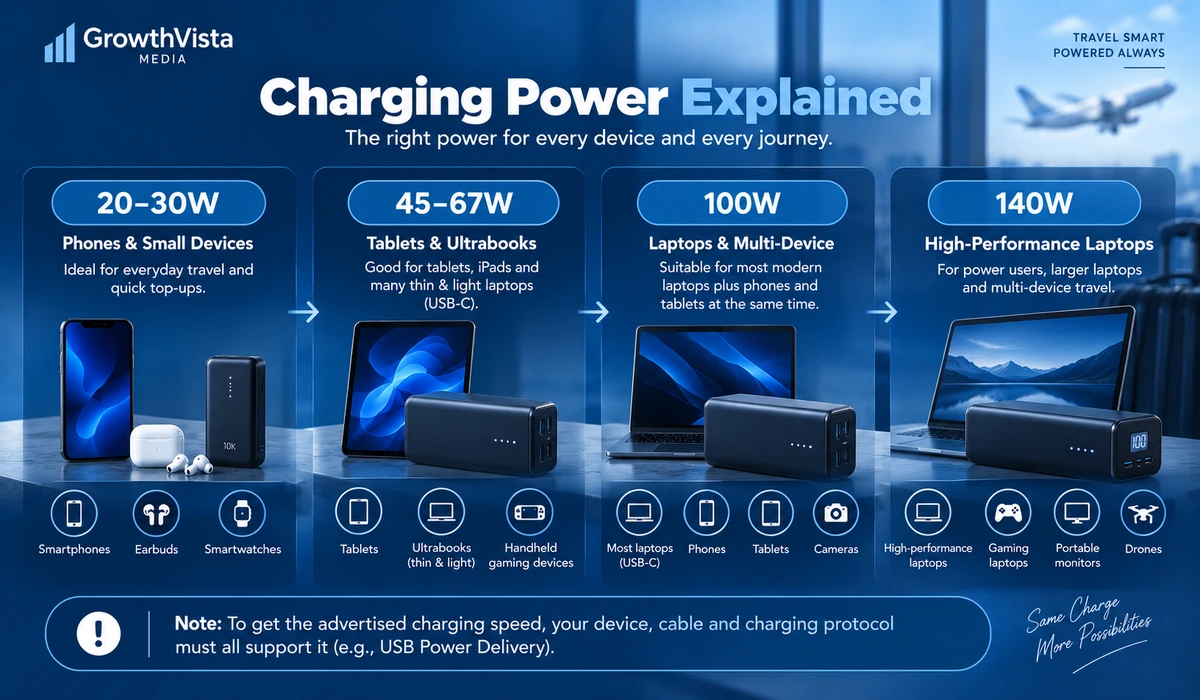
Check the laptop’s USB-C Power Delivery requirement. Many thin-and-light laptops are comfortable around 45W-65W, while higher-performance machines can benefit from 100W or 140W-class USB-C PD.
The cable matters too. High-power USB-C modes can require an appropriately rated E-marked cable.
Built-In Cable vs Separate Cable
Built-in cables reduce travel clutter and make the power bank more self-contained. They are especially useful for commuters and short trips.
A separate cable is easier to replace if damaged and lets you choose length. For important travel, carrying one spare USB-C cable is sensible even when the bank has an integrated cable.
Fast Recharging Matters on Multi-City Trips
A large power bank that takes most of the night to refill can be frustrating when travel days are close together.
High-input models can recharge much faster when paired with a sufficiently powerful USB-C charger.
Check input wattage separately from output wattage; they are not necessarily the same. A 100W output bank may accept only 65W input, while premium models can accept substantially more.
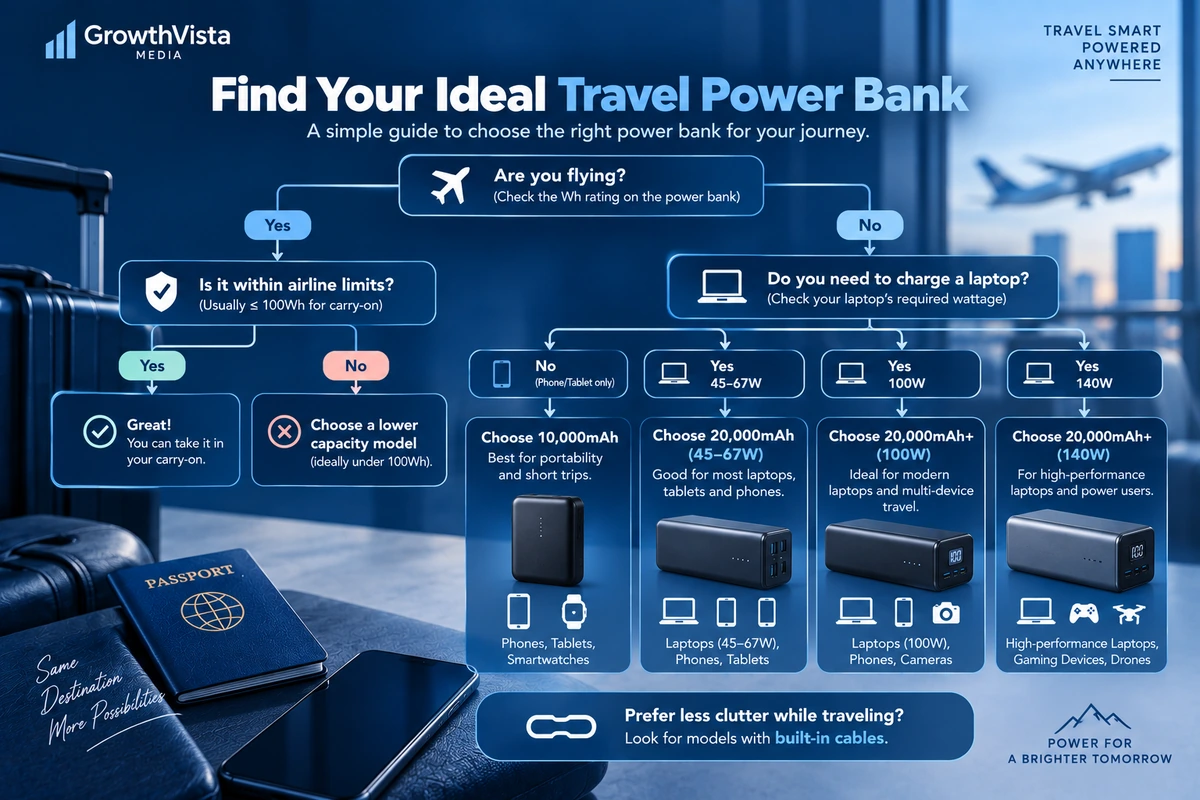
How to Choose a Travel Power Bank
- Check the exact Wh rating and your airline’s current rules.
- Choose 10K for light carry, 20K for balanced travel, or near-100Wh only if you need the energy.
- Match USB-C output to the highest-power device you actually carry.
- Check the number of USB-C ports and how power is shared.
- Verify self-recharge input speed.
- Decide whether a built-in cable is worth the convenience.
- Compare weight, not only capacity.
- Use a properly rated USB-C cable for high-wattage charging.
- Verify the exact model/SKU before buying because similarly named variants can differ.
Frequently Asked Questions
What size power bank is best for travel?
10,000mAh is convenient for phone-focused travel, while 20,000mAh is a strong balance for multiple devices and many USB-C laptops. Near-100Wh models suit heavier laptop use.
Can I take a 20,000mAh power bank on a plane?
Many 20,000mAh power banks are around 72-74Wh and below the common 100Wh threshold, but always check the printed Wh rating and your airline’s current policy.
Can power banks go in checked luggage?
Power banks are generally treated as spare lithium batteries and should be carried in cabin baggage rather than checked baggage. Verify current airline rules.
How many watts do I need to charge a laptop?
It depends on the laptop. Thin-and-light models often use 45W-65W USB-C charging, while more powerful laptops may use 100W or 140W-class USB-C PD.
Is 100W output better than 65W?
Only if your device can use the extra power. A 65W laptop gains little from a 100W bank if it never draws more than 65W.
What does 99Wh mean on a power bank?
Watt-hours measure stored energy and are the unit airlines use for lithium-battery limits. Near-99Wh power banks maximize capacity while staying below the common 100Wh threshold.
Are built-in power-bank cables reliable?
They are convenient, but a fixed cable can be harder to replace. Carrying a spare cable is sensible on important trips.
Can one power bank charge a laptop and phone together?
Many multi-port models can, but total output is shared. Check the manufacturer’s multi-port power allocation.
Does a 20,000mAh bank really deliver 20,000mAh to my phone?
No. Conversion losses and voltage differences mean usable output is lower than the internal cell-capacity number.
Should I buy the biggest airline-safe power bank?
Only if you need the energy. Near-100Wh banks are heavier; a smaller 10K or 20K model is often more comfortable for everyday travel.
Final Thoughts
When comparing the best power banks for travel, prioritize the workflow and specifications that match your actual use case rather than choosing on headline features alone.
The best travel power bank is the smallest model that reliably covers your devices and trip length.
For phone-focused trips, a compact 10K model is easier to live with. A 20K bank is the practical middle ground for business travel, while 25K-27K models near 100Wh make sense for users who regularly charge laptops away from outlets.
High-output Anker Prime and UGREEN Nexode models are worth investigating for laptop-heavy travel, while smaller built-in-cable options reduce the number of accessories you need to pack.
Before buying, verify the exact model, Wh rating, port-level output and current airline policy. For Amazon links, use the exact verified SKU or a tagged search link rather than guessing an ASIN.