Edit AI Writing: Turn a Draft Into a Useful Article
Editorial scope: Researched practical guide. Examples are illustrative, not hands-on product benchmarks. Reviewed October 2026.
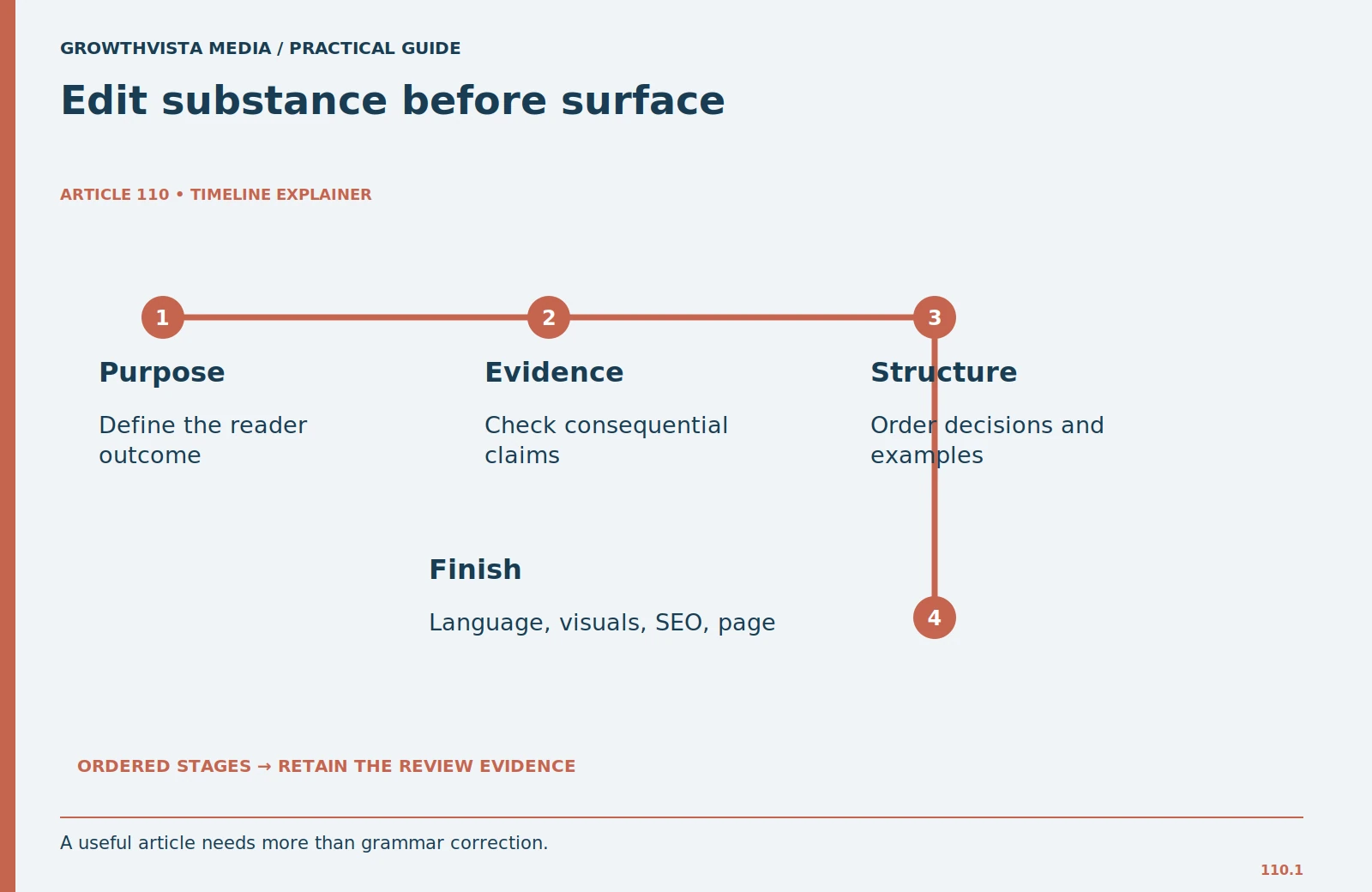
To edit AI writing well, start by asking whether the draft answers a real reader question. Grammar is only one part of the job. A smooth article can still repeat familiar advice, include unsupported claims, or hide the useful answer beneath a long introduction.
This guide shows how to turn a draft into a publication-ready working article. It covers research, structure, examples, language, visuals, and Rank Math fields. The before-and-after examples are invented editorial exercises, not quotations from another publication or evidence of actual product testing.
Edit AI writing by defining the reader outcome
Write one sentence describing what the reader should be able to do after the article. For example: “Choose a storage device that works with their computer and intended transfer workflow.” This is more actionable than “learn about the best storage devices.” Use that outcome to judge every section.
Identify the reader's starting knowledge and constraints. A beginner needs explanations of compatibility and units. An experienced buyer may need specific trade-offs and a comparison method. Do not combine several unrelated audiences into one article unless the structure clearly separates their needs.
Read the draft and mark paragraphs that do not support the outcome. Remove or rewrite broad introductions, repeated conclusions, and generic benefits. A shorter draft with a clear purpose can be a stronger foundation for a detailed article than a long one containing little decision support.
Build a claim inventory before polishing
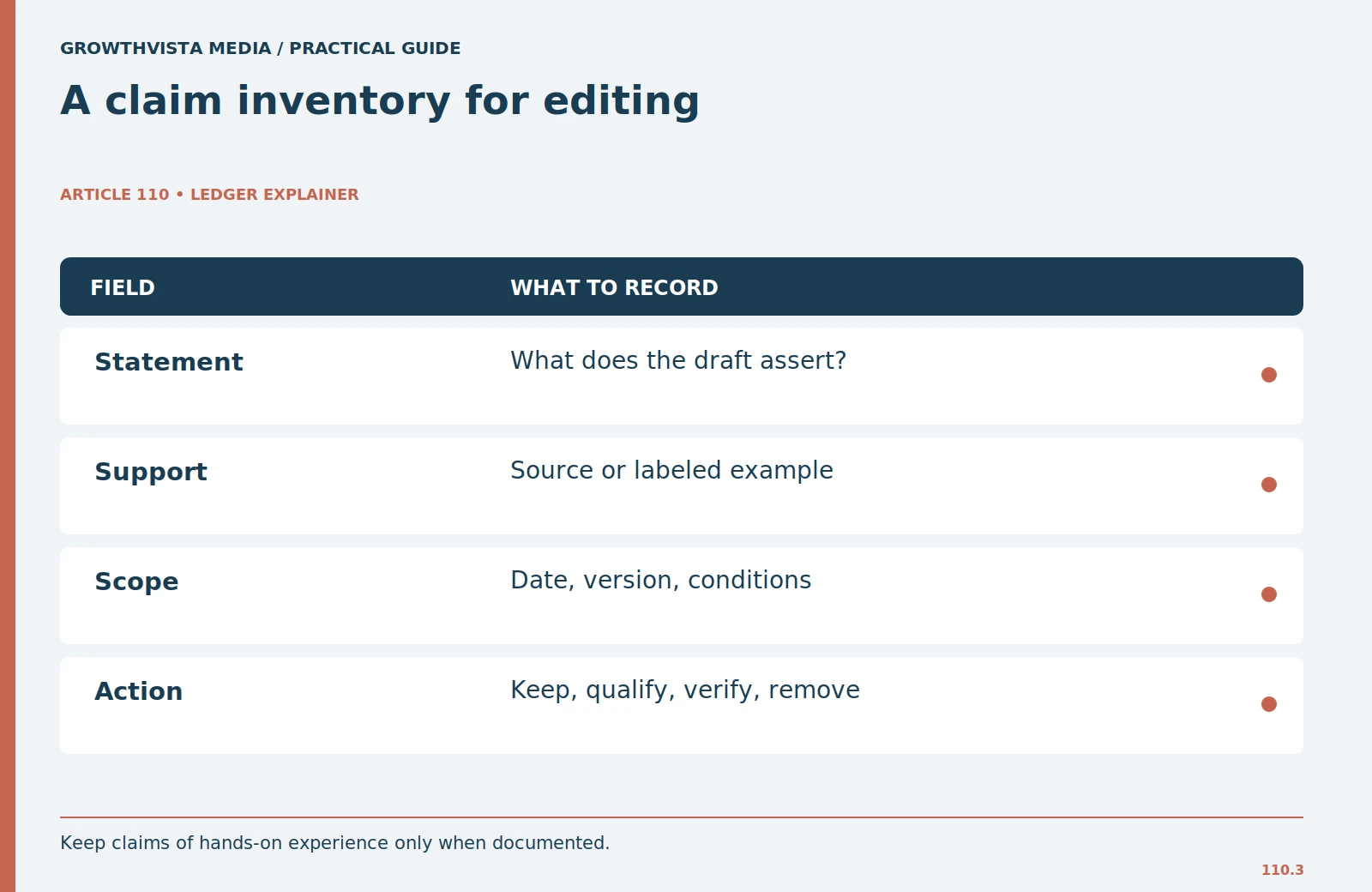
Highlight factual statements, numbers, product capabilities, and claims of experience. Give each important claim a source or remove it. Distinguish facts supplied by an official document from interpretation and from hypothetical examples. Do not let a smooth narrative merge those categories.
Check the scope of each source: date, region, account, version, and conditions. If the draft says a tool “supports every file,” replace the phrase with a verified description or a question the reader should check. Broad absolute claims are often less useful than a precise boundary.
Never retain invented hands-on language. Statements such as “we tested,” “our results,” or “customers reported” require actual documented evidence. If the article is a researched guide, say what it is and provide the relevant sources. Transparency makes the review easier and prevents the visuals from implying experience you do not have.
Rebuild the outline around decisions and obstacles
Put the direct answer or framework near the beginning. Then organize the article around the decisions the reader needs to make. A compatibility guide might cover connection type, real workflow, capacity, performance constraints, and buying checks. Each heading should identify a useful part of the answer.
Combine sections that repeat the same point. Move prerequisites before steps that depend on them. Place cautions near the action they affect rather than in a generic disclaimer at the end. A reader should not have to discover a crucial limitation after following the process.
Create a contents list after the outline is stable. Check that every anchor points to the intended heading. If the article is long, short section introductions and informative headings make it easier to scan without reducing the depth of the explanation.
Add specific examples that teach a method
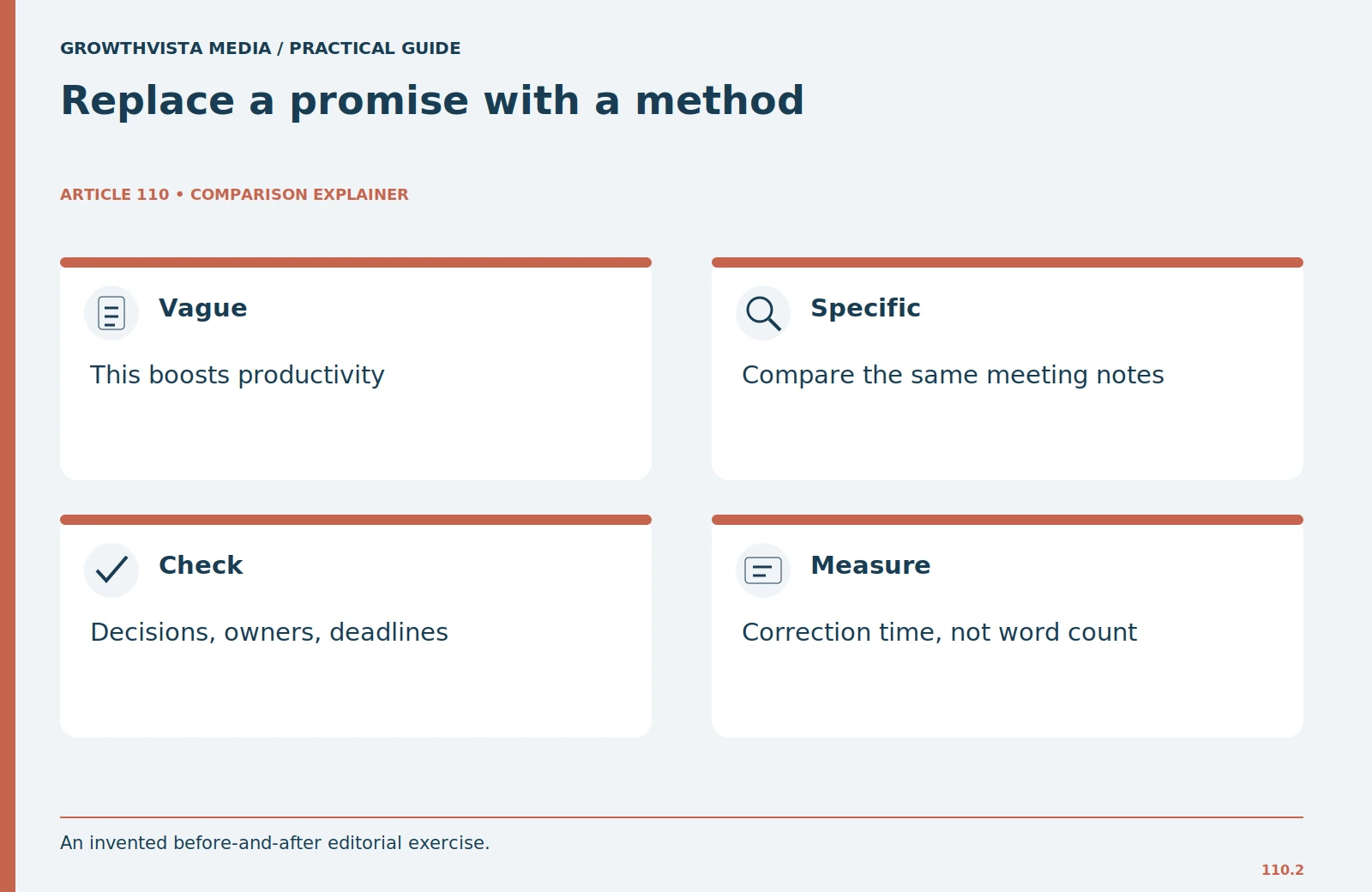
Replace vague claims with a worked situation. Instead of “this saves time,” show how a reader would compare manual and assisted task time, including review. Label invented numbers as hypothetical and explain the assumptions. Do not present the illustration as a measured product result.
Here is a simple before-and-after exercise. Before: “An AI assistant boosts productivity and makes your work seamless.” After: “Use the same meeting notes to compare two drafts. Check whether each preserves decisions, owners, and deadlines, then record the time needed to correct missing details.” The second version teaches a repeatable action.
Include at least one failure case. Explain what to do if a file cannot be exported, a source does not support a claim, or an answer assumes missing information. A useful article helps readers recover from ordinary problems rather than describing only the ideal path.
Replace generic language with precise sentences
Read each sentence for the action, object, and consequence. Prefer “check the export in your spreadsheet” to “ensure seamless integration.” Replace exaggerated adjectives with the condition that makes the feature useful. If you cannot explain that condition, the sentence may not need to remain.
Remove repetitive transitions and punctuation that do not fit the publication's style. If your editorial rule avoids em dashes, replace them with ordinary sentence structure rather than mechanically substituting another symbol. Keep paragraphs connected and use lists when the items are genuinely parallel.
Do not chase a detector score or deliberately introduce mistakes. Edit for clarity, accuracy, and a recognizable editorial voice. A human-sounding sentence without useful information is still weak content. The goal is an article readers can act on and reviewers can defend.
Choose visuals that explain distinct relationships
Map each planned image to a section and a reader question. Use a decision tree for branching choices, a process diagram for ordered stages, a comparison matrix for trade-offs, and a worked example for a calculation. Avoid repeating the same decorative stock-style scene four times.
For precise numbers and labels, create graphics from verified content. Mark hypothetical values clearly and ensure the text explanation includes the same information. A generated editorial cover can introduce the topic, but it should not depict an invented test as though it happened.
Check the featured title against the article title and preview it at small size. Write descriptive alt text and useful captions. On mobile, inspect whether the labels remain readable. If a graphic requires zooming to understand its main point, simplify it or provide the details alongside it as real text.
Add SEO fields after the substance is sound
Choose a focus keyword that describes the article's main intent. Use it naturally in the title, introduction, a relevant heading, and a descriptive image field where appropriate. Write a concise meta description explaining what the reader will gain. A descriptive URL should match the topic without becoming unnecessarily long.
Rank Math analyzes focus-keyword placement in fields such as the SEO title, description, URL, and content. Use those checks to catch omissions, then reread the article for awkward repetition. The plugin cannot verify an invented source or create a useful example on your behalf.
Google's guidance for AI-assisted content emphasizes original, helpful information rather than a particular production method. Keep internal links relevant and link to sources supporting consequential facts. Do not add links merely to satisfy a count. After import, run the actual content analysis in your WordPress editor rather than assuming metadata alone determines the score.
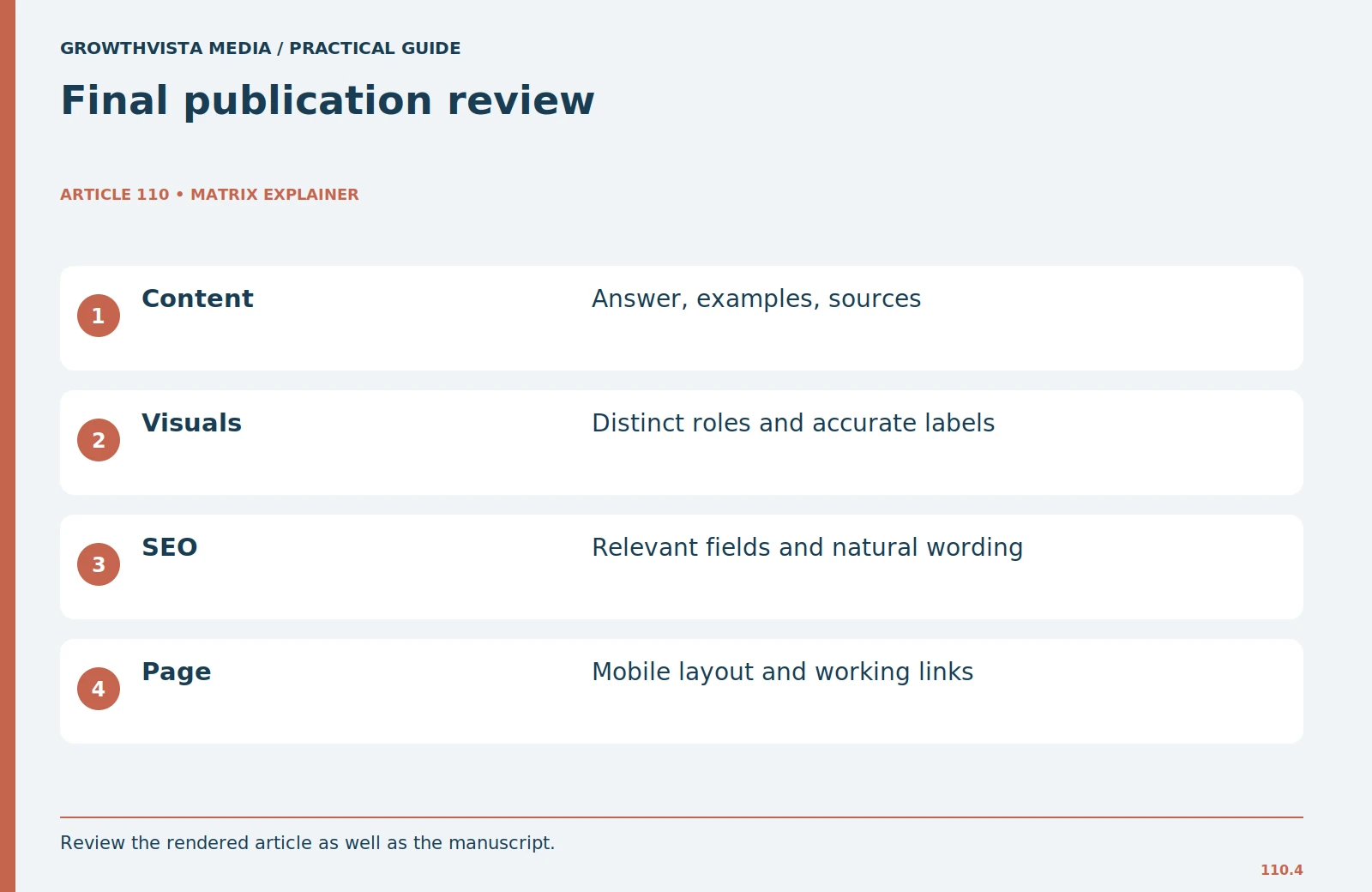
Perform a final editorial and page review
Read the finished article without the original prompt. Does the opening answer the intended question? Do examples have explicit assumptions? Are sources attached to the claims they support? Are there any unsupported experience statements or repeated sections? This independent pass often catches gaps that sentence-level editing misses.
Then inspect the rendered page. Check heading hierarchy, table behavior, contents links, images, captions, and mobile spacing. Verify that related links point to the intended guides and that draft-only links are handled before publication. A well-edited document can still become difficult to use in a poorly rendered page.
Keep a brief editorial note describing sources checked, visual scope, and any remaining time-sensitive items. Set an update task when a price, eligibility rule, or feature limit could invalidate the article. Publication is a reviewed version of the work, not the end of its maintenance.
Frequently asked questions
Should I rewrite every AI sentence?
No. Keep accurate, useful sentences that fit the voice. Spend effort on unsupported claims, weak structure, generic language, and missing reader guidance.
How long should the article be?
Long enough to answer the question with necessary explanation and examples. Do not expand it with repeated advice simply to reach a word count.
Can I remove all signs of AI writing?
Focus on editorial quality rather than disguising production. Clear sources, honest scope, specific examples, and a consistent voice matter more than superficial wording tricks.
What does Rank Math support mean?
It means supplying appropriate keyword and metadata fields and a well-structured body. It does not guarantee a particular score, indexing, or ranking.
Sources and further reading
Official documentation supports the provider-specific and publishing guidance above. Workflows, examples, and rubrics are editorial methods, not vendor performance findings.
- Google: guidance about AI-generated content
- Google: helpful, reliable, people-first content
- Rank Math: focus keyword analysis
Related guides
Continue with these related practical guides.