AI Writing Tools for Small Business: 7 Buying Checks

Editorial scope: Researched practical guide. Examples are illustrative, not hands-on product benchmarks. Reviewed October 2026.
AI writing tools for small business can help draft emails, product descriptions, outlines, and help-center material. The purchase becomes useful when it improves a defined writing process. A large feature list matters less than whether the tool preserves your facts and produces text your team can review efficiently.
This guide offers seven buying checks and a small trial you can run with sanitized material. It does not claim hands-on results for named products or recommend a universal winner. The examples are invented business scenarios intended to show how to evaluate your own workflow.
1. Match AI writing tools for small business to actual deliverables
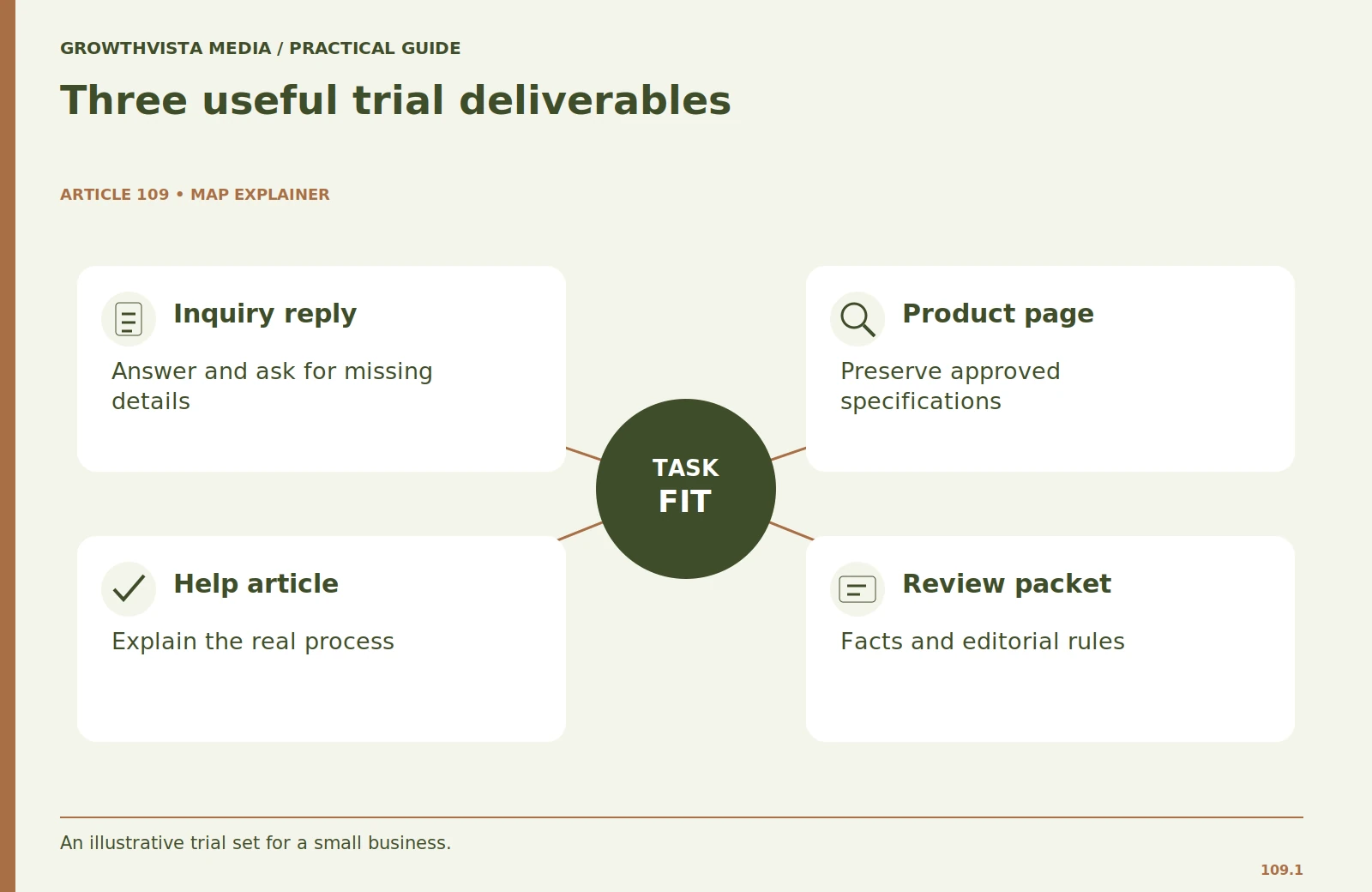
Choose three recurring deliverables, such as an inquiry reply, a product page, and a customer help article. Record the audience, purpose, approved source material, desired length, and publication channel. These requirements are more useful than a general request to “write marketing content.”
Separate tasks requiring original reporting from tasks that reorganize facts you already have. An assistant can help turn a verified specification sheet into a readable draft, but it should not invent customer experiences, product tests, or business policies to make that draft persuasive.
Pick a tool that fits the input and output of those tasks. A simple rewriting workflow may not need campaign automation, social scheduling, and broad app access. Starting with a narrow requirement makes it easier to compare options and avoid overlapping subscriptions.
2. Test factual control before judging the tone
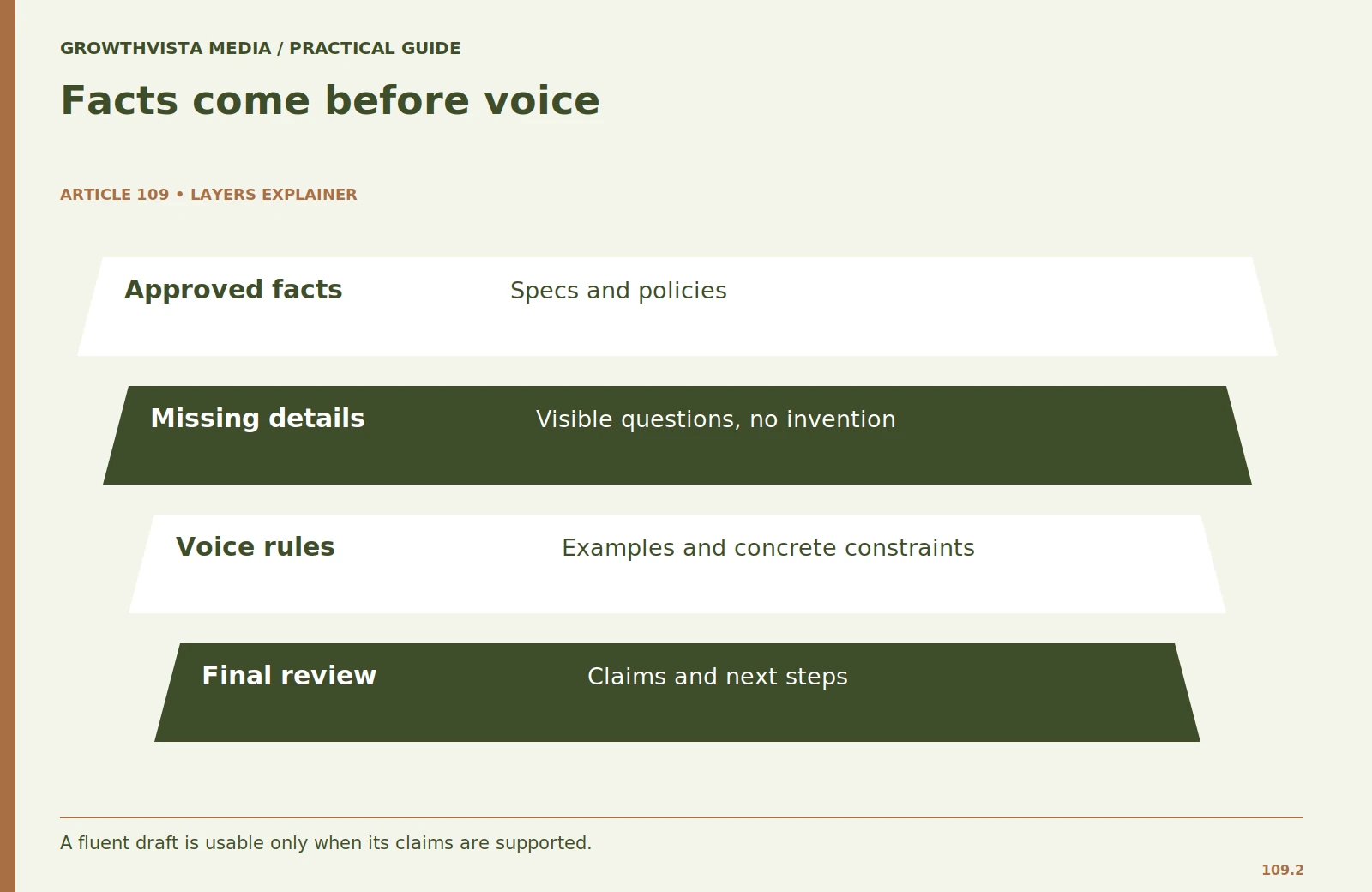
Prepare a short fact sheet with approved details and deliberate gaps. For a fictional shop, include materials, dimensions, delivery area, and a confirmed return policy. Leave the warranty period unspecified. Ask the tool to draft a product description using only the fact sheet and to list missing information separately.
Inspect whether the draft invents certifications, guarantees, shipping dates, or customer satisfaction claims. A polished sentence containing an unsupported promise is not usable copy. Record the exact errors so you can judge whether they are easy to correct or recur across tasks.
Repeat the test with a different product or service. One successful draft is not enough to establish reliability. Keep an approved facts file for real work and assign someone to maintain it when policies or specifications change.
| Deliverable | Required input | Approval check |
|---|---|---|
| Inquiry reply | Sanitized inquiry and approved facts | No invented price or deadline |
| Product page | Verified specification sheet | No unsupported claims |
| Help article | Actual process and known exceptions | Steps match the real workflow |
3. Build brand voice from examples and concrete rules
Provide a few approved examples and explain what makes them appropriate. You might prefer short sentences, specific benefits, restrained claims, and a direct next step. Identify words or punctuation you avoid, including em dashes if that is part of your editorial preference.
Do not rely on broad adjectives such as friendly or professional alone. Two writers can interpret them differently. A more useful instruction is: “Explain the practical benefit, avoid exaggerated claims, use ordinary language, and do not invent a customer’s reaction.”
Test voice on more than one channel. An inquiry reply and a product page need different structures even when they share a brand. The tool should adapt to the purpose while preserving the approved facts and editorial rules. If every draft sounds like the same advertisement, refine the brief or try a different workflow.
4. Check editing and collaboration features
Drafting is only one stage. Test how reviewers comment, revise, compare versions, and approve final copy. If your team already uses a document editor, check whether the assistant’s output fits that process rather than forcing everyone into a separate workspace.
Give a reviewer a draft without the original chat and ask whether they can locate the source facts and unresolved questions. This tests whether the process is reviewable outside the tool. Keep assumptions and placeholders clearly marked instead of hiding them inside polished prose.
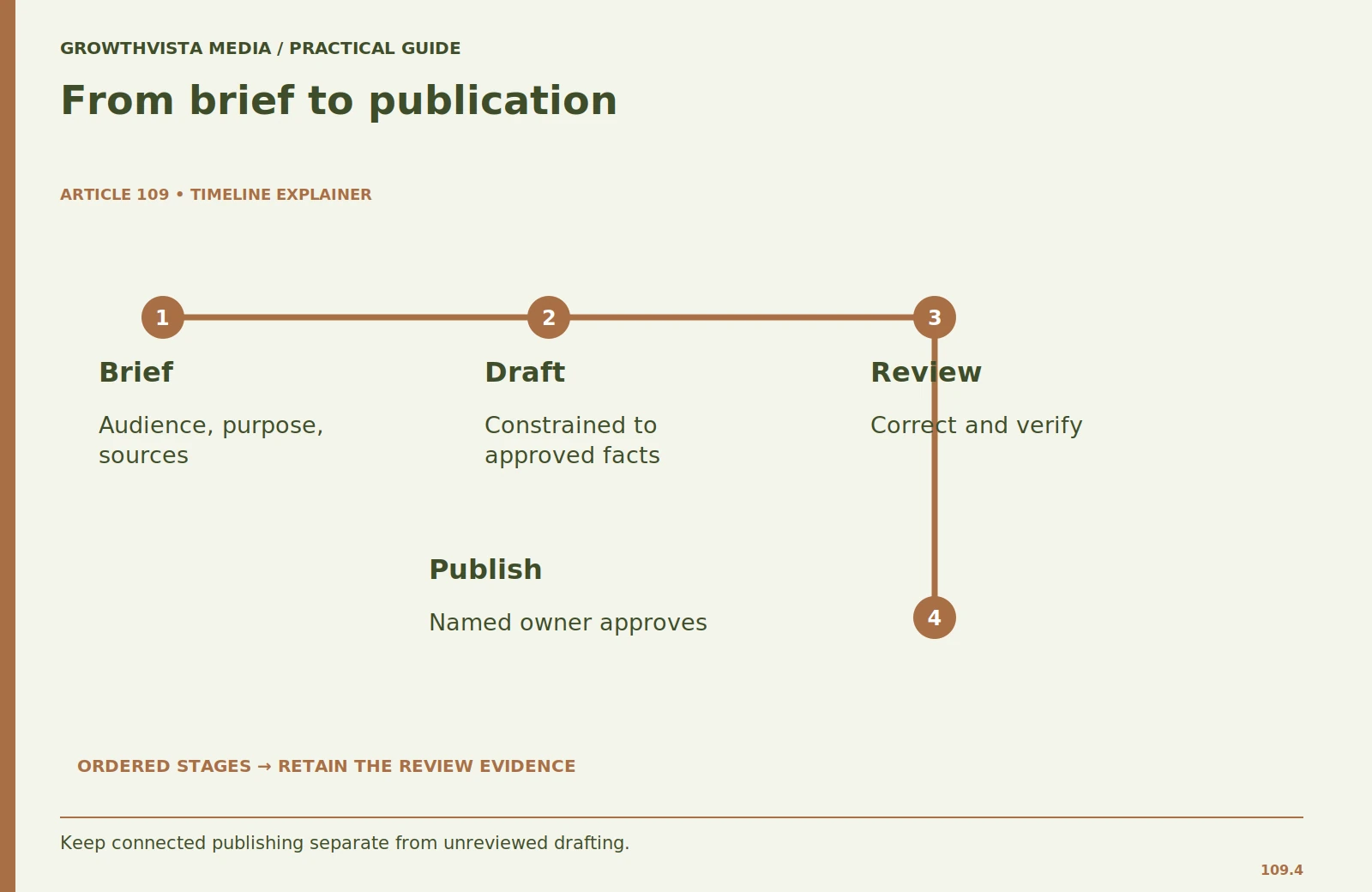
For a small team, define an owner for the fact sheet and an owner for publication. These can be the same person, but the responsibilities should be clear. A writing assistant should not automatically move an unreviewed draft into a live channel because it completed the text.
5. Inspect data handling and integrations
Review the privacy and account terms for the service you will actually use. Avoid uploading customer messages containing private details during the trial. A sanitized example can reveal whether the tool handles structure and tone without exposing the original customer’s information.
Check any connection to your website, email system, or document storage. Determine what it can read and whether it can publish or send. Start with draft-only output if that meets the need. The convenience of a connected workflow does not remove the need for an approval step.
Record account ownership and removal procedures for team members. Keep reusable briefs and approved source material in your normal business system as well, so the writing process does not depend on one person’s personal login or chat history.
6. Test SEO support as an editing aid
If you publish articles, test whether the tool can work with a clear search intent, descriptive title, relevant headings, and a concise meta description. Verify that the focus keyword appears naturally where it helps identify the topic. Do not reward a draft for repeating the same phrase until the text becomes awkward.
Rank Math describes focus-keyword analysis as checking placements such as the title, description, URL, and content. Those checks can assist editing, but they do not establish that an article is original, accurate, or useful. Read the article as a reader before relying on a plugin indicator.
Ask for a useful answer and supporting examples, then add SEO fields. Google’s people-first content guidance emphasizes value to readers. A writing workflow that produces many pages without new information has not solved the editorial problem, even if every metadata field is filled.
7. Compare the cost of approved copy
Track drafting, correction, fact checking, review, and publishing time. A tool that writes quickly but invents details may increase the total effort. Compare the finished deliverable with your manual baseline, not the time taken to display the first answer.
Use a bounded trial on your three tasks. Record which outputs were approved, what needed correction, and whether the tool created any recurring extra work. Include subscription fees, team seats, and separately billed usage where applicable. Confirm current terms directly rather than relying on a price quoted in an old article.
Adopt for the tasks that show practical benefit. Your decision might be to use the tool for internal outlines and inquiry drafts while keeping product claims and final publication under direct review. A narrow successful use is better than trying to automate every writing task immediately.
A small-business trial packet you can reuse
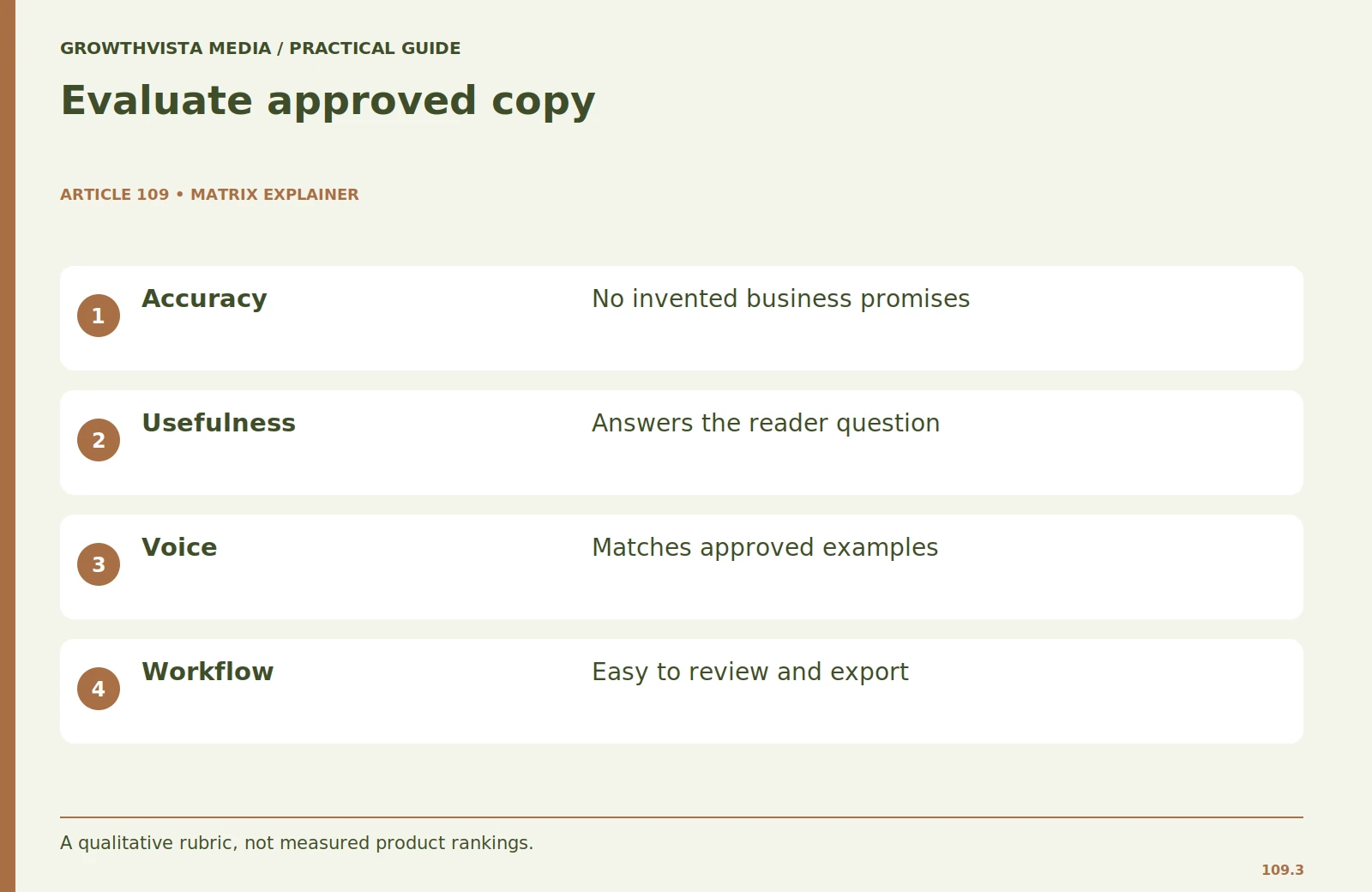
Include a one-page fact sheet, two approved writing examples, three task briefs, and an acceptance checklist. The checklist should cover factual accuracy, missing information, tone, readability, required call to action, and export quality. Keep the packet free of private customer data.
For an illustrative inquiry reply, success means addressing the customer’s question, asking for the missing project details, and avoiding a price or deadline you have not approved. For a product page, success means preserving specifications and explaining relevant benefits without inventing testing. For a help article, success means clear steps that match the actual process.
Use the same packet when reassessing a tool. You can then identify whether an improvement comes from the service, a better brief, or changes to your own review process. This turns the purchase into a repeatable decision rather than a reaction to a polished demonstration.
Frequently asked questions
Should I choose a specialist writing tool or a general assistant?
Test the deliverables you need. A specialist may offer useful workflow features, while a general assistant may be enough for a simpler process. Avoid buying based only on the category label.
Can AI write product claims?
It can draft from approved evidence, but review every claim. Do not let it invent guarantees, certifications, or experience.
Does a high SEO score mean the article is good?
No. Keyword and metadata checks do not replace factual accuracy, original value, and a readable answer to the intended question.
How do I keep a consistent voice?
Use approved examples and concrete editorial rules. Check drafts across several channels rather than judging one sample.
Sources and further reading
Official documentation supports the provider-specific and publishing guidance above. Workflows, examples, and rubrics are editorial methods, not vendor performance findings.
Related guides
Continue with these related practical guides.