Self vs Professional Monitoring: What to Compare
Self vs professional monitoring is mainly a choice about who receives an event, assesses it, and takes the supported next action. Self-monitoring assigns that work to you or agreed contacts. Professional monitoring adds a service with defined event coverage and procedures. Neither label guarantees a particular dispatch or arrival time.
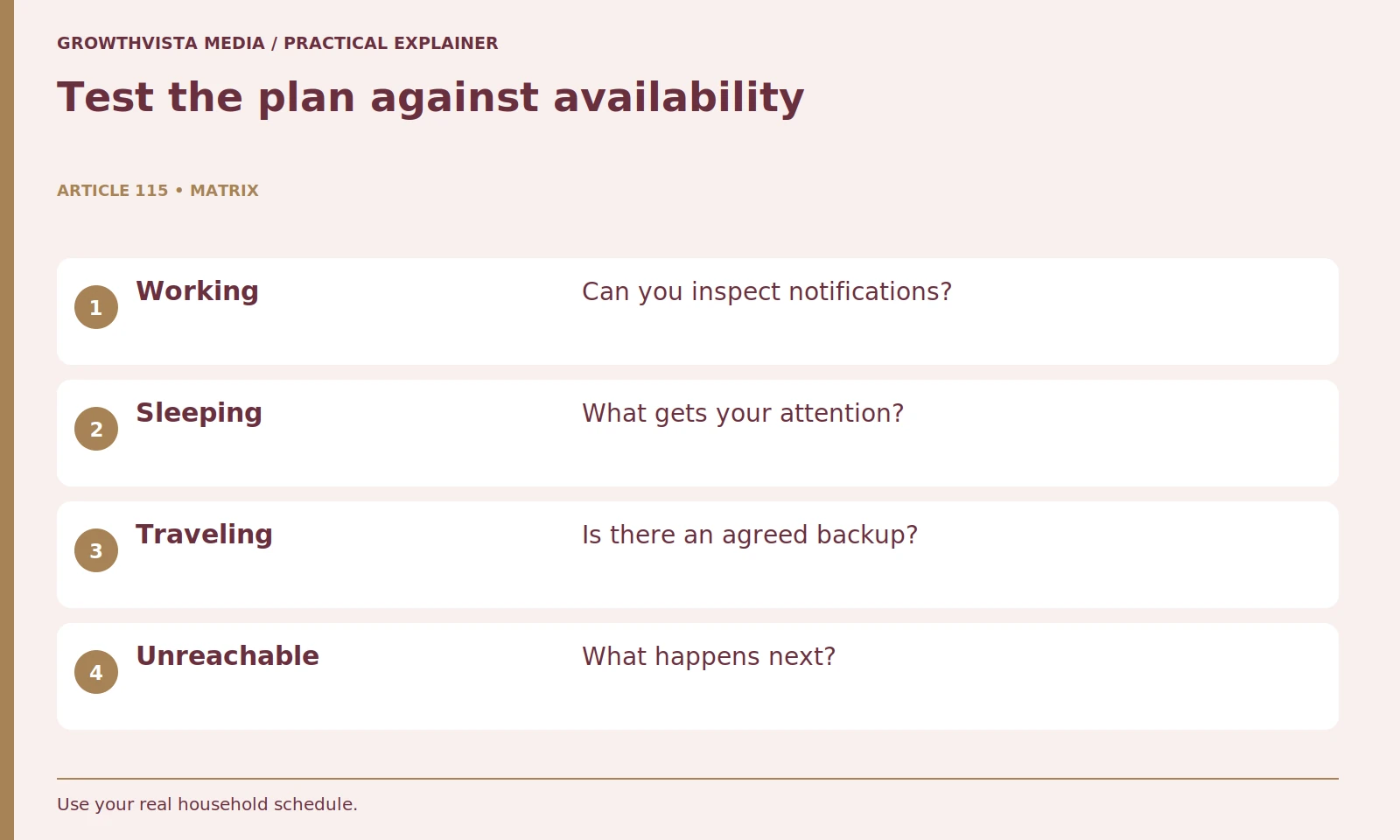
Compare the response chain against periods when you are asleep, working, traveling, or unreachable. Then verify communication requirements, service eligibility, and contract terms. This guide provides a decision method rather than an untested ranking. A camera recording subscription should not be assumed to include alarm monitoring unless its current terms explicitly say so.
Your decision checklist
- Map detection through supported action.
- Check periods when nobody can respond.
- Verify exact covered events and backup requirements.
- Review cancellation and supported test procedures.
How do you compare self vs professional monitoring?
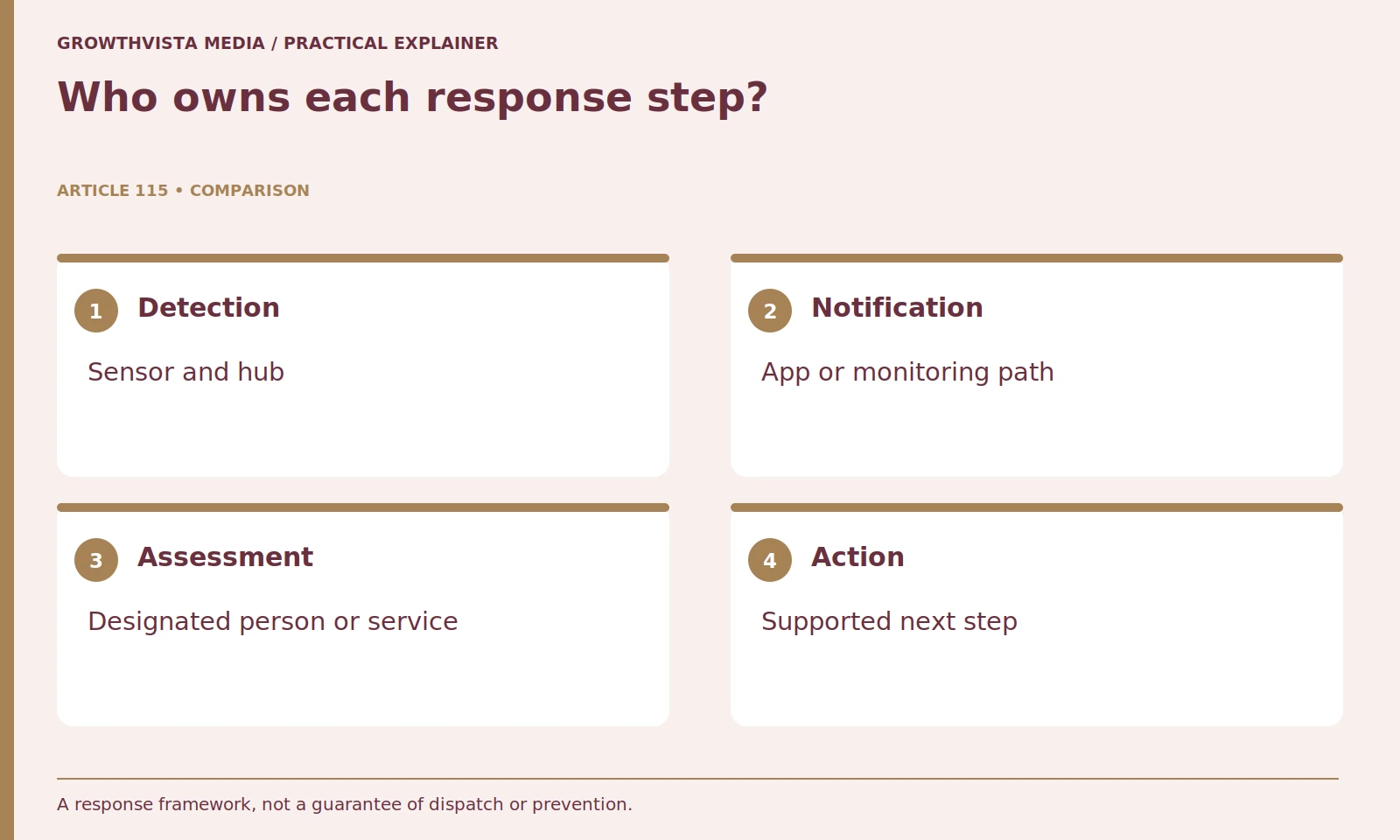
Compare detection, notification, assessment, and action as separate stages. Identify the person or service responsible at every handoff. This reveals gaps that a monthly price or a broad promise of smart protection cannot explain.
For self-monitoring, name the primary and backup people. For professional monitoring, ask which events the service receives and how it verifies or handles them. Some services distinguish intrusion alarms, camera events, and environmental signals. Do not infer coverage from the existence of an app or a siren.
Write the chain in ordinary language. “The app sends a push notification, then I inspect the event” is more useful than “smart protection.” The comparison becomes clearer when you can identify every handoff and the conditions under which it might fail.

When is self-monitoring a practical arrangement?
It can fit a household with agreed recipients who can reliably notice and assess the relevant events. Review ordinary unavailable periods, notification settings, and backup contacts. Do not assign responsibility to a person who has not agreed or assume that phone alerts will always be read.
For an illustrative household, one person may be available during the day while both are unavailable during regular travel. Mark those periods on a simple schedule and identify a supported backup recipient. Verify whether the account can notify that person appropriately.
Avoid assigning responsibility to someone who has not agreed to it. The plan should say who receives events and what they are expected to do. If there is no dependable recipient for important periods, that gap deserves attention when comparing a monitoring service.
| Scenario | Self-monitoring question | Professional-monitoring question |
|---|---|---|
| Primary person available | Can the event be assessed? | Which contact procedure applies? |
| Primary person unreachable | Who agreed to receive it next? | What does the service do next? |
| Internet unavailable | Does the alert path continue? | Is backup communication included? |
| Plan canceled | Which functions remain? | What service and data access ends? |
What does professional monitoring actually include?
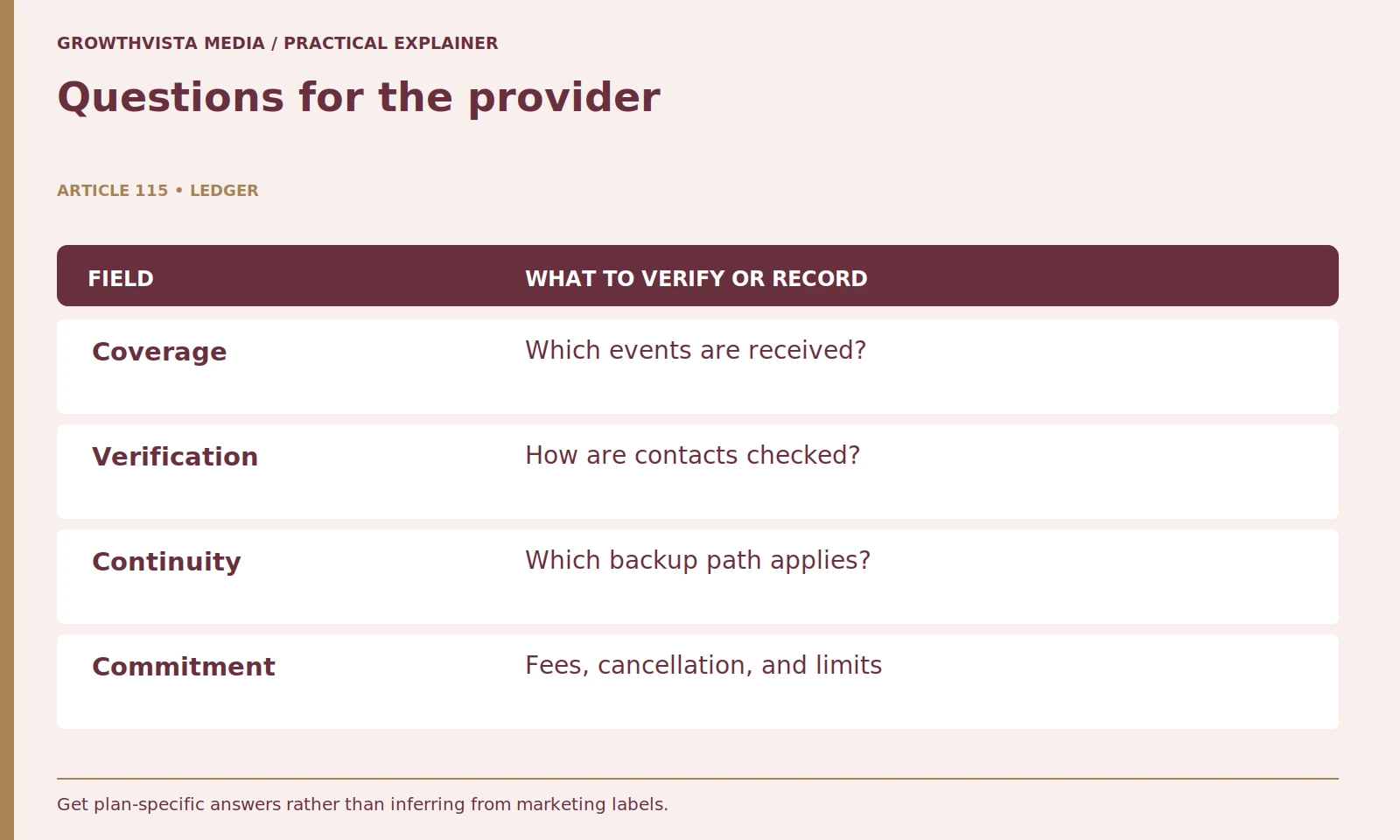
The answer comes from the exact plan and provider procedure. Ask which events are covered, how contact and verification work, and what happens when the account holder is unavailable. Treat unresolved coverage questions as purchase gaps rather than translating marketing language into a response guarantee.
Ask what happens if the provider cannot reach the account holder. Review the account's contact list and any required passcode or identity-verification procedure. Understand whether a particular event generates a call, an app request, or another action under the plan.
Do not translate a provider's marketing language into a guarantee of dispatch or arrival time. Response depends on the service procedure and external circumstances. Record the actual terms and unresolved questions so you can compare providers without inventing a numerical performance score.
What communication backup should you verify?
Identify the hub’s normal path and any supported backup, then check hardware, subscription, and activation requirements. Ring’s outage documentation illustrates model-specific backup behavior. A powered hub, a working camera upload, and a delivered monitoring signal are different outcomes. Ring: power and internet outage behavior
Check the phone side too. An event can leave the house successfully while your notification settings prevent you from noticing it. Test the approved notification path on the devices and accounts that will actually be used.
For professional monitoring, ask how communication failure is reported and what the service expects you to maintain. For self-monitoring, keep a simple contingency for a lost or replaced phone. The companion outage guide provides a dependency worksheet for separating these questions.
Which monitoring contract details matter most?
Check equipment requirements, eligibility, setup and recurring charges, commitment, cancellation, and the features left after ending the plan. Compare the same service scope and billing period. Keep account ownership and approved recovery routes clear to the household.
Ask what remains usable after cancellation. Can the household still arm locally, receive alerts, view a live feed, or retrieve saved recordings? The answers are system-specific and may differ by feature. Check them before you decide that you can easily switch later.
Keep account ownership and authorized access clear. If one person manages the subscription, another appropriate household member should know the approved recovery and support process. Avoid relying on a shared personal password as the only continuity plan.
How should a monitored system be tested?
Coordinate a supported test and record which stage it verifies. SimpliSafe documents a test signal and automated contact that are different from an actual alarm response. Do not use a test-call time as evidence of emergency response time or casually trigger emergency functions. SimpliSafe: testing your system
Do not casually trigger panic, smoke, carbon-monoxide, or other emergency features to see what happens. Test-mode scope can vary across event types. Ask support or the monitoring service when the manual is unclear and follow its instructions.
Record the outcome precisely. A successful app event is evidence of that step, not proof of every possible response. Update contacts and retest the relevant path after changing phone numbers, equipment, plans, or notification settings.
How can household scenarios guide the decision?
Compare an ordinary daytime event, an overnight event, and a time when the primary recipient cannot respond. For each, name who notices, assesses, and acts under the supported arrangement. Choose by the responsibility gap the service addresses, not only the subscription label.
Avoid scoring a service solely by monthly cost. Compare whether the response chain addresses your availability gap and whether you understand the contract. Equally, do not purchase professional monitoring merely because it sounds more comprehensive if the relevant events are not covered by that plan.
The goal is a workable allocation of responsibility. Choose the arrangement you can maintain, and keep its limitations visible. No monitoring choice removes the need for appropriate household security measures or maintenance.
When should you update the response plan?
Review it after contact, travel, household, equipment, or subscription changes. Keep a concise responsibility record and the approved test procedure available to authorized people. An outdated backup contact should be treated as an unresolved gap, not reassurance.
Review the plan after travel changes, household changes, or a subscription revision. Reconfirm the assumptions that drove the purchase. If a backup contact is no longer available, update the chain rather than leaving a reassuring but outdated name in the account.
Map detection through supported action. Check periods when nobody can respond. Verify exact covered events and backup requirements. Review cancellation and supported test procedures. Keep verified findings separate from expectations, and revisit the decision after a material change.
Frequently asked questions
Does professional monitoring guarantee a response time?
This guide makes no arrival or dispatch guarantee. Review the provider’s covered events, verification process, service eligibility, and current terms.
Is a camera subscription the same as alarm monitoring?
Not necessarily. Check the exact services and event coverage included with the plan.
What is the biggest self-monitoring question?
Whether an agreed person can reliably receive, assess, and act on the relevant events during the periods that matter.
Can a test call predict emergency response speed?
No. A supported test contact demonstrates the documented test path, not every stage or timing of an actual emergency response.
Does a hub battery prove remote alerts will arrive?
No. Verify the communication path, service activation, and receiving-device conditions as separate dependencies.
What should I check before canceling a plan?
Confirm cancellation terms and which local, app, recording, and notification functions remain with your exact equipment.
Sources and further reading
Official documentation supports the technical guidance. Examples and worksheets are editorial methods, not hands-on product benchmarks. Reviewed October 2026.
- SimpliSafe: testing your system
- Ring: power and internet outage behavior
- NIST: consumer IoT cybersecurity baseline