Air Purifier Filters: HEPA, Carbon, and Running Costs
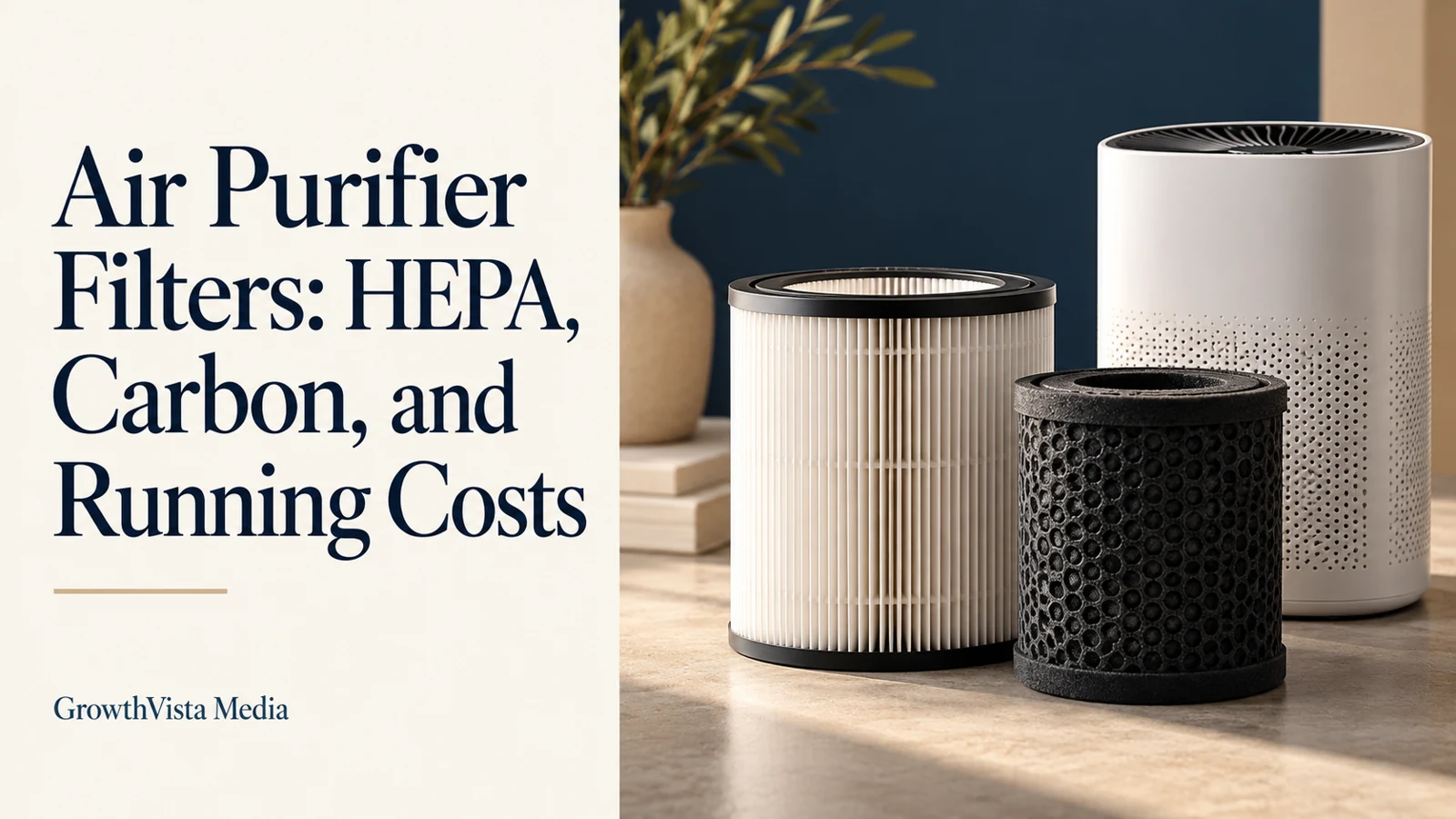
Air purifier filters should be compared by their documented function and ownership requirements. Particle filters and gas-removal stages do different jobs, and a label such as HEPA or carbon does not establish the complete device’s performance in every condition. Check the exact stage, replacement part, approved care, availability, and recurring cost.
This guide explains how to turn filter claims into verifiable questions. It includes a hypothetical annual-cost worksheet, not current vendor pricing or a measured electricity result. The purpose is an understandable maintenance plan. It does not recommend filtration as medical treatment or infer that one filter label guarantees a hazard-free room.
Your decision checklist
- Separate particle and gas-removal functions.
- Verify exact replacement parts and availability.
- Follow each stage’s approved care instructions.
- Calculate costs with visible prices and use assumptions.
How do you compare different air purifier filters?
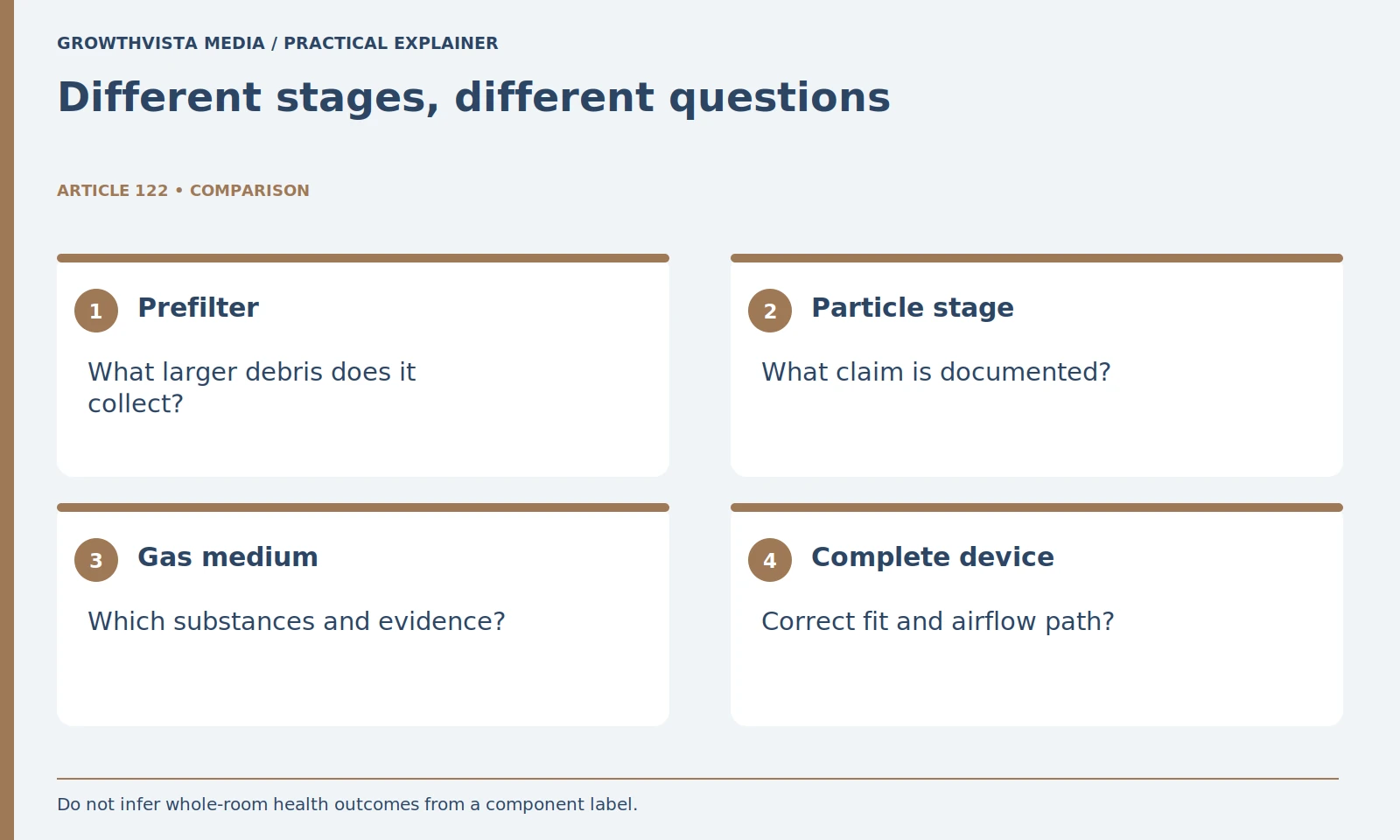
Name the function of each stage before comparing labels. Particle capture and gas removal require different evidence. The EPA’s technical summary distinguishes these roles, so compare documented functions rather than treating a multi-stage filter as proof of universal pollutant removal. EPA: residential air cleaners technical summary
EPA's technical summary distinguishes particle filtration from gas-phase treatment. That distinction matters when a listing claims broad odor or chemical removal without explaining the material or evidence. A strong particle rating does not automatically establish gas-removal performance.
Write your intended job beside the relevant stage. If you primarily need a particle-cleaning function in a defined room, compare that evidence directly. If a specific gas problem drives the purchase, obtain appropriate guidance and avoid treating a generic carbon description as a complete answer.
Does a HEPA label describe the entire purifier?
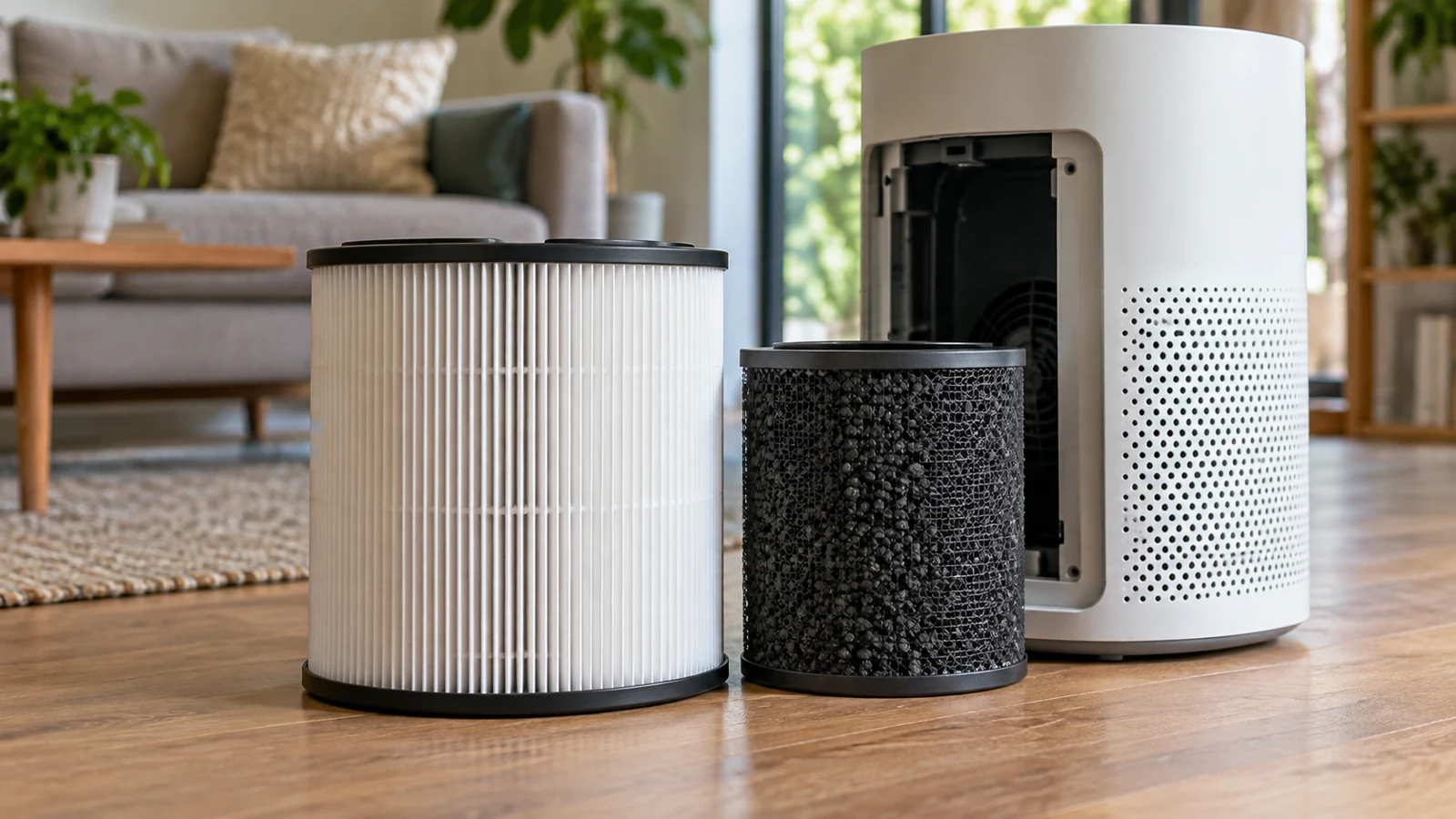
A filter claim and complete-device performance are different questions. Read the documented specification and its scope, then check how the filter fits the device and its rated operation. Do not turn a media label into an untested promise about the whole room.
The complete arrangement includes how air passes through the device and whether the specified filter is correctly fitted. A high-performing component is less informative if the installation or replacement part is wrong. Confirm the exact part number and orientation.
Do not turn a filter percentage into a guaranteed percentage reduction in a lived-in room. Room conditions and operation differ from a component test. Keep the documented claim within its stated scope and leave health conclusions to appropriate evidence and advice.
| Item | Assumption | Annual amount |
|---|---|---|
| Filter bundle | $50, twice per year | $100.00 |
| Electricity | 40 W, 12 hours/day | 175.2 kWh |
| Energy price | $0.15/kWh | $26.28 |
| Example combined cost | Filters plus electricity | $126.28 |
What should you ask about carbon and odor removal?
Identify the gas-removal claim, its conditions, and the documented material or evidence behind it. The particle CADR is not a substitute for gas-removal evidence. The EPA explains that filters can target different pollutant types and that no filter removes every pollutant. EPA: choosing air cleaners for the home
Do not assume that removing a noticeable smell establishes safety. A purifier is not a carbon-monoxide alarm, gas-leak solution, or moisture repair. Those problems require the appropriate detection, source control, and response.
If the supplier provides no meaningful performance basis for the intended gas-related task, mark that limitation in the comparison. It is more useful than copying an expansive marketing sentence into a confident product recommendation.
How do you verify replacement-filter compatibility?
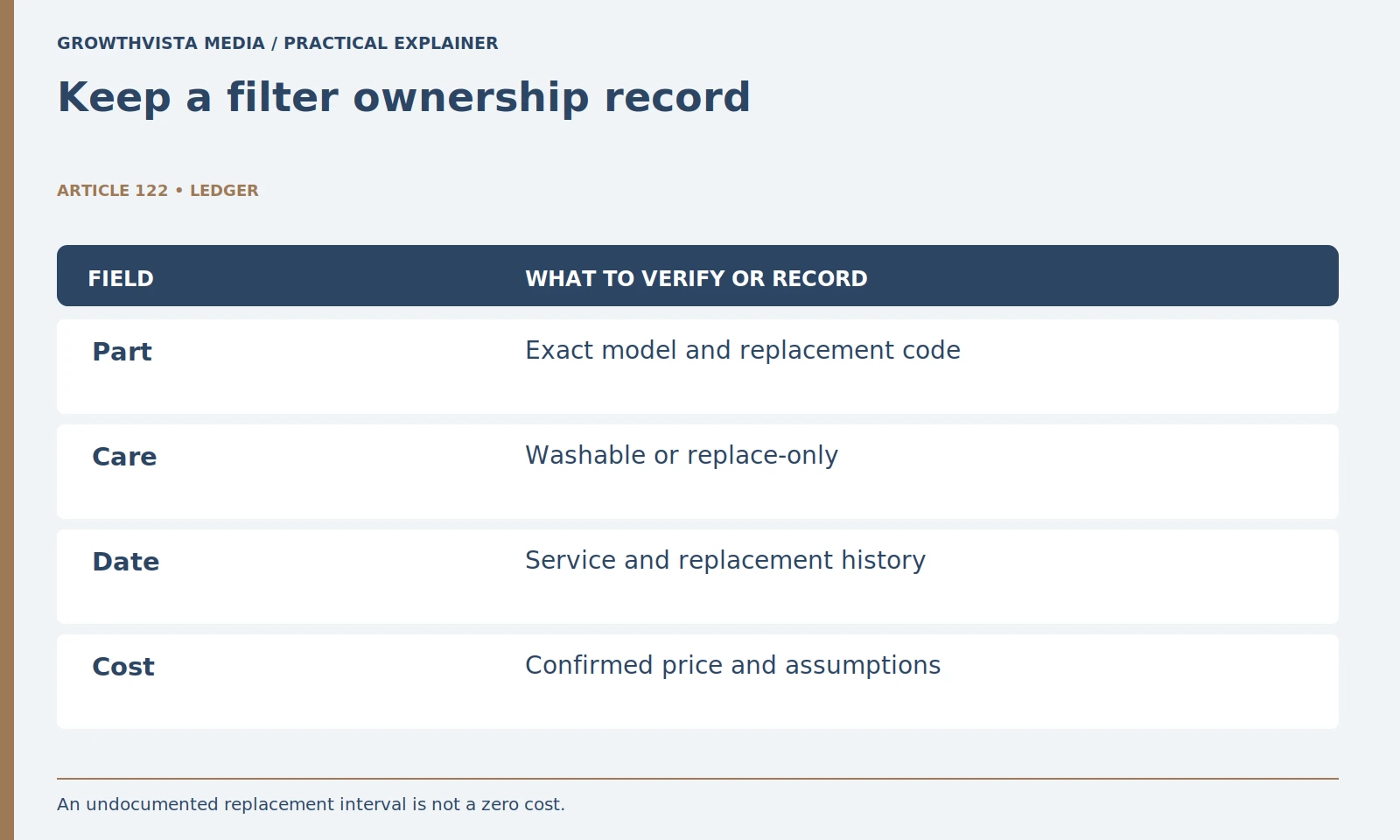
Use the exact model revision and replacement part number, not shape or a similar product name. Check whether stages are purchased together and whether approved replacements are available in your market. Keep unresolved compatibility and warranty questions visible before buying alternatives.
Check current availability and the supplier's replacement instructions. Keep part numbers and support links in your ownership notes. A cheap appliance with an unavailable proprietary filter can become an expensive inconvenience.
If third-party replacements are considered, review documented compatibility and any warranty implications rather than assuming every inexpensive listing is equivalent. Do not modify a filter frame or force an incorrect part into the housing.
Can every purifier filter be washed?
No universal cleaning method applies. Read the model’s instructions for each stage, including what is cleaned, replaced, or left untouched. A washable prefilter does not establish that the main particle or gas-removal stage can be washed in the same way.
Keep dates and the relevant status indicator in a simple record. A timer can help organize maintenance, but it does not independently measure every condition that affects filter use. Follow the manual and contact support if replacement indicators or symptoms are unclear.
After service, confirm that all required parts are present, dry where applicable, and correctly oriented. Do not operate without a required stage as an experiment. Proper fit and repeatable care belong in the purchase decision.
How do you estimate annual filter and electricity costs?
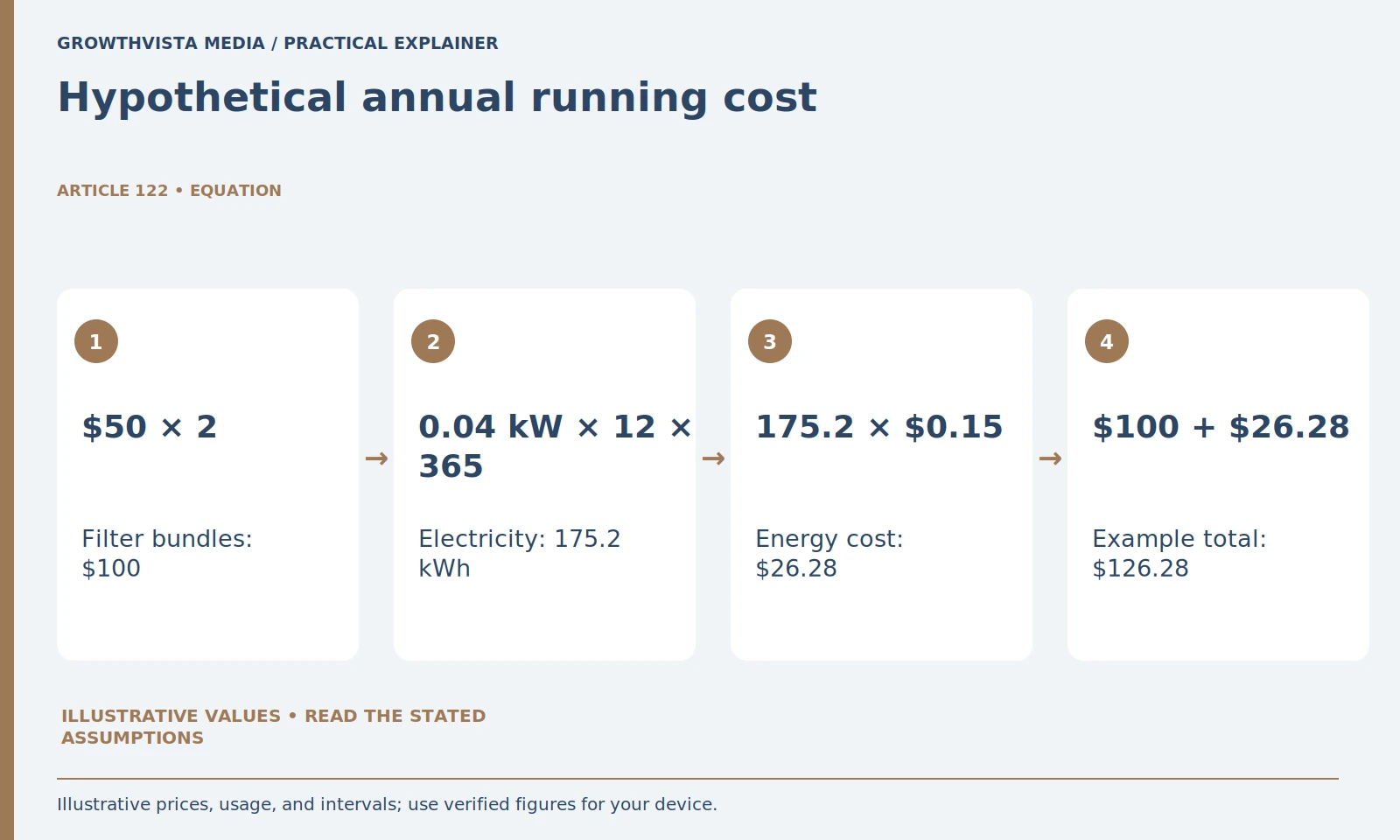
Use documented or explicitly hypothetical filter prices, replacement assumptions, average power, operating hours, and electricity tariff. Keep those inputs beside the calculation. A maximum electrical rating is not automatically the measured average of your routine.
Here is a hypothetical worksheet, not a vendor offer. Suppose a replacement bundle costs $50 and your planning assumption is two bundles per year. That contributes $100 annually. The interval is an illustration; use the instructions and circumstances of the exact product for your own estimate.
Assume an average electrical draw of 40 watts for 12 hours a day. Divide by 1,000 to get kilowatts, then multiply by hours and days: 0.04 × 12 × 365 = 175.2 kWh per year. At an illustrative $0.15 per kWh, electricity costs $26.28. The combined example is $126.28 before other costs.
Actual power varies by mode and the tariff can include other charges. Do not treat a maximum electrical rating as a measured average. Keep the assumptions beside the arithmetic and update them when real information becomes available.
How should two purifier ownership plans be compared?
Apply the same planning period and intended routine to both devices. Separate the purchase, consumables, and electricity estimates, then record unknown intervals or mode-specific data. A cheap filter is not automatically a low-cost plan if it is incompatible or unavailable.
Do not replace unknown figures with zero. An undocumented replacement interval is an uncertainty, not proof that a filter lasts indefinitely. Record a range or an explicit question when the provider has not supplied a useful basis.
Choose a device whose consumables and care process you can maintain. A feature that depends on neglected or incorrect replacement media is not a durable benefit, however attractive the first-use demonstration looks.
Can a filter specification guarantee a health outcome?
No individual health result is established by this buying worksheet. Keep documented filter functions separate from medical claims and the response to an indoor hazard. The EPA’s ozone guidance also cautions against confusing an ozone-producing device with an appropriate air-cleaning shortcut. EPA: ozone generators sold as air cleaners
This guide does not recommend a purifier as treatment or establish that a room is free of hazards. Address sources and obtain relevant advice when the concern is health-related, chemical, or structural. Do not use a pleasant smell or app color as proof that a problem is solved.
Separate particle and gas-removal functions. Verify exact replacement parts and availability. Follow each stage’s approved care instructions. Calculate costs with visible prices and use assumptions. Keep verified facts, examples, and unanswered questions distinct when making the final decision.
Frequently asked questions
Is HEPA a guarantee for every pollutant?
No. Read the filter specification and complete-device evidence within their scope. Particle and gas-removal functions are different questions.
Is activated carbon performance established by CADR?
No. The particle CADR does not establish gas-removal performance. Review the specific claim and documented conditions.
Can I wash a filter if it looks dirty?
First read the exact model’s procedure for that stage. A washable prefilter does not imply that the other stages are washable.
Are the example annual costs current product prices?
No. The $126.28 total uses hypothetical filter and electricity inputs. Replace them with documented prices and your own operating assumptions.
What should I verify about a replacement filter?
Check model revision, part number, stages included, supplier availability, care instructions, and any relevant compatibility or warranty conditions.
Does a filter label establish a health result?
This guide claims no individual health outcome. Keep product specifications separate from medical advice and the response to an indoor hazard.
Sources and further reading
Official documentation supports the technical guidance. Examples and worksheets are editorial methods, not hands-on product benchmarks. Reviewed October 2026.
- EPA: residential air cleaners technical summary
- EPA: ozone generators sold as air cleaners
- EPA: choosing air cleaners for the home