Air Purifier Room Size: Read CADR Before You Buy

Air purifier room size should be checked against the space served, the particle-cleaning CADR, and the conditions behind the coverage claim. Measure the room and ceiling height, include connected areas where relevant, and compare rating units and fan settings. A large square-foot label alone does not show how the device fits your actual room.
The worksheet below makes those assumptions explicit and explains an idealized equivalent clean-air calculation. It is a buying framework, not a medical prescription or an original purifier benchmark. The EPA treats filtration as a supplement to appropriate source control and ventilation, rather than proof that every indoor pollutant has been removed. EPA: choosing air cleaners for the home
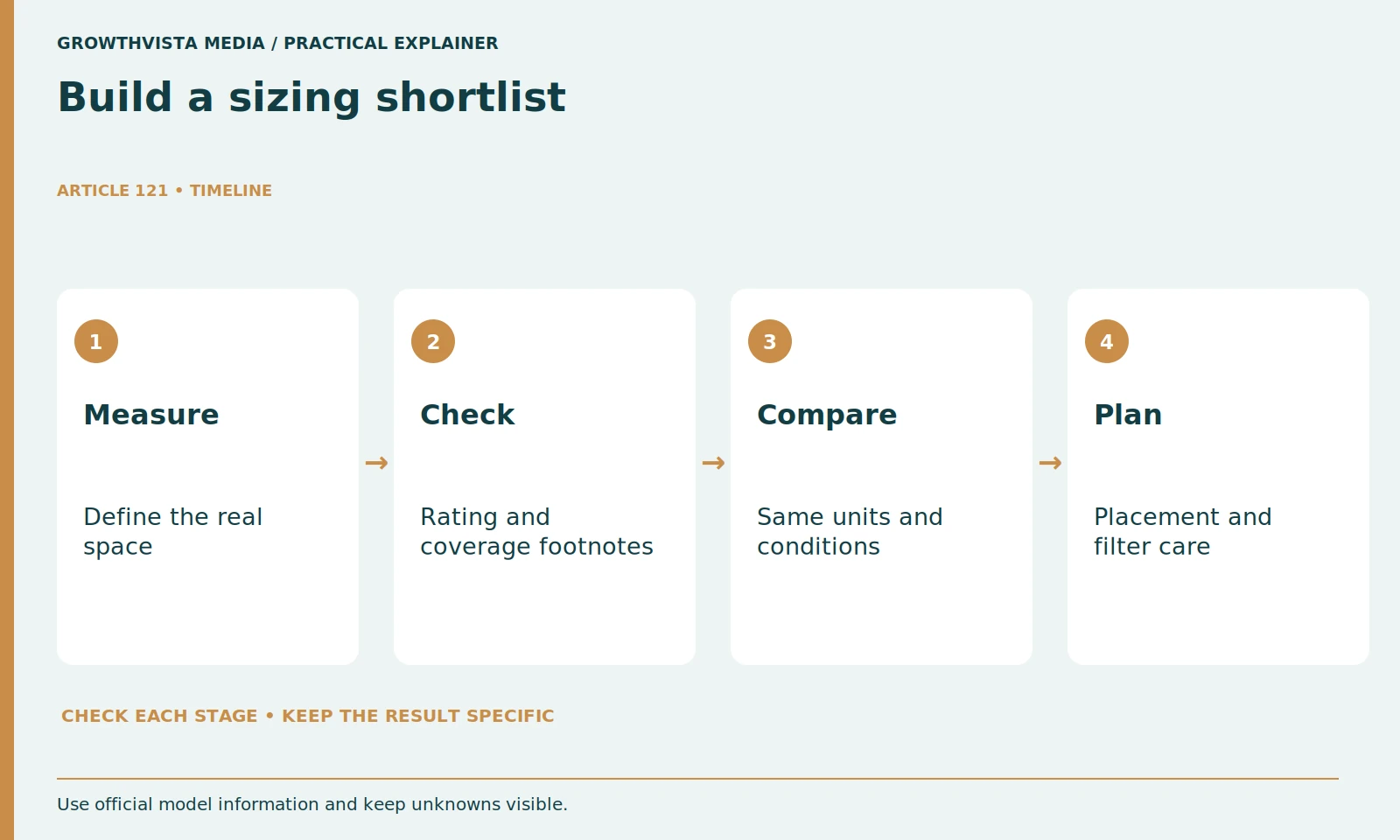
Your decision checklist
- Measure the served space and ceiling height.
- Read CADR units and the coverage assumptions.
- Check the intended mode and clear airflow path.
- Keep calculations separate from guaranteed outcomes.
How do you check an air purifier room size claim?
Measure the area the device will actually serve and record its ceiling height and connected spaces. Compare those conditions with the basis of the coverage label. An open living area and a closed bedroom should not be treated as the same sizing problem merely because one part of each has similar floor area.
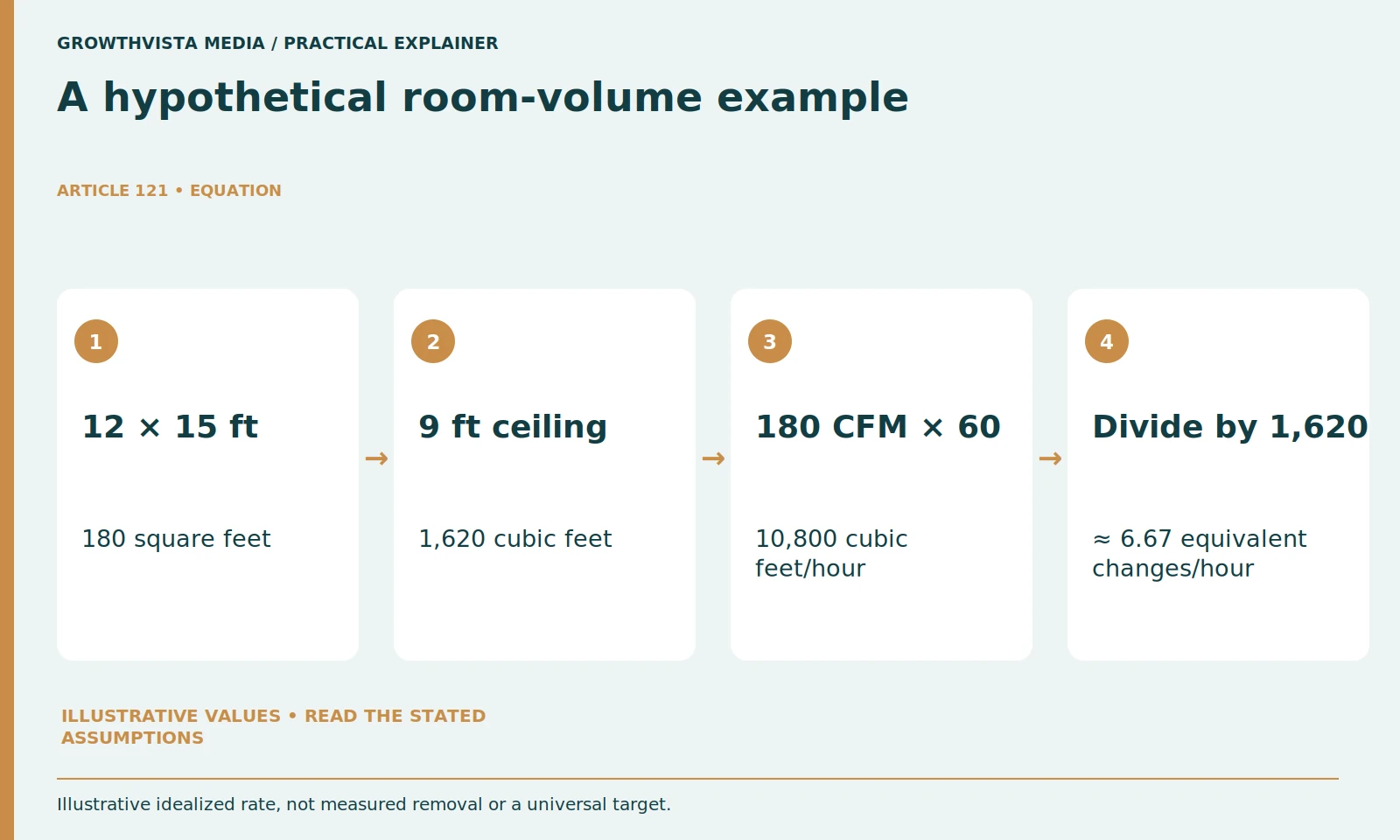
For an illustrative room measuring 12 by 15 feet, the floor area is 180 square feet. With a nine-foot ceiling, the volume is 1,620 cubic feet. These dimensions are invented for the explanation, not measurements of a tested home.
Write down the boundary you are assuming. If a broad opening remains open during use, do not silently treat the purifier as working only on the smaller room. Compare the manufacturer's room-size statement with the actual arrangement, then identify the assumptions you need to confirm.
What does CADR measure?
CADR is a particle-cleaning rate used in air-cleaner selection. It is not a general rating for every gas or odor. Read the particle type and units shown and compare like with like. The EPA’s technical summary discusses clean-air delivery and the scope of air-cleaning technologies. EPA: residential air cleaners technical summary
EPA's consumer guide distinguishes CADR from gas-removal claims and explains that the rating is commonly measured at the highest operating speed. That makes the fan setting important when you plan to use a quieter mode.
Keep the rating next to the model and configuration in your notes. A similarly named version or a listing with a different filter package may require another check. CADR is useful evidence for a defined function; it is not a universal score for noise, energy use, odor removal, or health outcomes.
| Item | Calculation | Result |
|---|---|---|
| Floor area | 12 ft × 15 ft | 180 ft² |
| Room volume | 180 ft² × 9 ft | 1,620 ft³ |
| Clean-air rate | 180 CFM × 60 ÷ 1,620 | ≈ 6.67 per hour |
| Lower-rate illustration | 90 CFM × 60 ÷ 1,620 | ≈ 3.33 per hour |
Does maximum coverage apply at every fan setting?
Do not assume it does. Identify the fan setting, room conditions, and cleaning-rate assumptions behind the claimed area. If the intended quiet mode has no documented rate, keep that gap visible rather than assigning it the maximum-speed figure.
EPA's sizing guidance uses an eight-foot-ceiling basis and notes that higher ceilings require consideration. Use that as a reason to inspect volume rather than applying a room-area label mechanically to every space.
For the illustrative nine-foot room, record the extra height explicitly. Do not turn an unexplained large coverage number into a guarantee that the whole connected floor will be treated equally. The clearer comparison is between documented assumptions that resemble your intended use.
How can you calculate an equivalent clean-air rate?
For a stated CADR in cubic feet per minute, multiply by 60 and divide by room volume in cubic feet. The result is an idealized equivalent rate per hour. It describes assumptions in a planning model, not a guaranteed pollutant concentration or a universal health target.
To understand volume, multiply an assumed CADR in cubic feet per minute by 60 and divide by room volume in cubic feet. This gives an idealized equivalent clean-air change rate per hour. It is a planning calculation, not a prediction of real pollutant concentration or a required target for every household.
Using the hypothetical 1,620-cubic-foot room and an assumed 180 CFM CADR gives 10,800 cubic feet per hour divided by 1,620, or about 6.67 equivalent clean-air changes per hour. If the assumed rate were 90 CFM, the same arithmetic would give about 3.33.
Actual conditions include mixing, continuing sources, placement, and the operating mode. Do not claim that the room becomes completely clean after a particular number of minutes. Use the calculation to make assumptions visible and ask better sizing questions.
Which fan setting should you compare when buying?
Compare the setting you expect to use routinely, including its documented cleaning performance and acceptable operating experience. A maximum performance figure and the quietest-mode noise claim may describe different conditions. Do not combine them as though they occur together.
For a bedroom, consider whether normal use remains practical while sleeping. For a work area, consider calls and concentration. These are workflow constraints to test, not reasons to declare a universal noise threshold.
Avoid comparing a quiet-mode noise claim with a high-speed CADR as though both occur at the same time. Put the mode beside every figure in your worksheet. If information is missing, label it unknown rather than filling the gap with an assumed proportional reduction.
What else belongs in the room-sizing decision?
Check the approved position, clear airflow path, power connection, controls, filter supply, and service routine. A purifier that nominally fits the area can still be impractical if the intended corner blocks its intake or the replacement filter cannot be obtained.
Check the filter part number, replacement availability, control accessibility, and maintenance procedure before buying. Include the cost of the required filters and the power use of your expected routine where documented. The companion filter-cost guide shows how to keep those assumptions separate.
Choose the room first and the device second. Moving one underspecified purifier between several rooms is a different plan from maintaining filtration in one defined area. Write down the routine you will actually follow.
How do you compare two purifier candidates fairly?
Use the same room dimensions, rating units, intended mode, and ownership assumptions for both. Record documented values, unknowns, and calculated examples separately. The most useful shortlist is one that exposes a missing requirement instead of hiding it inside a general score.
Compare similar conditions rather than simply sorting coverage numbers. If one vendor provides a complete basis and another provides only a promotional area, that information gap should remain visible. Do not invent a ranking to make the table look complete.
A sensible shortlist meets the room requirement with documented assumptions and a routine you can maintain. Purchase price is one part of the decision, but an unsuitable daily setting or unavailable filter can undermine an otherwise attractive specification.
Does correct sizing prove the room is free of hazards?
No. Sizing does not assess all pollutants or resolve every source. The EPA advises against intentionally ozone-producing air cleaners. Keep ordinary appliance selection separate from the appropriate response to moisture, gas, structural, or health concerns. EPA: ozone generators sold as air cleaners
If an indoor hazard or health concern is driving the purchase, use appropriate professional or public-health advice for that issue. This calculation does not assess mold, carbon monoxide, gas leaks, or medical treatment needs.
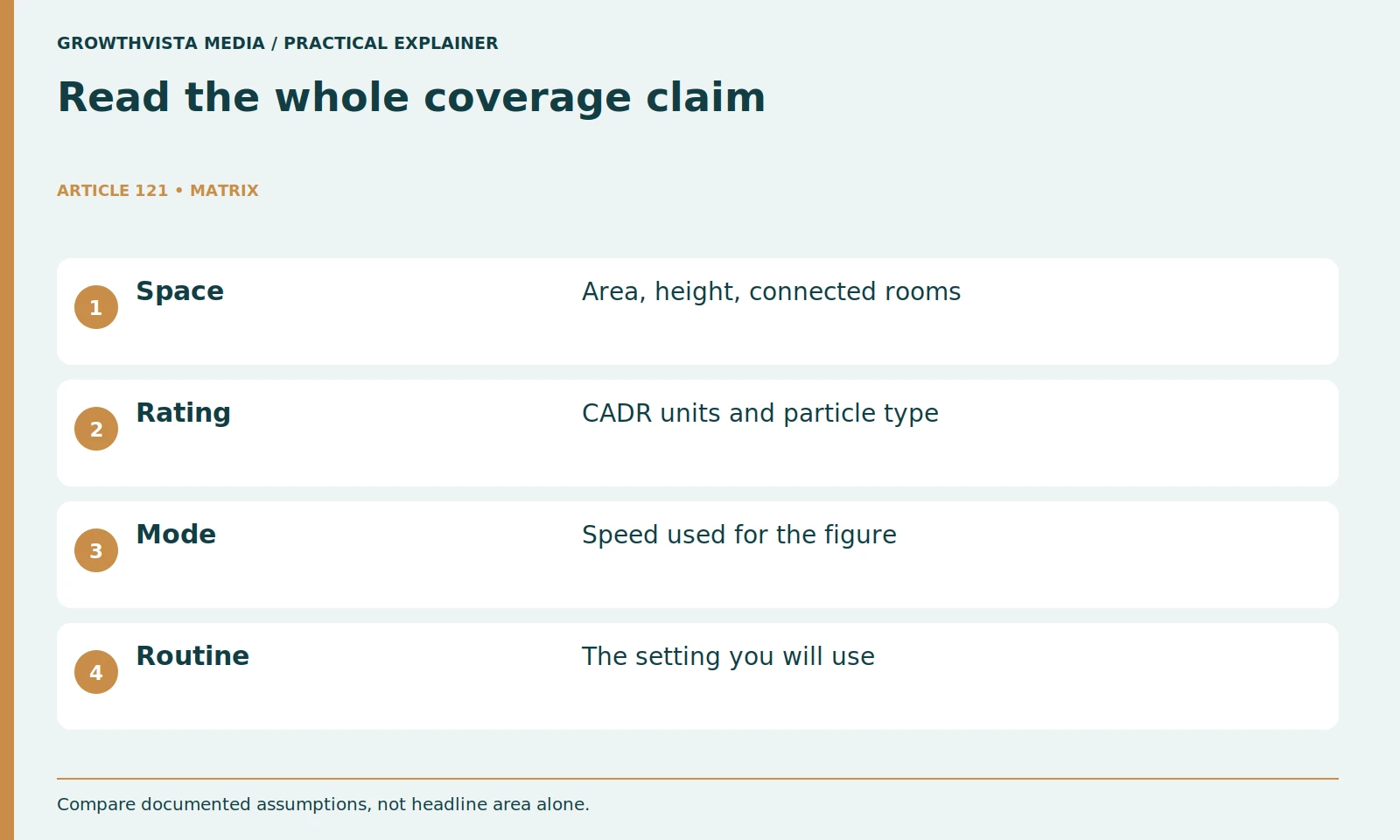
Measure the served space and ceiling height. Read CADR units and the coverage assumptions. Check the intended mode and clear airflow path. Keep calculations separate from guaranteed outcomes. Keep verified facts, examples, and unanswered questions distinct when making the final decision.
Frequently asked questions
Does an advertised room area apply to every ceiling height?
Check the stated basis and record your own ceiling height and connected space. A floor-area label should not be transferred to different room conditions without review.
Does CADR rate odor or gas removal?
CADR concerns particle cleaning. Gas and odor claims need separate documented evidence and should not inherit the particle rating.
Does the example rate of 6.67 per hour guarantee clean air?
No. It is an idealized equivalent-rate calculation using the stated room volume and CADR, not a measured concentration or guaranteed health outcome.
Should I compare only the maximum fan setting?
Compare its conditions with the setting you intend to use. If mode-specific information is missing, keep that limitation visible.
Should open connected areas be included?
Identify the space the device is intended to serve and compare that arrangement with the coverage claim. A closed-room claim may not describe a connected layout.
Does correct sizing solve every indoor-air concern?
No. Use appropriate source control, ventilation, and relevant professional guidance. This buying calculation does not assess every building hazard.
Sources and further reading
Official documentation supports the technical guidance. Examples and worksheets are editorial methods, not hands-on product benchmarks. Reviewed October 2026.
- EPA: choosing air cleaners for the home
- EPA: residential air cleaners technical summary
- EPA: ozone generators sold as air cleaners