Debt Repayment Plan: Compare Avalanche and Snowball

A debt repayment plan makes the required payments and the next extra payment visible. Start with a complete list of balances, rates, due dates, and account conditions. Then choose a prioritization method you can maintain. A plan based on money you do not actually have will fail even if its spreadsheet looks efficient.
Make an inventory before selecting a method
For each debt, record the balance, APR, minimum payment, due date, and any promotional or secured-debt conditions. Separate accounts that are past due or have consequences that require immediate attention. Check statements rather than memory. A repayment comparison needs the same current information for every account, including fees and rates that may change.

Two targets from the same account list
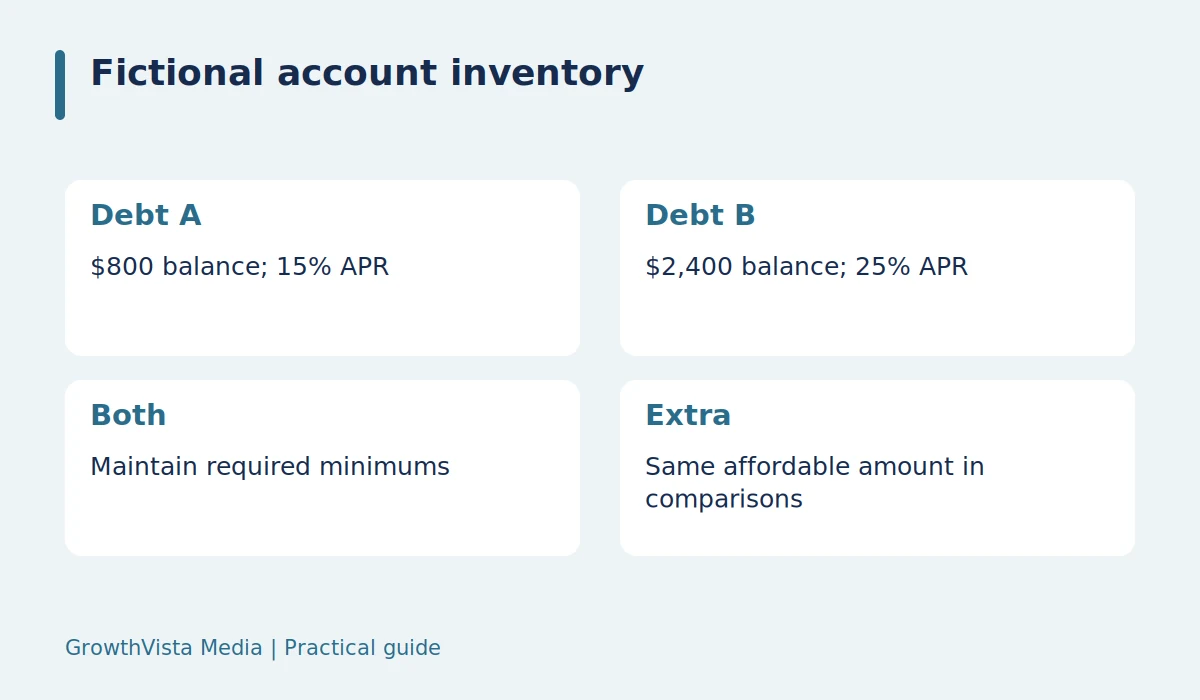
A fictional borrower has an $800 balance at 15% APR and a $2,400 balance at 25% APR. After both minimums, avalanche targets the 25% debt, while snowball targets the $800 balance. The example identifies priority only; it does not calculate a payoff date because minimum-payment formulas and fees are unspecified. Using identical affordable extra payments makes a fair cost comparison possible.
| Item | Detail |
|---|---|
| Debt A | $800 balance; 15% APR |
| Debt B | $2,400 balance; 25% APR |
| Both | Maintain required minimums |
| Extra | Same affordable amount in comparisons |
Debt repayment plan using the avalanche method
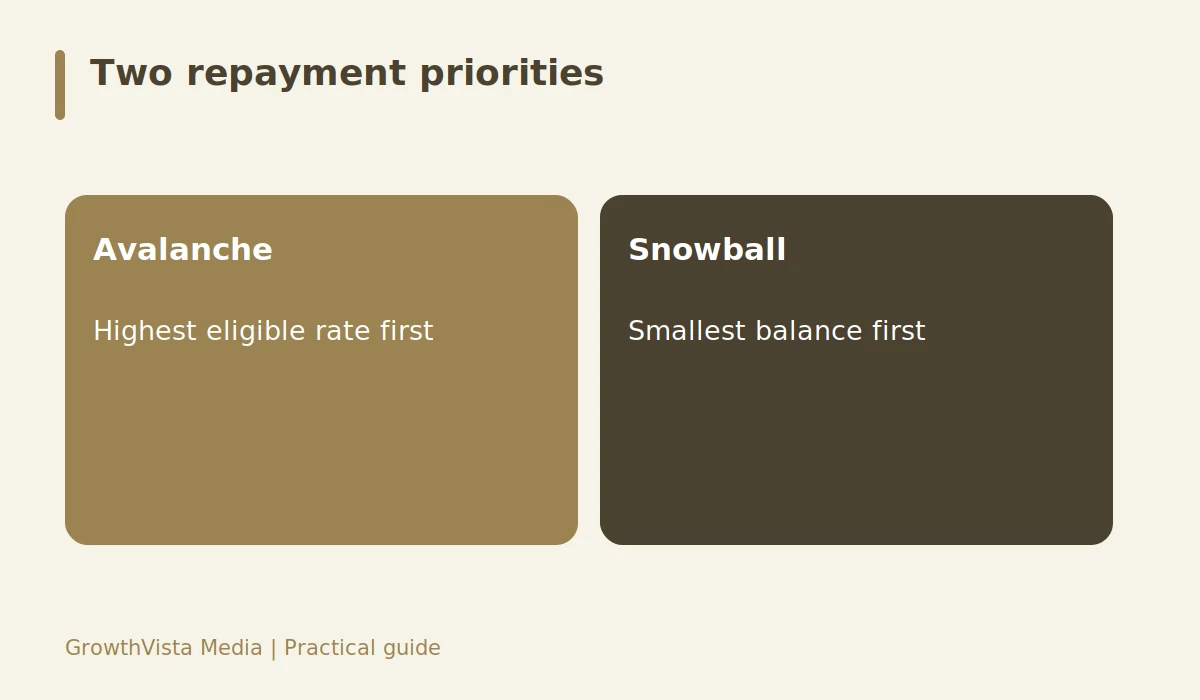
After meeting required minimums, the avalanche approach directs extra money toward the highest-rate eligible debt. Under otherwise comparable conditions, that can reduce interest more efficiently. Promotional deadlines and special account consequences may complicate a simple rate ranking. Once the target is paid, redirect its payment toward the next priority instead of letting the freed amount disappear into everyday spending.
Debt repayment plan using the snowball method
The snowball approach targets the smallest balance first after minimums. Completing an account can provide a visible milestone and simplify the list. It may cost more interest than a highest-rate approach. Compare both using the same affordable monthly amount. Motivation is relevant, but it should be considered alongside the actual cost and consequences of keeping a higher-rate balance outstanding.
Stabilize the spending underneath the plan
Identify why the balances grew and whether new charges are still being added. Set aside known upcoming costs so a repayment push does not create another borrowing cycle. Keep payment dates aligned with income. If minimums are unaffordable, contact creditors promptly and investigate reliable support rather than relying on a larger extra-payment target.

Review assistance carefully
A hardship arrangement, counseling service, or consolidation product has its own terms and costs. Ask what changes, who receives payments, what fees apply, and how the arrangement affects account status. Be cautious about promises to erase debt without explaining consequences. Maintain copies of agreements and verify payments reached the right accounts. Qualified help can be valuable when the situation is complex.
Your next steps
- Inventory balances, APRs, minimums, and due dates.
- Resolve urgent account consequences first.
- Calculate an affordable extra-payment amount.
- Choose and record a priority method.
- Review statements and redirect freed payments.
Related guides: Credit Card Interest: APR, Daily Balances, and Grace Periods · Monthly Budget: Build a Plan Around Real Payment Dates · Emergency Fund: Set a Target That Fits Your Risks
Questions readers ask
Which method always works best?
No method fits everyone. Avalanche emphasizes interest efficiency; snowball emphasizes smaller completed balances. Compare cost, account consequences, and your ability to maintain the routine.
Should I stop all minimum payments except one?
No. These methods generally maintain required payments on other debts while targeting extra money. Missed minimums can create fees and other consequences.
Will consolidation solve the problem?
Only if the terms and repayment plan improve the situation. Compare fees, rates, term, and the risk of adding new balances after consolidation.
Further reading
Editorial update: October 12, 2026. U.S.-focused general education, not individual investment, tax, or legal advice. Examples are hypothetical, not current product offers.