Certificate of Deposit: Rates, Terms, and Early Access

A certificate of deposit, often called a CD, generally holds money for a stated term under agreed interest conditions. It may fit a goal with a known date, but it is less flexible than ordinary savings. Compare what happens before maturity and at renewal, not just the advertised yield. The right term depends on when you might need the money.
Match the term to the spending date
A six-month, one-year, or longer CD can create a different access commitment. Money needed for an uncertain emergency may not belong in a product with a withdrawal penalty. Keep a separate accessible reserve if that fits your circumstances. Compare the maturity date with the actual bill or goal date; a slightly higher yield can be unhelpful if it locks cash past the deadline.

Read the certificate of deposit rate structure
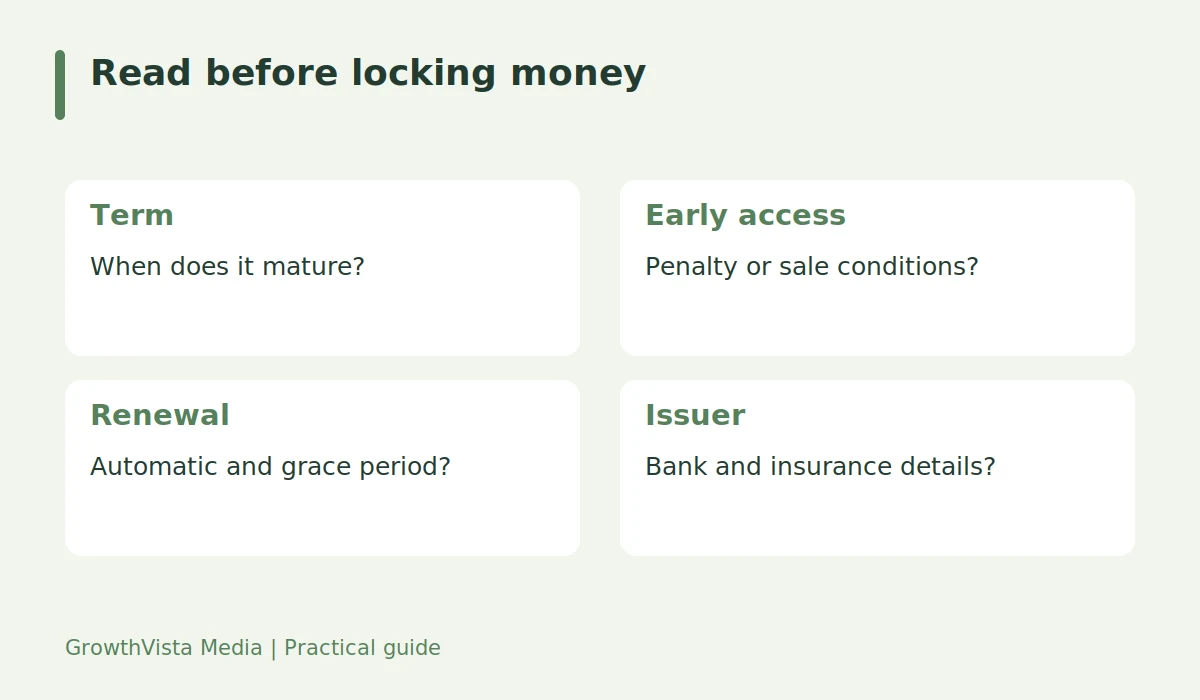
A conventional CD may have a fixed rate, while other products have variable, step-up, or special conditions. APY includes compounding assumptions, so compare APYs on the same basis. Check minimum deposits and whether interest is added to the CD or paid elsewhere. Avoid assuming a product with CD in its name follows the terms of a standard bank-issued CD.
Calculate the early-access consequence
The agreement can specify a penalty for withdrawing before maturity. Find whether partial withdrawals are allowed, how the penalty is measured, and whether it could affect principal. A penalty expressed as months of interest needs to be translated into dollars. Some no-penalty products have their own waiting periods or restrictions. Read those conditions instead of assuming immediate unrestricted access.
Plan for maturity and renewal
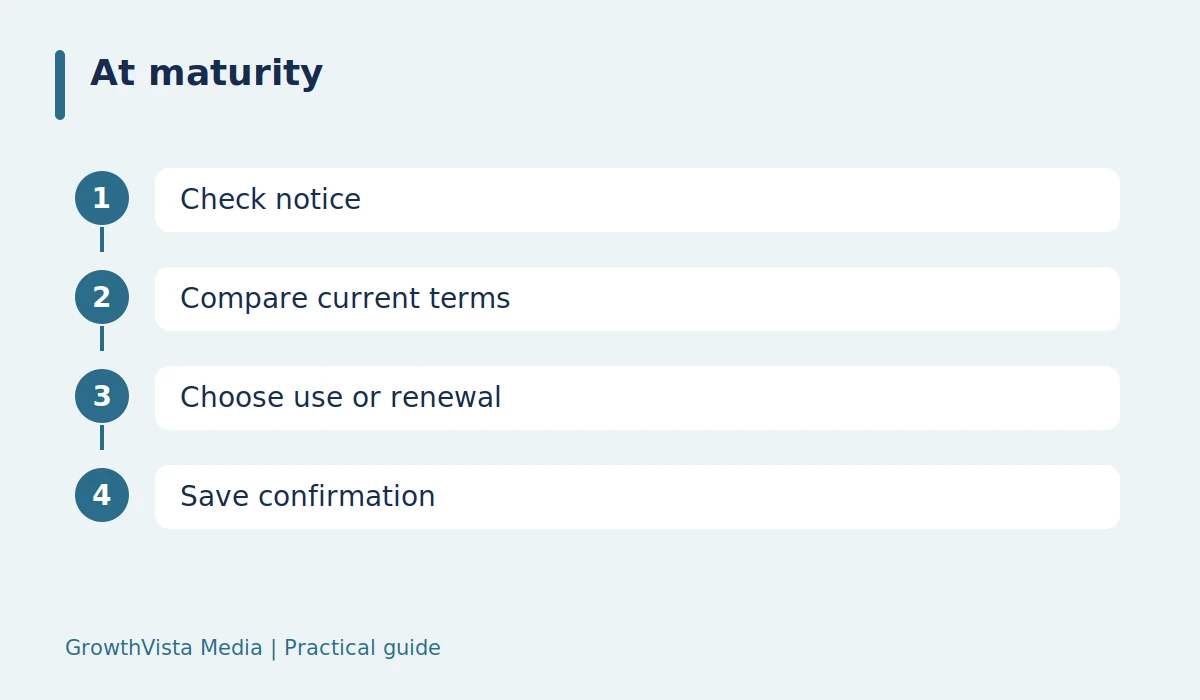
Record the maturity date, grace period, and automatic-renewal terms. An automatically renewed CD may have a new rate or term. Set a reminder in advance so you can compare options without missing the decision window. Keep contact details current. If a broker sells the CD, ask about secondary-market sale, price risk, and how access differs from withdrawing directly at a bank.
A ladder changes timing, not every risk
A CD ladder uses several maturity dates rather than placing all money into one term. It can create periodic opportunities to use or reinvest cash, but it still requires understanding each product’s terms. Reinvestment rates are uncertain. Verify the issuing bank and deposit-insurance arrangements, and remember that multiple CDs at the same bank may share a coverage category.
An illustrative three-rung ladder
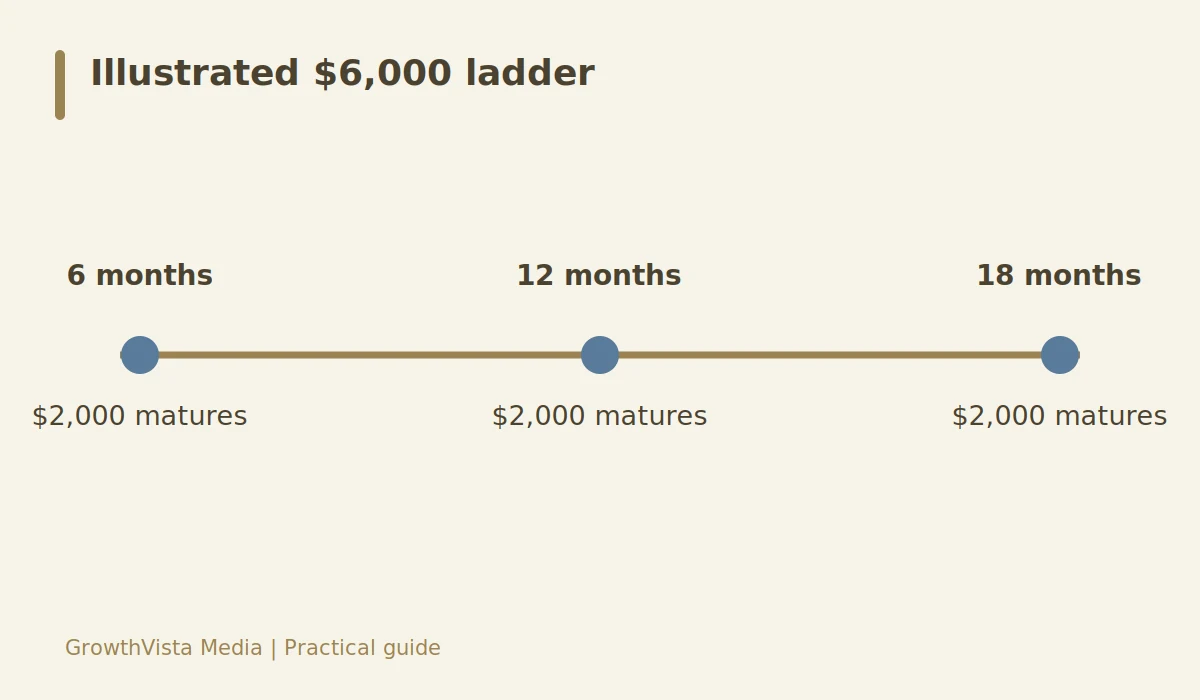
A fictional saver divides $6,000 into three $2,000 CDs maturing after six, twelve, and eighteen months. Each maturity gives a chance to take the cash or review a new term. This is a timing illustration, not an allocation recommendation or a rate forecast. Before using it, the saver would need an accessible emergency reserve and a reason those dates fit the planned expense.
Questions readers ask
Is the highest CD rate always preferable?
Not if the term or withdrawal conditions conflict with your goal. Compare the access commitment and renewal rules alongside yield.
Can I lose money by selling a brokered CD early?
A secondary-market sale can involve price changes and costs. That is different from a bank withdrawal penalty; ask how the specific product works.
Does a ladder guarantee rising interest?
No. Future rates can be lower or higher. A ladder creates staggered decision dates rather than a guaranteed return improvement.
Your next steps
- Write down when the money could be needed.
- Compare APY, term, and minimum deposit.
- Translate the early-withdrawal rule into dollars.
- Record maturity and renewal deadlines.
- Verify issuer and coverage details.
Related guides: Checking vs Savings Accounts: 5 Everyday Differences · High-Yield Savings Accounts: 6 Checks Beyond APY · Emergency Fund: Set a Target That Fits Your Risks
Further reading
Editorial update: October 12, 2026. U.S.-focused general education, not individual investment, tax, or legal advice. Examples are hypothetical, not current product offers.