Online Banks vs Traditional Banks: 6 Practical Trade-offs

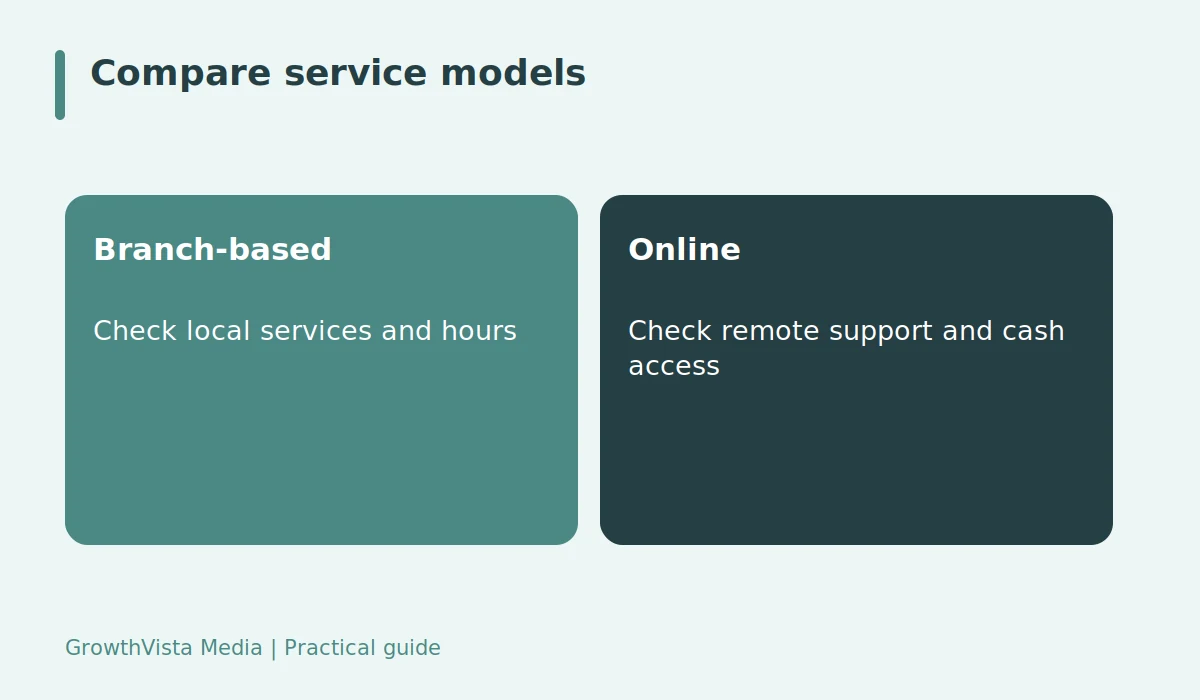
Online banks vs traditional banks is a service-model comparison. A branch can be useful for cash or face-to-face help; an online service can be convenient for routine digital tasks. Neither model alone tells you the fees, rate, or safety of a particular account. List how you actually use banking before choosing the interface that looks most appealing.
Start with cash and location
Think about whether you deposit cash, need cashiers’ checks, or regularly use an ATM. An online bank may use partner locations or not accept cash deposits at all. A branch-based bank may have limited local hours. Check the specific service, its fee, and the nearest usable location. A nationwide brand does not necessarily provide convenient access in your neighborhood.

Online banks vs traditional banks on everyday costs
Compare account fees, minimum balances, ATM charges, overdraft terms, and incoming or outgoing transfer costs. Online operation does not guarantee a cheaper account; a branch does not guarantee an expensive one. Read the same terms for both candidates and use your expected transaction pattern. Count related accounts only if you genuinely need them to obtain a waiver.
Choose around a real constraint
Consider two fictional customers. Lee is paid digitally and uses electronic bills, so external-transfer reliability and remote support are priorities. Sam receives cash and needs frequent deposits, so a convenient cash-deposit route matters more. Each should compare fees and account terms, and each might choose a different provider. The point is to rank the constraint that occurs in ordinary life, not to declare one model superior.
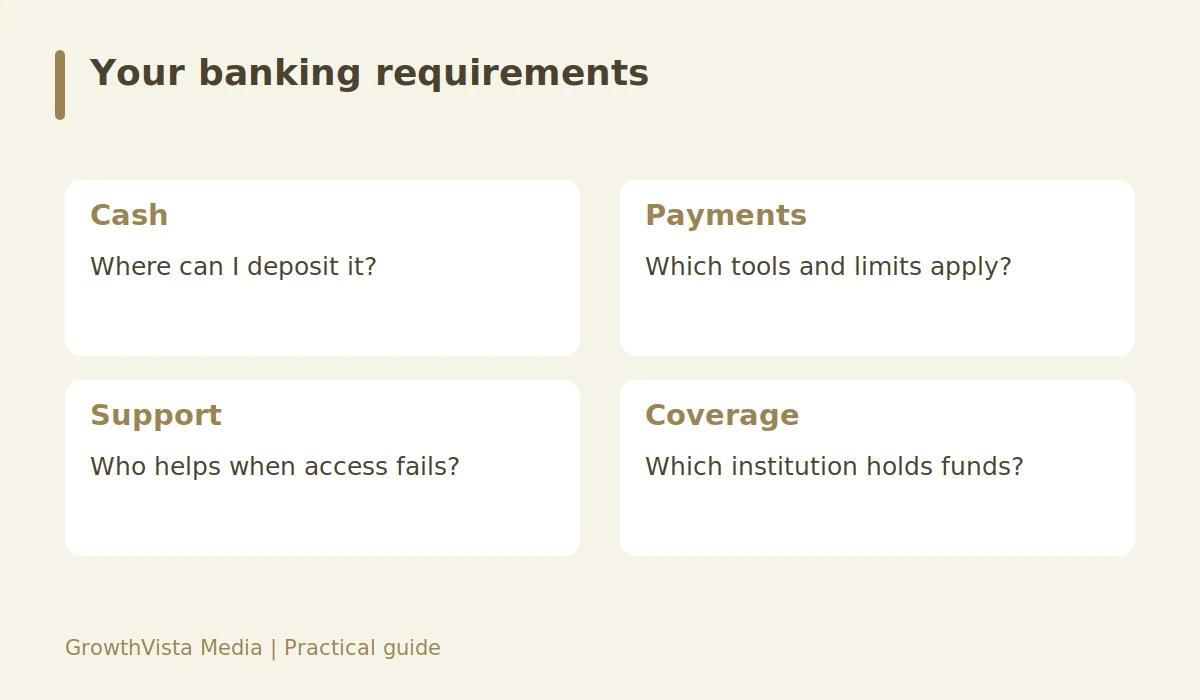
| Item | Detail |
|---|---|
| Cash | Where can I deposit it? |
| Payments | Which tools and limits apply? |
| Support | Who helps when access fails? |
| Coverage | Which institution holds funds? |
Test the digital experience
Both bank types may provide an app. Check bill payment, check deposit, transfer limits, alerts, and login recovery. A pleasant dashboard is less important than a payment arriving when required. Review availability rules for deposited checks and external transfers. If you share household finances, verify how separate users receive access without sharing a password.
Find a route to a person
Look up support hours and channels before a problem occurs. Ask how fraud concerns, frozen cards, failed transfers, and account closures are handled. A branch employee may still need a specialist team for some issues; online chat may have limits too. Keep the official contact details somewhere accessible if your phone or bank login becomes unavailable.
Verify the bank behind the brand
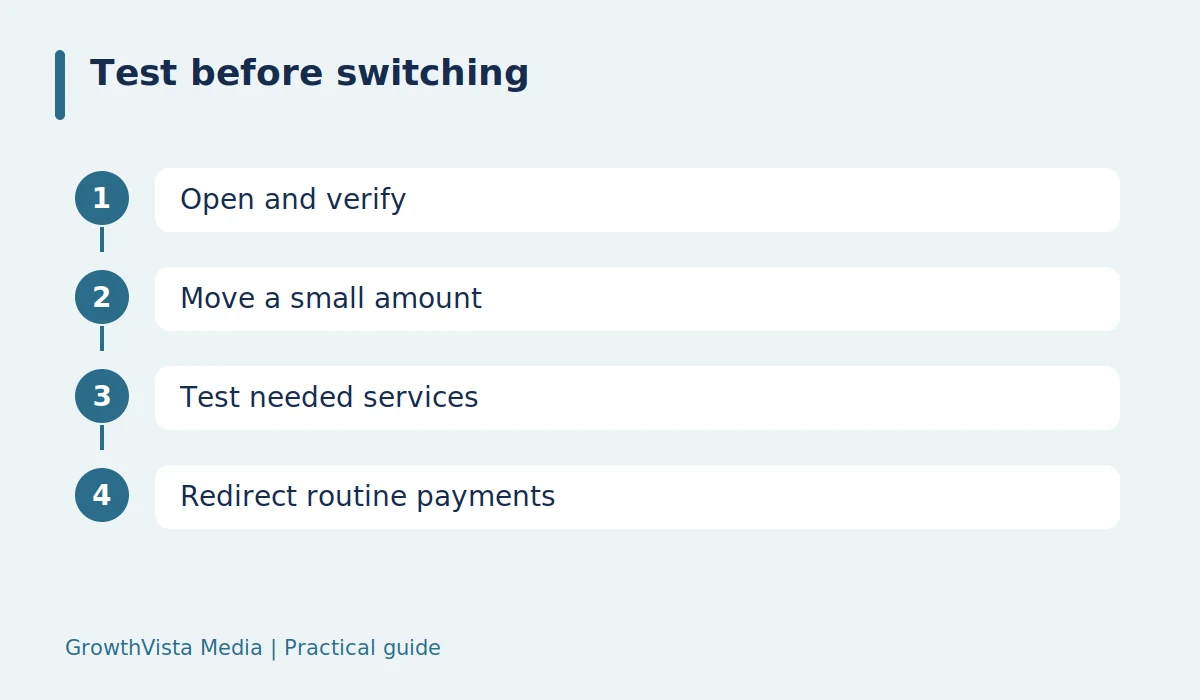
Confirm the institution holding the deposit and its insurance status. A financial app may be an intermediary rather than a bank. Read any program-bank arrangement and account conditions. At an insured bank, coverage depends on depositor, institution, and ownership category. Evaluate the actual account relationship instead of treating a familiar app name as proof of coverage.
Questions readers ask
Are online banks insured?
Some are insured banks; some apps are intermediaries. Verify the actual institution and account arrangement rather than rely on the interface.
Do traditional banks have good apps?
Many offer digital tools, but features and reliability differ by provider. Compare the specific tasks you need, not just whether an app exists.
Should I keep accounts at both?
A second account can serve a distinct purpose, but it also adds records and possible fees. Use it only when its benefit outweighs the complexity.
Your next steps
- List cash-deposit and ATM requirements.
- Compare costs using the same transaction pattern.
- Check holds and transfer limits.
- Find support hours and login recovery procedures.
- Verify where the deposit is legally held.
Related guides: Checking vs Savings Accounts: 5 Everyday Differences · High-Yield Savings Accounts: 6 Checks Beyond APY · Emergency Fund: Set a Target That Fits Your Risks
Further reading
Editorial update: October 12, 2026. U.S.-focused general education, not individual investment, tax, or legal advice. Examples are hypothetical, not current product offers.