VPN Buying Checklist: Apps, Trust, and Total Cost

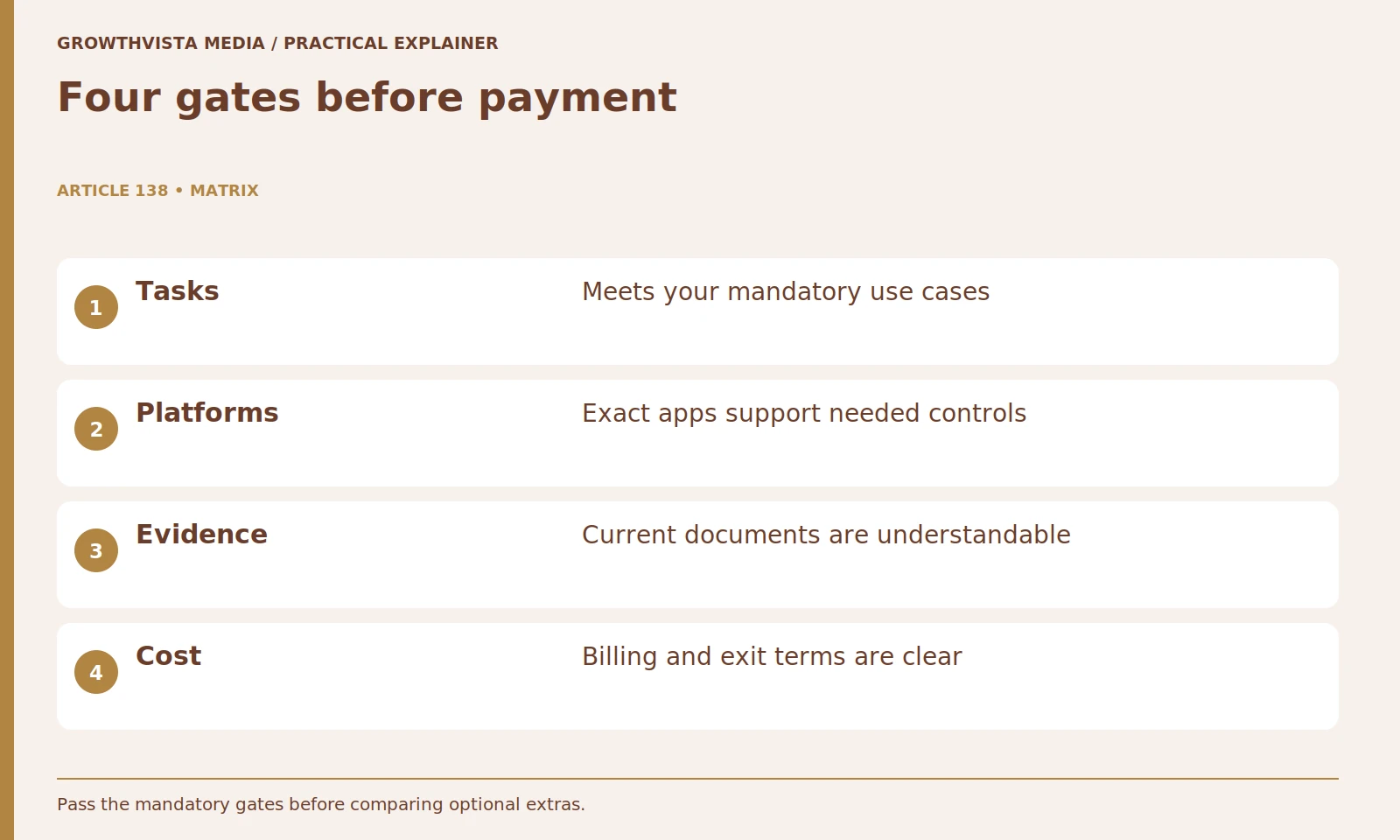
A VPN buying checklist should begin with the tasks and devices the service must support, then examine documentation, provider information, billing, and the exit route. Verify platform-specific features instead of relying on a headline list. Compare the amount charged, coverage period, renewal terms, and the actual refund or cancellation procedure.
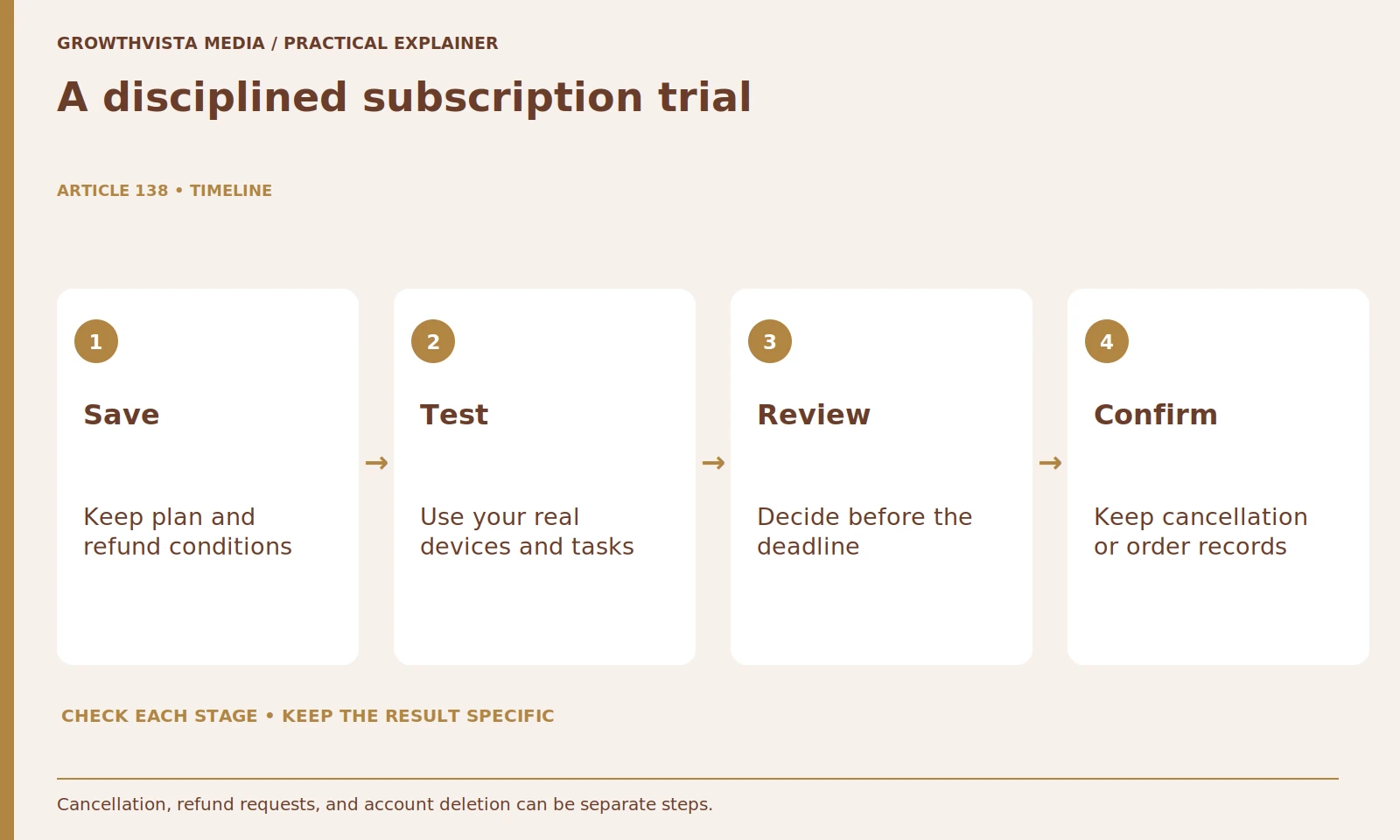
Use any permitted trial to test those same requirements. This guide offers a repeatable evaluation process rather than a provider ranking or invented privacy score. The cost examples are hypothetical, and a local trial does not establish worldwide performance. Keep current plan evidence and unanswered questions visible before paying.
Your decision checklist
- Define mandatory tasks and actual platforms.
- Read provider and feature-specific evidence.
- Separate upfront billing, renewal, and refund terms.
- Test the requirements and review before the deadline.
What belongs first in a VPN buying checklist?
Define the required tasks, devices, networks, and any organizational restrictions. Separate mandatory functions from optional extras and phrase each requirement so it can be checked. This keeps a long feature list from outweighing a missing essential capability.
Use requirements that can be checked. “Supports my current phone and laptop” is clearer than “works everywhere.” “Provides a documented way to exclude a required local application” is clearer than “advanced features.” This list keeps the shortlist manageable. A product with many extras should not outrank one that meets the essential tasks with clearer documentation and a more usable setup.

Do all platforms receive the same VPN features?
Do not assume so. Read documentation for the actual operating systems, app versions, and setup methods you intend to use. Check connection limits and plan coverage too. A desktop feature or server-location count is not proof of phone or router compatibility.
Record device limits and any restrictions on simultaneous connections. Check whether the subscription includes the planned setup, especially when household devices are involved. Avoid treating the number of server locations as a substitute for platform compatibility. The most important location or app is the one your real workflow needs, and its current availability should be verified rather than inferred from a global coverage claim.
| Requirement | Evidence to collect | Decision |
|---|---|---|
| Platform support | Current app documentation | Pass or unresolved |
| Needed feature | Exact operating-system behavior | Pass or fail |
| Provider information | Policy, identity, and report scope | Acceptable or unclear |
| Subscription | Charge, coverage, and renewal | Within budget or decline |
| Exit route | Refund and cancellation process | Understood or unresolved |
What provider evidence should be collected before payment?
Locate the responsible organization, support route, current terms, privacy policy, and the scope of cited reports. FTC VPN guidance recommends researching the app and information practices. Record evidence and unresolved questions rather than making an unsupported numerical trust score. FTC: VPN app purchasing considerations
For privacy claims, distinguish the current policy from promotional wording. Ask which data categories are described and whether retention or diagnostic settings are explained. If a report or audit is cited, read its scope and date rather than copying a badge into your comparison sheet. The purpose is to establish what evidence exists, not to construct an invented numerical trust score.
How should kill-switch and split-tunneling claims be compared?
Read the exact implementation and supported failure behavior for your platform. Similar names do not prove identical operation. Use supported tests during a trial and organizational guidance for managed devices, rather than disabling safeguards or changing restricted settings to experiment.
During a trial, follow supported tests and observe ordinary network changes such as switching from your usual Wi-Fi to another permitted connection. Avoid disabling device security or altering work-managed settings just to experiment. If a setting blocks local devices or a required application, ask support about the documented configuration. A useful service needs both the intended routing behavior and a manageable way to handle ordinary use.
Is the advertised monthly equivalent the billing schedule?
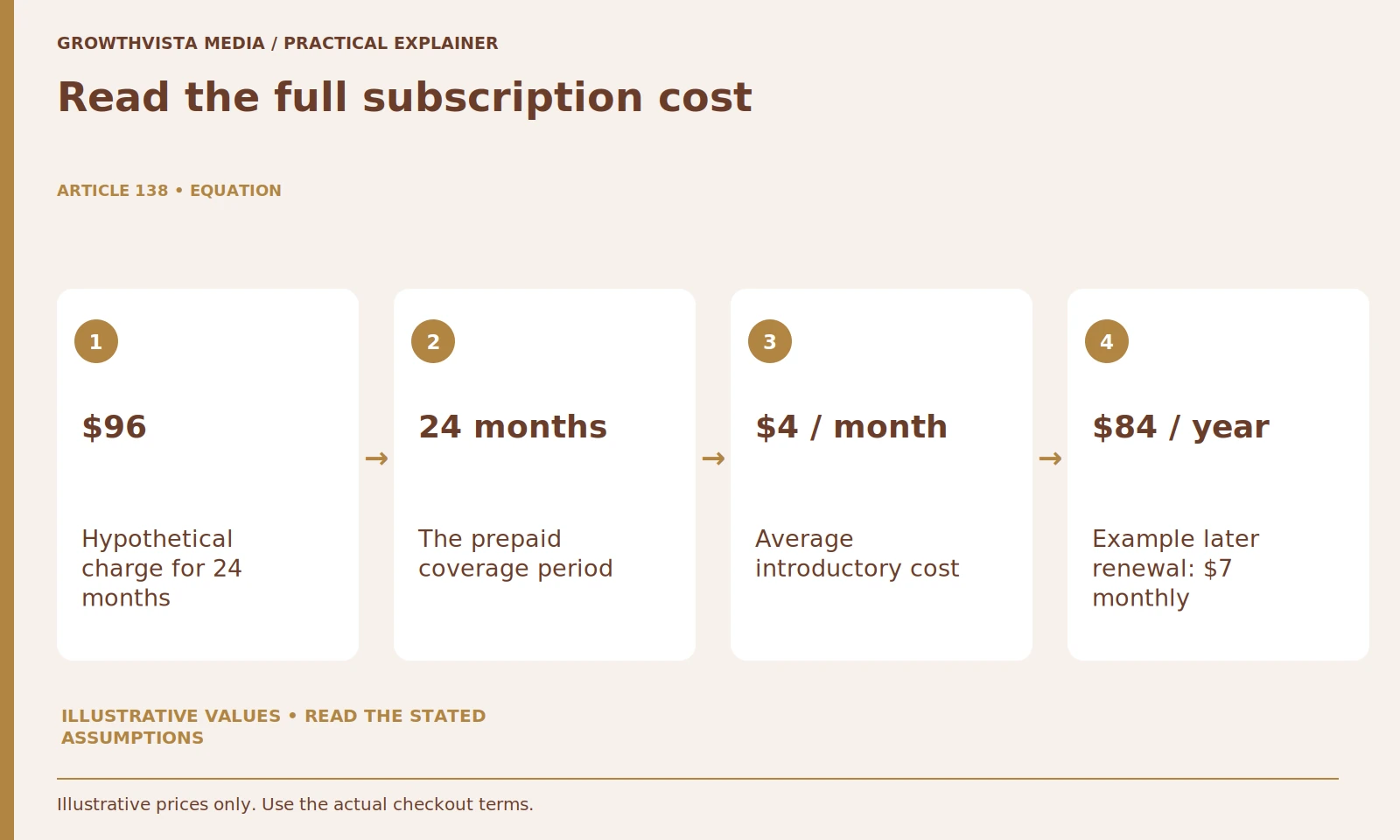
Not necessarily. A prepaid total divided by covered months describes an average for that term. Record the upfront commitment and later renewal separately. The hypothetical examples below demonstrate arithmetic, not current prices or a promise that the introductory rate continues.
Record the amount charged today, the period covered, taxes where applicable, and the stated renewal price. Divide a prepaid total by its covered months only to understand the introductory effective cost; it does not mean the service bills monthly. Keep billing schedule and average cost separate.
For example, a hypothetical 24-month charge of $96 averages $4 per month for that period. A later hypothetical annual renewal of $84 averages $7 per month. These are arithmetic examples, not current provider prices. Include add-ons you genuinely need and any separate charges. Use the actual checkout and terms for your final decision, and save the information that applies to the order.
Does canceling renewal automatically request a refund?
Do not assume it does. Read refund eligibility, deadlines, and payment-channel procedures separately from cancellation. Save confirmations and decide within the applicable period. A free trial, refund window, and discounted paid term are different arrangements.
Set a personal review reminder early enough to make a decision within the applicable period. Keep the confirmation after canceling or requesting a refund. Do not rely on a comparison page’s summary when the checkout terms say something different. A clear exit route makes testing more practical and prevents a disappointing trial from becoming an unwanted long-term expense.
What should a useful VPN trial test?
Use the actual devices and tasks from the requirements list, including ordinary browsing, calls, uploads, and relevant local access. Record versions and settings. A trial answers limited questions about your situation, not an untested claim of global speed or universal privacy.
When measuring speed, use paired observations with a consistent test method and separate download, upload, and latency. Keep the result local to your circumstances. Do not turn a home test into a claim about the provider’s global performance. If support is part of the purchase criteria, ask one clear nonsecret question and assess whether the response resolves the documented issue.
How do you choose from the trial evidence?
Require clear answers for mandatory functions, then compare acceptable optional differences and total cost. EFF distinguishes provider evidence and service limitations, so keep the scope of reports and observations visible. Review again after material changes to the service or your needs. EFF: evaluating VPN providers
Keep the subscription review date and the documents you relied on. Recheck when the price, app, ownership information, or your needs change. A buying checklist is valuable because it can be reused without pretending the market is fixed. The result should be a clear reason for choosing or declining a service, supported by current terms and your own limited trial.
Define mandatory tasks and actual platforms. Read provider and feature-specific evidence. Separate upfront billing, renewal, and refund terms. Test the requirements and review before the deadline. Keep verified findings, illustrative examples, and unresolved requirements separate in the final decision.
Frequently asked questions
Is a longer prepaid VPN plan always better value?
Compare the commitment, renewal, needs, and confidence in the service. A lower introductory average does not eliminate the cost of unused months.
Does every platform receive the advertised features?
Check the exact app and setup documentation for each platform rather than assuming the headline applies everywhere.
Does cancellation mean an automatic refund?
Not necessarily. Read the separate processes and payment-channel conditions.
Can one speed test rank worldwide providers?
No. A local observation evaluates limited conditions and cannot establish global leadership.
Does the monthly equivalent mean monthly billing?
No. Divide the prepaid total only to understand its average, while recording the actual amount charged and coverage period.
What should remain visible in the final shortlist?
Mandatory requirements, current supporting documents, total cost, trial findings, and unresolved questions.
Sources and further reading
Official documentation supports the technical guidance. Examples and worksheets are editorial methods, not hands-on product benchmarks. Reviewed October 2026.