Supplements: 7 Questions Before Adding a Product

Dietary supplements can be useful in particular circumstances, but adding more products does not automatically improve health. Begin with the reason for considering one: a documented gap, a specific recommendation, or a marketing claim. Then check ingredients, amounts, interactions, and suitable professional advice. A product sold without a prescription can still create risks.
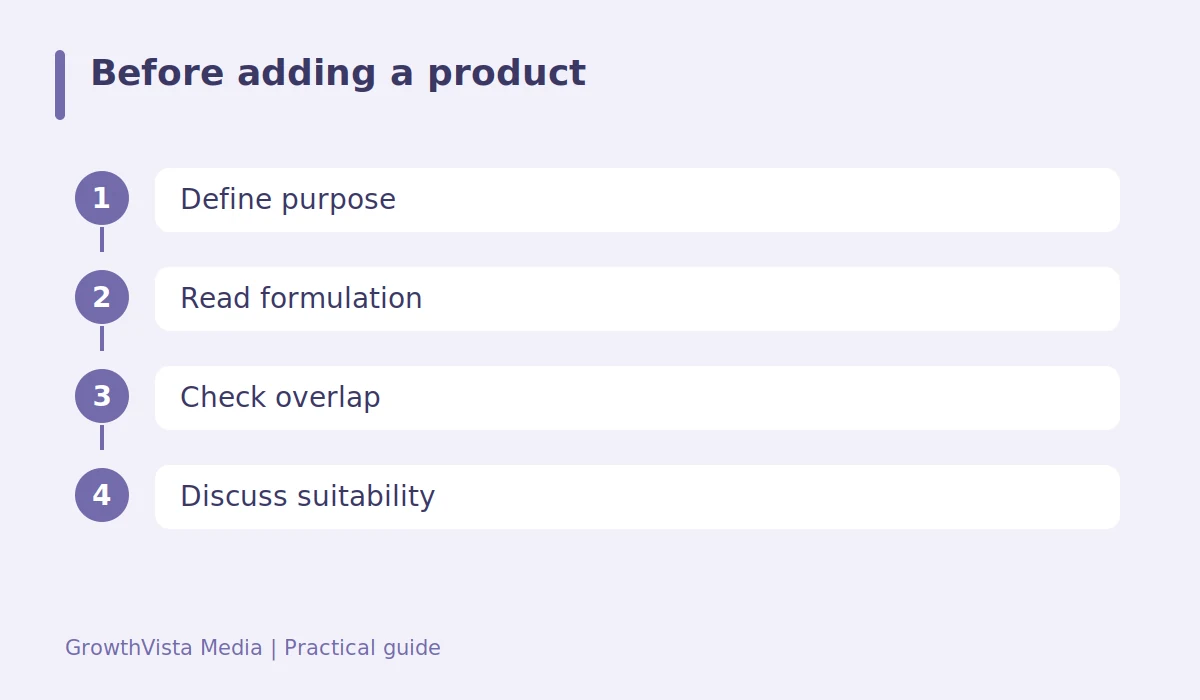
Identify the problem the product is meant to address
A supplement should have a clear purpose rather than a vague promise to optimize everything. Ask what evidence supports its use for your circumstances. A testimonial is not the same as a documented need. Food intake, health conditions, life stage, and medications may change the discussion. A clinician can help determine whether a gap or other reason actually exists.

Dietary supplements require an ingredient review
Read the Supplement Facts panel and other ingredients. Check the serving size, amount per serving, and directions. A blend name may obscure how much of each component is included. Compare the exact formulation rather than assuming two products with a similar headline ingredient are equivalent. Allergens and added ingredients can matter independently of the advertised nutrient.
Add up exposure across products
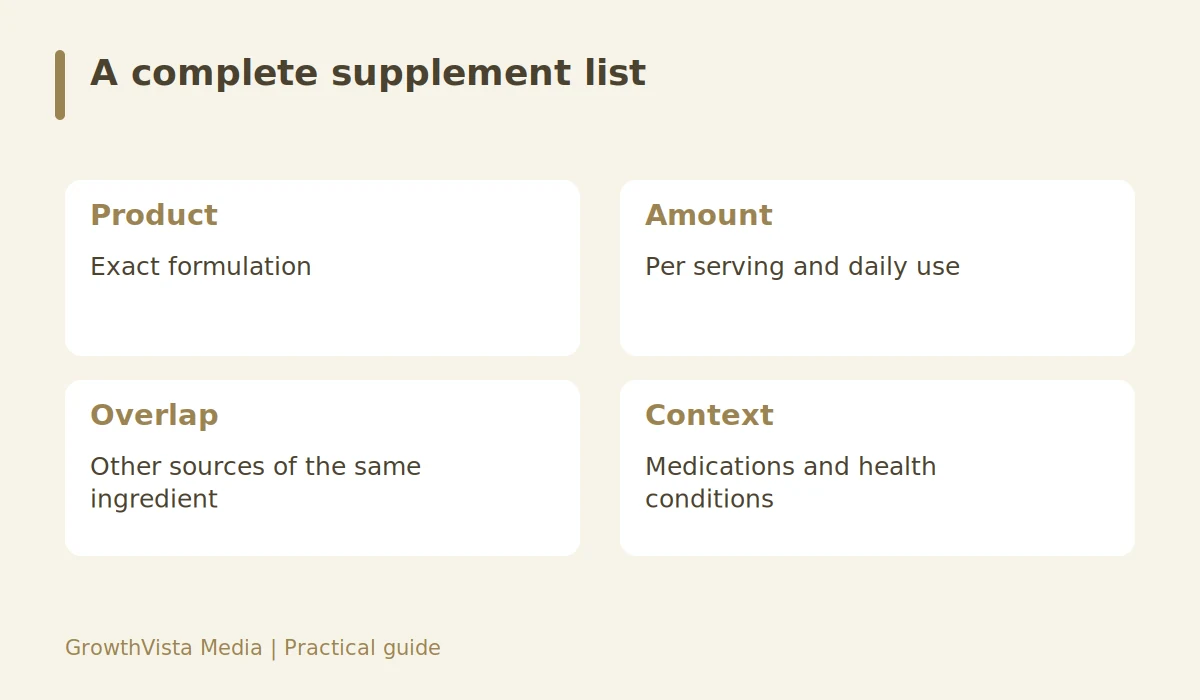
A multivitamin, single-nutrient product, fortified food, and other supplements can overlap. Keep a complete list for a professional review. More is not always better, and a label amount does not establish your personal need. Do not combine products because each looks modest on its own without considering the total and relevant health circumstances.
Ask about interactions and care
Supplements can interact with medications or affect medical procedures. Tell the appropriate health professional what you use, including brands, amounts, and frequency. Do not stop prescribed treatment to replace it with a supplement based on an advertisement. Seek advice before starting when pregnancy, a medical condition, or a planned procedure makes the decision more complex.
Understand what quality claims do and do not show
Manufacturing or third-party testing information can address specific quality questions, but it does not prove effectiveness or suitability for an individual. The FDA does not approve dietary supplements for safety and effectiveness before marketing in the same way as drugs. Evaluate the exact claim, avoid disease-cure promises, and include recurring cost in the decision.
An overlap review
A fictional reader takes a multivitamin and considers a separate product containing one of the same nutrients. Before adding it, the reader lists the amounts in each serving and brings the list to a clinician or pharmacist. The example does not prescribe a dose. It shows why the existing routine needs to be reviewed before treating a new bottle as an independent decision.
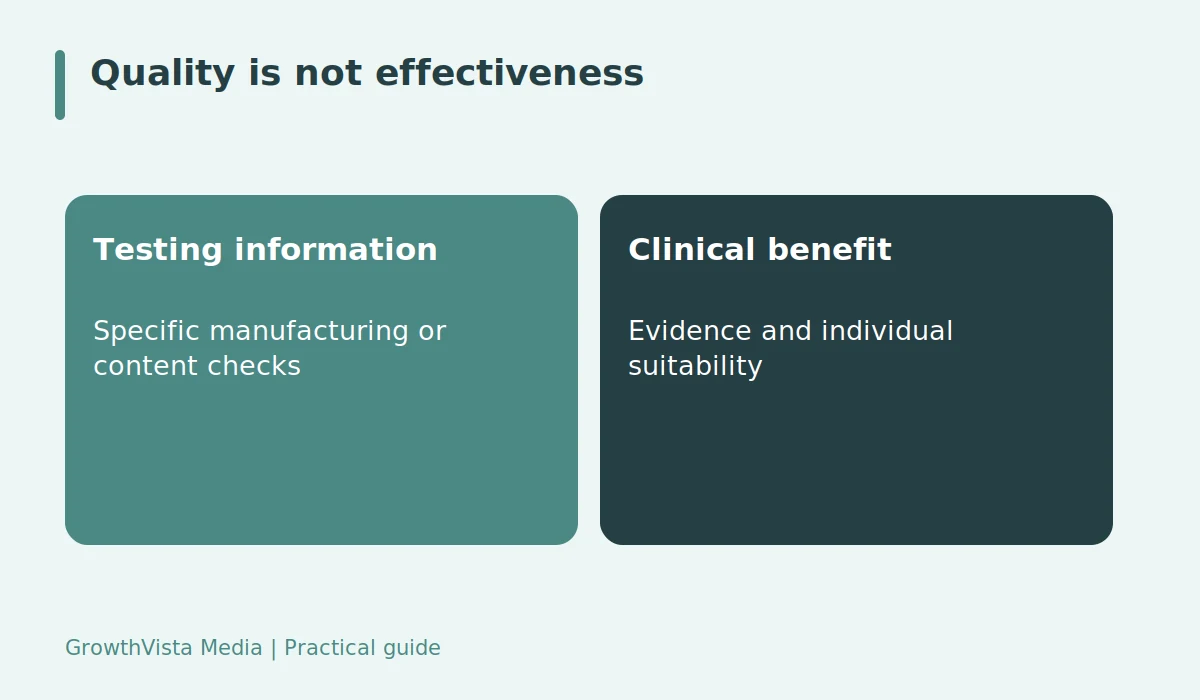
| Item | Detail |
|---|---|
| Testing information | Specific manufacturing or content checks |
| Clinical benefit | Evidence and individual suitability |
Questions readers ask
Does natural mean safe?
No. Ingredients can have effects and interactions regardless of how they are described. Review the actual formulation and your health circumstances.
Does a testing seal prove a product will help me?
Not necessarily. Testing has a specific scope and does not establish personal benefit or clinical suitability.
Should I tell my clinician about supplements?
Yes. Include ingredients, amounts, and frequency so interactions and overlap can be considered alongside medications and care.
Your next steps
- Write the specific purpose for the product.
- Read all ingredients and serving amounts.
- List overlap with current products.
- Discuss interactions and relevant conditions.
- Review evidence, testing scope, and recurring cost.
Related guides: Supplement Label: Read Ingredients, Amounts, and Claims · Vitamin D Supplements: Questions for Your Clinician · Protein Powder: Compare Products Without the Hype
Further reading
Editorial update: October 12, 2026. General educational information, not diagnosis or individualized treatment. Examples are illustrative; consult an appropriately qualified professional for personal health questions.