Mindfulness for Beginners: A Gentle Way to Try the Practice
Mindfulness for beginners means practicing attention to the present moment without demanding a blank mind. Thoughts and distractions still occur. A short, comfortable exercise can be a way to explore the practice, but it is not suitable for everyone or a substitute for care. Start gently, keep expectations realistic, and change or stop if the experience feels distressing.
Choose an ordinary moment
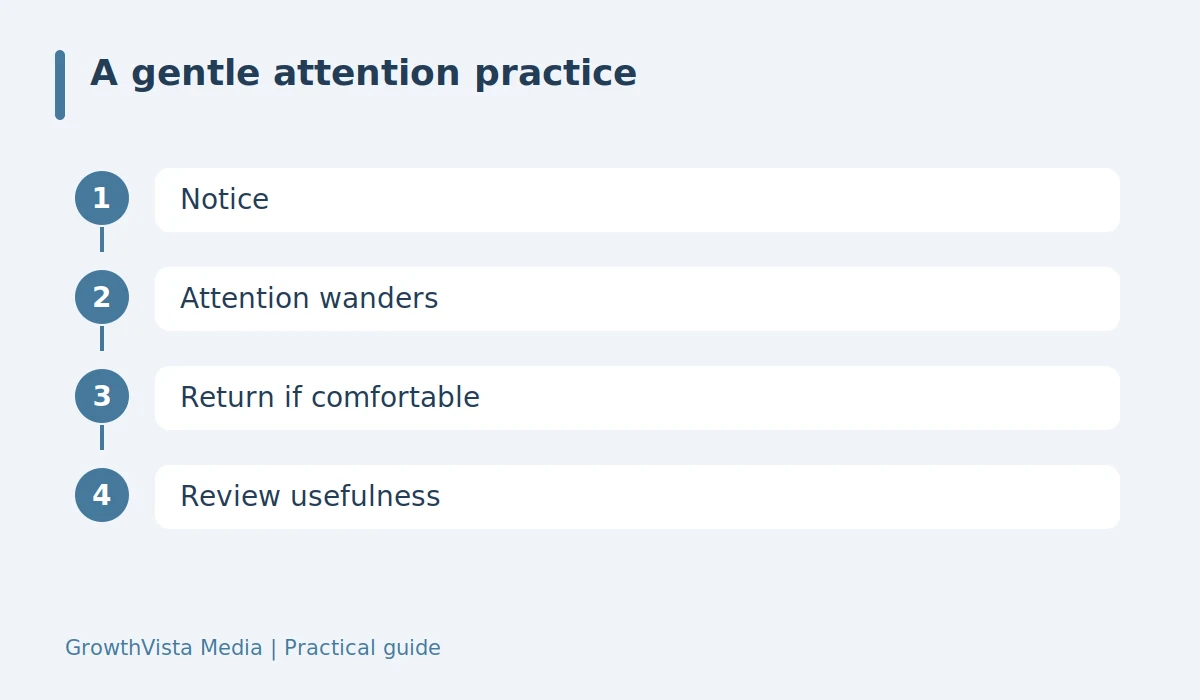
You can notice sounds, the feeling of your feet on the floor, or the texture of an object. Sitting in a special pose is not required for every practice. Pick a setting that feels safe and a brief period you can tolerate. Keeping your eyes open may be more comfortable. There is no need to force a sensation or a particular emotional result.

Mindfulness for beginners allows distraction
When attention wanders, noticing that is part of the practice. Return gently to the chosen point of attention if it remains comfortable. Do not turn the exercise into a test of whether you can eliminate thoughts. A difficult session does not prove personal failure. The aim is observation, not an obligation to feel peaceful on command.
Use alternatives if inward attention is uncomfortable
Some people prefer noticing an external object, a walking environment, or ordinary sounds rather than focusing on breath or bodily sensations. Others may prefer a different coping approach entirely. Adapt the practice to comfort and circumstances. If symptoms or a history of distress make it uncertain, seek qualified guidance rather than following a generic recording through discomfort.
Questions readers ask
Do I need to empty my mind?
No. Distraction can occur. A beginner practice often involves noticing and gently returning attention rather than eliminating every thought.
Must I focus on breathing?
No. External sights or sounds may be more comfortable for some people. Choose a tolerable approach and seek guidance when symptoms make it uncertain.
Can mindfulness replace therapy?
No. It should not replace appropriate care or delay assessment. Its suitability and usefulness vary by person and practice.
Keep claims proportional to the evidence
Research on meditation and mindfulness varies by practice, population, and outcome. A general exercise cannot promise to treat a condition. Do not replace conventional care or postpone assessment because an app claims benefits. A personal experience of feeling better is useful information, but it does not establish that the same technique will work for everyone.
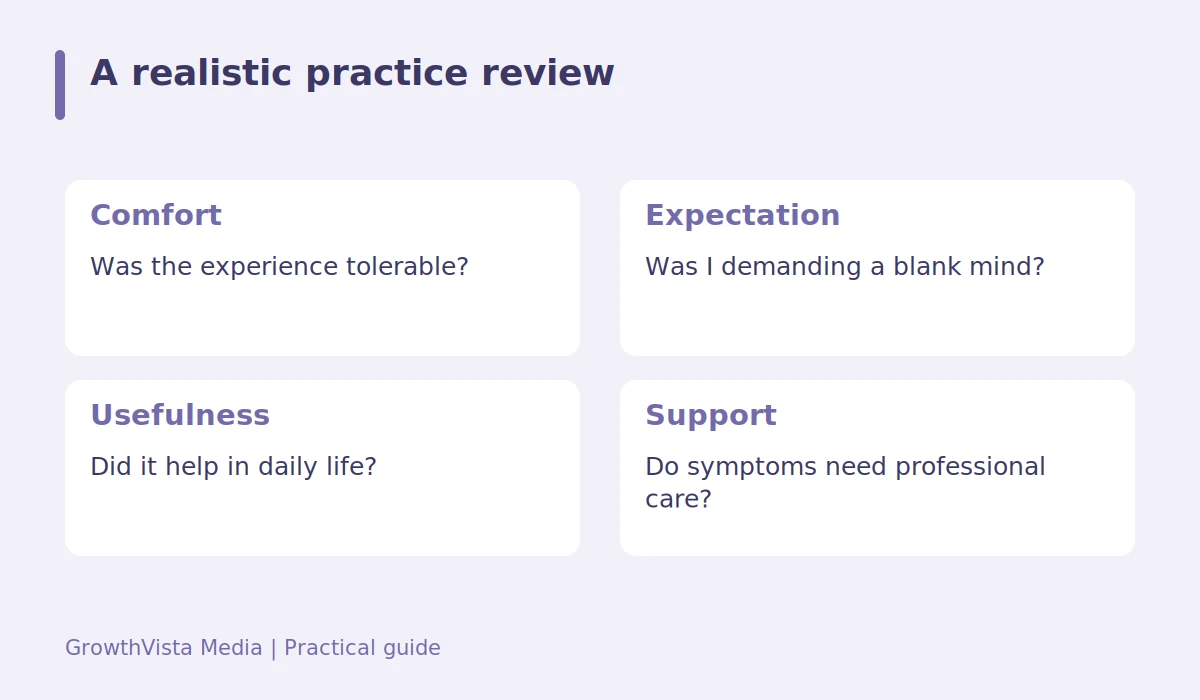
Review usefulness rather than a streak
After trying a brief practice, ask whether it felt tolerable and useful in ordinary life. A streak counter can support a routine but can also become another demand. Keep the amount modest and adjust if necessary. If distress increases, stop and seek appropriate support. There is no requirement to continue a technique simply because it is popular.
An external-attention example
A fictional beginner sits near a window and notices the colors and shapes of nearby leaves for a brief comfortable period. When a thought interrupts, the person returns to the leaves without trying to suppress the thought. The example is an optional attention exercise, not treatment. If it feels uncomfortable, the person stops or chooses another approach.
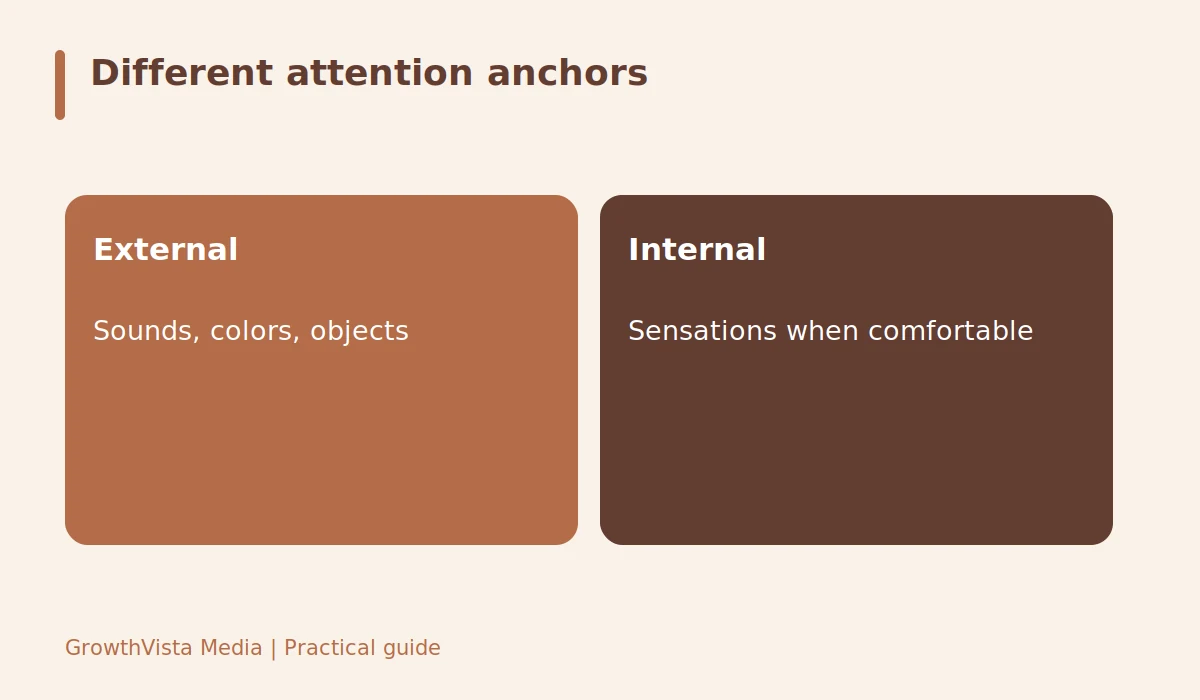
| Item | Detail |
|---|---|
| External | Sounds, colors, objects |
| Internal | Sensations when comfortable |
Your next steps
- Choose a safe, comfortable setting.
- Pick a tolerable point of attention.
- Keep the first practice brief.
- Allow distraction without judging it.
- Stop or seek guidance if distress occurs.
Related guides: Manage Stress: Practical Supports for an Ordinary Week · Mental Health Support: How to Find Help and Prepare · Meditation App: 6 Checks Before Starting a Subscription
Further reading
Editorial update: October 12, 2026. General educational information, not diagnosis or individualized treatment. Examples are illustrative; consult an appropriately qualified professional for personal health questions.